This week’s featured additive manufacturing (AM) success story highlights a significant advancement in the post-processing of complex metal parts, specifically 1,100 meticulously crafted titanium spinal cages. These intricate components, destined for critical medical applications, were precisely depowdered using a specially reconfigured Solukon SFM-AT350-E system, integrated with an EOS M4 Onyx 3D printer. The innovative setup showcases Solukon’s commitment to providing tailored solutions for the evolving demands of high-precision additive manufacturing, particularly within the stringent requirements of the medical sector.
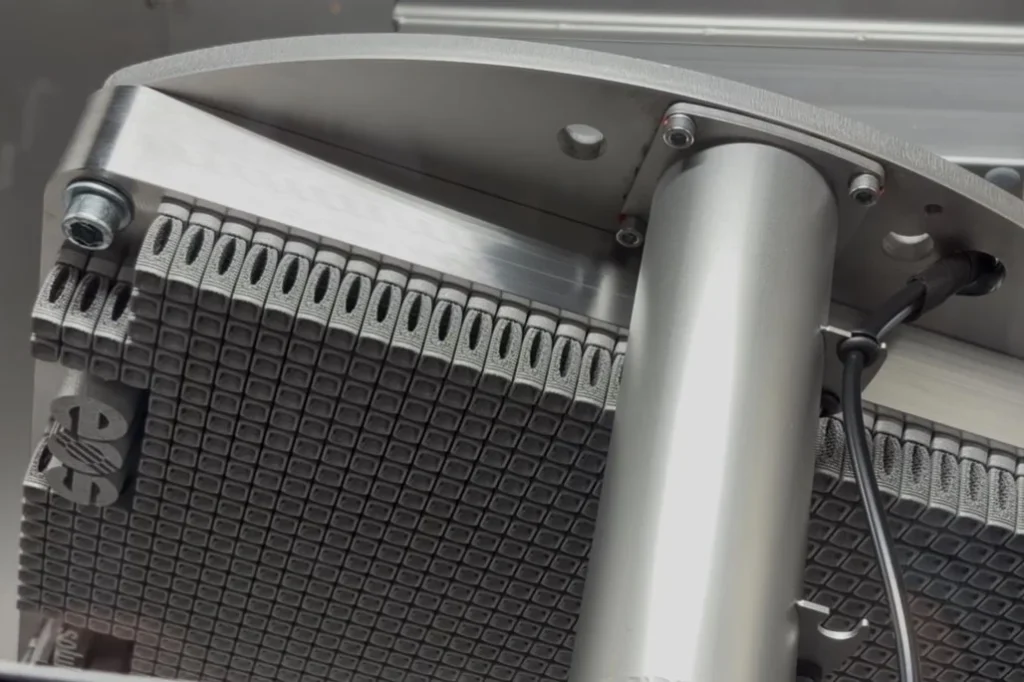
The image accompanying this report displays a substantial batch of these compact titanium spinal cages, neatly arranged on an EOS M4 Onyx build plate. The subsequent depowdering process, executed by a specialized version of Solukon’s SFM-AT350-E depowdering system, underscores the growing synergy between leading AM hardware manufacturers and specialized post-processing equipment providers. The EOS M4 Onyx, known for its substantial build volume of 17.7 x 17.7 x 15.7 inches (including the build plate), offers a robust platform for producing intricate metal parts. Solukon’s adaptation of its SFM-AT350-E system to seamlessly integrate with this large-format printer signifies a crucial step forward in enabling efficient and comprehensive depowdering for components printed within such extensive build envelopes.
Solukon, a globally recognized leader in automated depowdering solutions for additive manufacturing, unveiled this specialized edition of the SFM-AT350-E system at the prestigious RAPID + TCT 2026 trade show, held in Boston, Massachusetts. This event, a cornerstone of the AM industry calendar, serves as a critical platform for showcasing groundbreaking innovations and fostering collaboration. The SFM-AT350-E, in its standard configuration, is already a highly regarded system designed for the efficient depowdering of smaller parts, typically those with a Z-height below 250 mm and weighing up to 100 kg. The reconfigured system, however, demonstrates its adaptability to handle larger build plates and potentially higher part volumes, as evidenced by the 1,100 spinal cages processed in this instance.
The titanium spinal cages themselves represent a pinnacle of modern medical device manufacturing. Produced using Laser Powder Bed Fusion (LPBF) technology, a subset of metal additive manufacturing, these implants are designed to provide structural support and promote fusion in spinal surgeries. The use of titanium alloys is prevalent in orthopedic implants due to their biocompatibility, excellent strength-to-weight ratio, and resistance to corrosion. The intricate lattice structures often incorporated into 3D printed spinal cages can enhance osseointegration (bone growth into the implant) and reduce overall implant weight, contributing to improved patient outcomes. The precise depowdering of these parts is not merely a cleaning step; it is critical for ensuring the structural integrity, biocompatibility, and overall safety of the final medical device. Residual powder trapped within the complex internal geometries of the cages could lead to material inconsistencies, potential inflammatory responses, or even mechanical failure in vivo.
The Science Behind Efficient Depowdering: Ultrasonic Vibration
The SFM-AT350-E system employs a sophisticated mechanism to achieve its remarkable depowdering capabilities: high, self-regulating ultrasonic vibration. This method leverages the principles of piezoelectric excitation, a phenomenon where mechanical energy is generated from electrical energy. When an electric voltage is applied to a piezoelectric material, it causes the material to deform and vibrate at a high frequency. In the context of the SFM-AT350-E, this controlled vibration is transmitted to the build plate and the parts themselves, effectively dislodging and expelling any uncured or residual powder from even the most intricate internal channels and crevices.
This advanced technique offers several advantages over traditional depowdering methods. Ultrasonic vibration is highly effective at breaking the surface tension and adhesion forces that can bind fine powder particles to complex geometries. Furthermore, the "self-regulating" aspect suggests an intelligent system that can adapt its vibration parameters to optimize powder removal based on the specific part geometry and material characteristics, thereby minimizing processing time and ensuring thoroughness without damaging the delicate structures of the printed components.
While the exact cleaning time for any given part is inherently dependent on its specific design, including the density of internal features and the complexity of its geometry, the spinal cages in this instance were reportedly cleaned in approximately 30 minutes. This relatively short timeframe, for such a large quantity of intricate parts, speaks volumes about the efficiency and effectiveness of Solukon’s technology. In a production environment where throughput is a critical factor, such rapid and thorough depowdering is invaluable.
Synergy in Additive Manufacturing: EOS and Solukon
The collaboration between Solukon and EOS North America, the provider of the M4 Onyx printer, is a prime example of the integrated ecosystem developing within the additive manufacturing industry. EOS is a pioneer in industrial 3D printing, particularly with its extensive range of metal powder bed fusion systems. The EOS M4 Onyx, with its six-laser architecture, represents a significant technological leap, enabling faster build times and enhanced part quality. Its new filtration system, designed to trap and neutralize hazardous condensate, further emphasizes the industry’s focus on safety and operational efficiency.
The compatibility achieved between Solukon’s depowdering system and the EOS M4 Onyx’s build plate is a testament to the forward-thinking approach of both companies. By reconfiguring its SFM-AT350-E to accommodate the dimensions and operational parameters of the EOS M4 Onyx, Solukon has expanded the application scope of its depowdering technology, making it viable for users of high-volume, large-format metal AM printers. This level of interoperability is crucial for streamlining production workflows and reducing bottlenecks in the AM value chain.

Background and Chronology of Innovation
The development of sophisticated depowdering solutions like Solukon’s SFM-AT350-E is a direct response to the growing complexity and adoption of additive manufacturing, particularly in high-value sectors like aerospace and medical devices. Early in the history of metal AM, powder removal was often a labor-intensive and time-consuming manual process, involving brushes, compressed air, and vacuum systems. This manual approach was prone to inconsistencies, potential operator exposure to fine metal powders (which can be hazardous), and damage to delicate part features.
The industry’s demand for automated, efficient, and safe post-processing solutions led to the development of specialized machines. Solukon has been at the forefront of this evolution, focusing on leveraging advanced technologies like ultrasonic vibration. The introduction of the SFM-AT350-E at RAPID + TCT 2026 marks a significant milestone in this ongoing innovation. While the exact timeline of Solukon’s reconfiguration efforts for the EOS M4 Onyx is not detailed, the debut at a major industry event like RAPID + TCT suggests a period of intensive research, development, and testing leading up to the announcement. Industry events of this magnitude are typically where companies showcase their latest advancements after rigorous internal validation and, often, early customer trials.
The specific focus on compact titanium spinal cages points to a targeted application development strategy by Solukon. The medical industry, with its stringent regulatory requirements and high demand for precision and biocompatibility, has been an early and enthusiastic adopter of AM. By demonstrating the capability to depowder these critical medical components efficiently and effectively, Solukon is positioning itself as a key partner for medical device manufacturers embracing additive manufacturing.
Supporting Data and Technical Specifications
- Parts Processed: 1,100 compact titanium spinal cages.
- Material: Titanium alloy (implied for spinal cages).
- 3D Printing Technology: Laser Powder Bed Fusion (LPBF).
- 3D Printer Used: EOS M4 Onyx.
- EOS M4 Onyx Build Volume: 17.7 x 17.7 x 15.7 inches (including build plate).
- Depowdering System: Solukon SFM-AT350-E (special edition).
- Depowdering Technology: High, self-regulating ultrasonic vibration (piezoelectric excitation).
- SFM-AT350-E Standard Capabilities: Designed for smaller parts, Z-height < 250 mm, weight up to 100 kg.
- Reconfigured System Capability: Accommodates EOS M4 Onyx build plate, enabling depowdering of parts printed on this larger platform.
- Cleaning Time (for spinal cages): Approximately 30 minutes.
Official Responses and Industry Reactions (Inferred)
While direct quotes from Solukon and EOS representatives regarding this specific deployment are not provided in the source material, the nature of such an announcement at RAPID + TCT 2026 would typically elicit positive reactions from both companies.
From Solukon (Inferred): Solukon would likely express pride in their ability to adapt their technology to meet the specific needs of large-format printers like the EOS M4 Onyx. Their focus would be on highlighting the value proposition for manufacturers requiring efficient, automated post-processing for complex metal parts, especially in the medical field. A spokesperson might emphasize the system’s reliability, precision, and contribution to reducing production costs and lead times.
From EOS North America (Inferred): EOS would likely view this integration as a validation of their M4 Onyx system’s capability to produce high-quality parts for demanding applications. They would emphasize the importance of a robust ecosystem of complementary technologies, such as Solukon’s depowdering solutions, in enabling their customers to achieve full production readiness with their printed parts. The seamless integration would be seen as enhancing the overall value proposition of the EOS M4 Onyx.
Broader Impact and Implications for the Additive Manufacturing Industry
The successful integration and application of Solukon’s reconfigured SFM-AT350-E system with the EOS M4 Onyx printer carry significant implications for the broader additive manufacturing industry:
- Enhanced Production Scalability: The ability to efficiently depowder large batches of complex parts from a large-format printer is a critical enabler for scaling up AM production. This moves the needle from prototyping and small-batch runs towards serial production of critical components.
- Accelerated Medical Device Innovation: For the medical sector, faster and more reliable post-processing directly translates to quicker development cycles for new implants and devices. This can lead to life-saving innovations reaching patients sooner.
- Improved Part Quality and Reliability: Automated, precise depowdering minimizes human error and ensures that intricate internal geometries are thoroughly cleaned. This leads to more consistent part quality, which is paramount for medical and aerospace applications where failure is not an option.
- Increased Automation and Reduced Labor Costs: The transition from manual depowdering to automated systems significantly reduces the need for manual labor, freeing up skilled technicians for higher-value tasks and contributing to overall cost efficiencies in AM production.
- Strengthened AM Ecosystem: This collaboration exemplifies the trend towards a more integrated AM ecosystem, where hardware manufacturers, software providers, and post-processing solution developers work together to create comprehensive workflows. This interoperability is crucial for widespread industry adoption.
- Democratization of Advanced AM: By making sophisticated depowdering accessible for large-format printers, Solukon and EOS are helping to democratize access to advanced metal AM capabilities for a wider range of companies, not just those with specialized in-house post-processing expertise.
In conclusion, the featured deployment of Solukon’s specialized SFM-AT350-E system for depowdering titanium spinal cages printed on an EOS M4 Onyx highlights a critical advancement in the post-processing capabilities of additive manufacturing. This synergy between leading technology providers addresses a key bottleneck in the AM value chain, paving the way for more efficient, scalable, and reliable production of complex metal parts, particularly for the demanding requirements of the medical industry. The ongoing innovation in depowdering technology, driven by solutions like Solukon’s, is instrumental in unlocking the full potential of additive manufacturing for critical applications worldwide.