In a groundbreaking advancement that opens new frontiers in quantum science and technology, researchers at Stanford University in the United States have successfully measured a quantum jump in sound in real time. This unprecedented achievement, detailed in the prestigious journal Science, marks a pivotal moment in understanding the fundamental behavior of matter at its smallest scales, promising profound implications for the burgeoning fields of quantum computing and advanced sensing. The real-time observation of these discrete energy transitions in sound, specifically in phonons—the fundamental quanta of vibrational energy—represents a global first, pushing the boundaries of what was previously thought measurable in quantum acoustics.
The concept of a quantum jump, or quantum leap, is central to quantum mechanics and describes the sudden, instantaneous transition of a quantum system from one energy state to another. This theoretical construct, first proposed by Danish physicist Niels Bohr in 1913 as part of his model of the atom, revolutionized our understanding of how particles absorb and emit energy. Bohr posited that electrons orbit an atomic nucleus only in specific, quantized energy levels, and any transition between these levels must occur abruptly, rather than continuously. For decades, these jumps remained a theoretical cornerstone, challenging experimental verification due to the fleeting and often disruptive nature of observing quantum phenomena.
It was not until 1986 that scientists achieved the first experimental observation of a quantum jump. This landmark feat involved trapped ions, where researchers could precisely control and monitor individual atoms, witnessing their discrete energy shifts. The ability to isolate and observe these transitions provided crucial empirical validation for Bohr’s century-old hypothesis. Building on this success, further advancements in quantum optics led to the observation of quantum jumps in photons, the fundamental particles of light, in 2007. These successive breakthroughs underscored the reality of quantum jumps across different types of particles and energy forms, continually refining our understanding of quantum dynamics. However, the realm of mechanical vibrations, or sound at the quantum level, remained largely unexplored in this specific context.
Nearly two decades after the photon observation, a dedicated team of scientists led by Amir Safavi-Naeini, a physicist at Stanford University, has now extended this understanding to the realm of sound. Their work focused on phonons, which are quantized units of vibrational energy that propagate through a material, analogous to photons for light. Safavi-Naeini elucidated the phenomenon by drawing a parallel to the everyday experience of a struck bell. When a bell is struck, its sound gradually diminishes over time, a continuous process observable in the classical world. However, at the quantum level, these reductions in vibrational energy are not continuous but occur in discrete "jumps." The Stanford team’s remarkable achievement lies in their ability to measure these individual phonon quantum jumps in real time, a feat that distinguishes their work from previous statistical or indirect observations. This real-time detection provides an unprecedented window into the moment-by-moment evolution of quantum mechanical systems involving sound.
The Intricate Methodology: Capturing the Elusive Quantum Jump
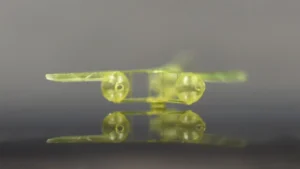
To achieve this unprecedented measurement, the Stanford researchers meticulously engineered a sophisticated experimental setup. At the heart of their design was a mechanical resonator, fabricated at the scale of computer chips. This miniaturization was crucial, allowing for the placement of multiple such units on a single chip, enhancing control and scalability. Much like a classical tuning fork, this resonator vibrates and "rings" when excited. However, the critical innovation lay in the resonator’s design parameters, specifically its "ringdown time." The researchers designed the resonator to possess an exceptionally long ringdown time of just two milliseconds. While this duration may seem minuscule in macroscopic terms, at the microscopic scale at which the resonator operates, this two-millisecond period is remarkably long, akin to a conventional tuning fork vibrating for several hours. This extended resonance time was indispensable, providing a sufficiently long window for observation during which the fragile quantum state could be probed without immediate decay.
This prolonged resonance, or "ringdown time," allowed the researchers to collect hundreds of readings during a single quantum event. This extensive data acquisition was key to precisely pinpointing the exact moment when the resonator’s vibrations transitioned from a state of one phonon (a single quantum of sound energy) to zero phonons—the precise instance of a quantum jump. The ability to monitor this transition with such fidelity and temporal resolution represents a monumental leap in experimental quantum physics. Previous studies often relied on inferring quantum jump probabilities or observing their collective effects, but the Stanford team’s method directly observed the singular event as it unfolded.
Overcoming Quantum Measurement Challenges
A pervasive and fundamental challenge in quantum mechanics is the act of measurement itself. Quantum systems are inherently fragile, and the very act of observing them can disturb their delicate states, altering the outcome. This "measurement problem" is a significant hurdle for researchers attempting to extract information from quantum systems without collapsing their superposition or entanglement. The Stanford team addressed this challenge ingeniously by pairing their mechanical resonator with a superconducting qubit. A qubit, the basic unit of quantum information, is notoriously sensitive and can exist in a superposition of states (both 0 and 1 simultaneously) until measured. In this experimental configuration, the superconducting qubit was not merely a component but acted as an exquisitely sensitive detector.
The paired qubit served as an intermediary, allowing researchers to detect the precise moment a quantum jump occurred in the phonon system without directly interfering with the phonon itself to an extent that would obscure the jump. This indirect yet highly accurate detection mechanism was critical. The interaction between the resonator and the qubit was carefully controlled, enabling the qubit to "read out" the state of the phonon without destroying the coherence of the system prematurely. This innovative coupling technique not only facilitated the real-time detection of quantum jumps but also established a foundational methodology for future quantum developments. It demonstrated a robust way to interface mechanical quantum systems with superconducting circuits, a critical step for integrating different quantum technologies.
Profound Implications for Quantum Computing and Sensing
The implications of this breakthrough extend far beyond fundamental physics, promising transformative advancements in several high-stakes technological domains. One of the most immediate and significant beneficiaries is quantum computing. Quantum computers leverage the principles of superposition and entanglement to perform calculations far beyond the capabilities of classical machines. However, the delicate nature of qubits makes them highly susceptible to errors. These errors often manifest as unintended quantum jumps, causing a qubit to prematurely decohere or transition to an incorrect state before computations are completed. Identifying the exact moment these quantum jumps—which are essentially errors—occur has historically been a formidable challenge, making real-time error correction extremely difficult.
The Stanford team’s ability to detect a quantum jump in real time could fundamentally alter the landscape of quantum error correction. By knowing precisely when and where an error occurs, quantum computing systems could implement targeted corrective measures with unprecedented speed and accuracy. This could lead to the development of more stable and fault-tolerant qubits, significantly improving the reliability and scalability of quantum computers. The current generation of quantum computers struggles with maintaining quantum coherence for long enough to perform complex calculations. This research offers a pathway to mitigate one of the most critical sources of decoherence, bringing us closer to practical, large-scale quantum computing.
Beyond computing, the microscopic resonator and qubit pairing holds immense promise for advanced quantum sensing. The extreme sensitivity required to detect a single phonon jump translates directly into capabilities for ultra-precise measurements of various physical phenomena. Safavi-Naeini and his team are already actively exploring this potential, collaborating with researchers at Caltech to develop new techniques for detecting and identifying proteins in cells. Such bio-sensing applications could revolutionize medical diagnostics, drug discovery, and fundamental biological research by enabling non-invasive, highly sensitive detection of biomolecules at very low concentrations. Furthermore, the technology could be adapted for applications in material science, environmental monitoring, and even for detecting gravitational waves or dark matter, where exquisitely sensitive detectors are paramount.
The Dawn of Quantum Acoustics and Future Horizons
The pervasive role of sound in modern technology underscores the broad potential impact of this research. From the microphones in our smartphones to advanced sonar systems and medical ultrasound, sound is an integral part of countless devices. The discovery that vibrating objects can exhibit quantum behavior, as demonstrated by this study, establishes a crucial prerequisite for many operations required by future quantum computing and sensing technologies. As Safavi-Naeini articulated in a press release, "We have seen that vibrating objects can exhibit quantum behavior, which is the prerequisite for many of the operations needed by quantum computing and sensing." He concluded, "What this study shows will allow us to move forward with developing new quantum technologies with sound."
This research effectively ushers in a new era of "quantum acoustics," a field dedicated to exploring and harnessing the quantum properties of sound. It provides a robust experimental platform for manipulating and understanding phonons in ways previously unimaginable. Future research directions could include creating phonon-based qubits for quantum information processing, developing quantum acoustic transducers to interface between different quantum systems (e.g., superconducting circuits and optical fibers), and exploring novel ways to store and transmit quantum information using sound. The ability to precisely control and measure individual quanta of sound could also lead to entirely new classes of devices, from ultra-sensitive microphones that can detect individual molecules to quantum resonators for extremely stable frequency standards.
The publication of these findings in Science validates the rigor and significance of the Stanford team’s work, placing it at the forefront of quantum research. It is a testament to decades of theoretical work and incremental experimental advancements that have collectively paved the way for such a sophisticated observation. This achievement not only deepens our fundamental understanding of the quantum world but also lays a critical cornerstone for the development of practical quantum technologies that could reshape computing, sensing, and our interaction with the physical world in the coming decades. The journey from Bohr’s theoretical jumps to the real-time observation of a single phonon transition exemplifies the relentless pursuit of knowledge that defines scientific progress, promising a future where the subtle whispers of quantum mechanics are not only heard but precisely controlled.