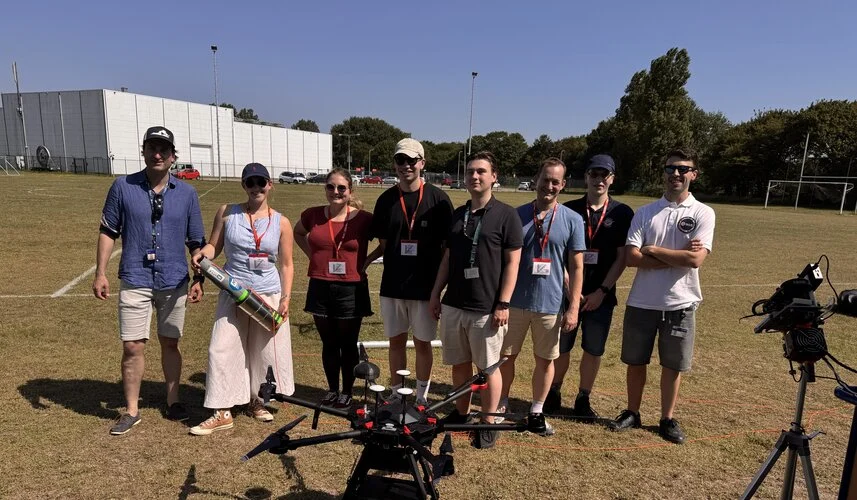
A pioneering drone test flight at the European Space Agency’s (ESA) technical centre, ESTEC, in the Netherlands, has marked a significant milestone for a student-developed radar retroreflector technology. The test, conducted on July 30, 2026, showcased the potential of this innovative, low-cost solution to enhance the detectability of small airborne vehicles. The successful demonstration paves the way for further testing, including a planned launch aboard a sounding rocket later this summer.
Innovative Technology Takes Flight Over ESTEC
On a sun-drenched afternoon at ESA’s Noordwijk campus, a powerful drone ascended, carrying an unusual and critically important payload. Suspended beneath it by a five-meter tether, a compact, cylindrical object swung gently in the Dutch breeze. This was no ordinary piece of equipment; it was a student-designed radar retroreflector, undergoing its inaugural flight test in a real-world aerospace environment. The drone, expertly piloted by ESA engineer Giovanni Serafini, executed a series of precise maneuvers, ascending to an altitude of 120 meters before descending rapidly to within three meters of the ground. These dynamic movements were crucial for assessing the retroreflector’s performance under varying flight conditions and angles relative to ground-based radar.
The test took place over ESTEC’s expansive football field, a location chosen for its open space and suitability for drone operations. The scorching summer heat, however, presented its own challenges, prompting the test team to seek refuge under a parasol and remain vigilant about keeping sensitive equipment from overheating. The objective of these rigorous maneuvers was clear: to validate the functionality of a novel invention conceived and built by a dedicated student team from Ruhr University Bochum in Germany.

Students at the Forefront of Innovation
The driving force behind this cutting-edge technology is a team of bright young minds from Ruhr University Bochum. Daria Tsukanova, a member of the student team, explained the core purpose of their endeavor. "We are here to test a radar retroreflector, which we developed for a competition organised by the Institute of Electrical and Electronics Engineers (IEEE)," she stated.
A retroreflector, in essence, is a passive device designed to bounce signals back directly to their source. The specific design developed by the Bochum students, measuring 28 cm in length, is a metal tube intricately covered with carefully crafted cavities. Its primary function is to significantly enhance the radar visibility of objects, making them far easier to detect and track without the need for any active electronics or onboard transmitters. This passive nature is a key advantage, simplifying the design and reducing potential points of failure.
The immediate application for such a device lies in improving the radar signature of small, often elusive airborne vehicles. This includes drones, which are increasingly utilized for a variety of purposes, from scientific observation to commercial deliveries, and sounding rockets, which are launched to the edge of space to carry out experiments before re-entering the atmosphere. For the purpose of this ESTEC test, the student team ingeniously attached their reflector to a longer plastic tube, effectively simulating the profile and flight characteristics of a sounding rocket.
Current radar systems often rely on the inherent metallic composition of conventional rockets for detection. However, even these metallic structures can become undetectable at certain viewing angles. The student-developed retroreflector aims to overcome this limitation, extending the detection window and ensuring that these crucial vehicles remain visible to radar for a considerably longer duration of their flight.

Cost-Effective and Practical Solutions
The ingenuity of the Ruhr University Bochum team’s retroreflector extends beyond its technical capabilities; its cost-effectiveness and practicality are equally compelling. "What’s unique about this technology is that it’s very cheap," remarked Stephan Hauptmeier, another member of the student team. "The reflector itself is passive, made by 3D printing and laser cutting." This approach to manufacturing allows for rapid prototyping and production at a fraction of the cost of traditional aerospace components.
Furthermore, the technology leverages readily available and established radar systems. "Another advantage is that to detect it, we can use a radar technology well-established in the automotive industry – the same one that is part of driver assistance systems and will, for example, cause a car to break automatically if an obstacle is detected," Hauptmeier elaborated. This means that specialized, expensive "space-grade" radar equipment is not required, significantly lowering the barrier to entry for deploying this technology.
Vaclav Valenta, an ESA microwave engineer, highlighted the synergistic nature of this collaboration. "This has been a unique opportunity to leverage hardware previously developed within ESA’s Technology Development Element programme for planetary and in-orbit missions, based on automotive radar technology," he stated. "By making one of these prototypes available to students, we enable them to gain practical experience with real radar technology and explore how such systems can be configured and optimized for specific applications." This cross-pollination of expertise and resources underscores ESA’s commitment to fostering innovation and supporting emerging talent.
From Academic Competition to ESA-Backed Launch
The successful drone test at ESTEC represents a significant step in the evolution of this student-led project. What began as an entry in an academic competition has now garnered the attention and support of a major space agency, paving the way for even more ambitious testing. In a single afternoon, the team not only verified the retroreflector’s functionality but also gained invaluable data for future refinements.

The immediate next phase for the project is a scheduled launch aboard a sounding rocket. This will take place later this summer in Brno, Czech Republic, with the rocket ascending to an altitude of one kilometer above a designated test range. This upcoming flight will provide a more dynamic and challenging environment to further assess the retroreflector’s performance under stratospheric conditions.
Karol Masztalerz, an ESA Graduate Trainee, commented on the broader significance of this trajectory. "This project is a great example of how student initiatives can evolve beyond the competition environment," he observed. "What began as a university-led challenge has grown into an international collaboration between ESA, two European universities – the Ruhr University Bochum in Germany and Imperial College London in the UK – industry partners, and the Czech Rocket Society, who are providing their new Sherpa rocket for the next round of testing." This expanding network of collaborators signifies the growing momentum and potential impact of the project.
A Collaborative Endeavor with Far-Reaching Implications
The genesis of this innovative project can be traced back to an International Microwave Symposium (IMS) competition, organized by the Institute of Electrical and Electronics Engineers (IEEE). The competition, designed to foster innovation in microwave technologies, provided the initial platform for the Ruhr University Bochum team to develop their concept.
The project’s management is a testament to effective international collaboration, overseen jointly by Vaclav Valenta from ESA and Markus Gardill from the Brandenburg University of Technology Cottbus-Senftenberg. Gardill, who organized the competition as co-chair and chair of IEEE’s Microwave Theory and Techniques Society’s technical committee for Microwave Aerospace Systems (TC-29), played a pivotal role in nurturing the student’s innovative spirit.

A crucial element in the project’s advancement involved the adaptation of existing radar technology. The radar unit employed for the ESTEC testing was initially sent to Imperial College London. There, engineer Vaclav Pavlicek undertook the vital task of modifying both the system configuration and operating parameters. His work ensured that the automotive-grade radar, originally designed for terrestrial applications, was optimized for the unique requirements of this new terrestrial use case, demonstrating a remarkable adaptability of existing technologies.
The implications of this successful demonstration are substantial. By offering a low-cost, passive solution for enhancing radar visibility, the student-developed retroreflector has the potential to revolutionize the tracking and management of small airborne assets. This could lead to improved safety protocols for drone operations, more efficient recovery of sounding rocket payloads, and potentially even enhance the capabilities of future space exploration missions where lightweight, passive tracking aids are paramount. The project serves as a powerful example of how academic curiosity, coupled with strategic industry and agency partnerships, can drive tangible advancements in aerospace technology. The upcoming sounding rocket launch will undoubtedly be a closely watched event, signaling another significant step in this promising technological journey.