The celestial landscape of the early universe is undergoing a radical transformation as astronomers peel back the layers of the most distant cosmic structures ever observed. At the forefront of this revolution is a team of researchers led by Rohan Naidu, a NASA Hubble Fellow and Pappalardo Fellow at the MIT Kavli Institute for Astrophysics and Space Research (MKI). Their latest findings, centered on a peculiar object designated as MoM-BH*-1, suggest the existence of a theoretical "black hole star"—a massive celestial entity that challenges conventional models of stellar evolution and galaxy formation. This discovery provides a potential solution to one of the most persistent enigmas of the James Webb Space Telescope (JWST) era: the identity of the "little red dots" that have populated early deep-space imagery.
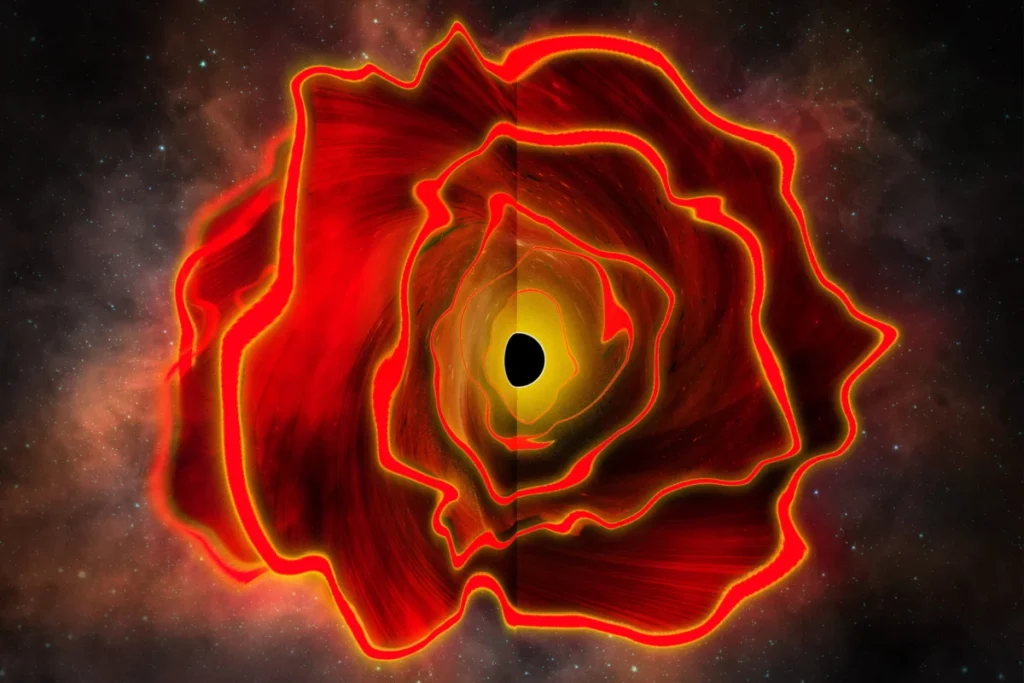
According to the study’s lead author, the conceptualization of this object is shifting as more data becomes available. The current model posits a central black hole with a mass approximately 100,000 times that of the Sun. This gargantuan gravitational engine is not exposed to the vacuum of space but is instead shrouded within an immense, extended envelope of hydrogen gas. This envelope is estimated to be roughly the size of our entire solar system, creating a hybrid object that appears from the outside like a colossal star but is powered by the physics of an active black hole rather than nuclear fusion.
The Mirage or Miracle Survey and the Quest for Early Galaxies
The discovery of MoM-BH*-1 was not the primary objective of Naidu and his colleagues. The team was originally conducting a systematic search for the most distant and earliest galaxies formed during the dawn of the universe, just a few hundred million years after the Big Bang. This initiative, aptly titled the "Mirage or Miracle" (MoM) survey, was designed to investigate a burgeoning paradox in modern cosmology: the appearance of unexpectedly bright and mature-looking galaxies in the very early universe.
In the initial years of JWST operations, astronomers were surprised to find numerous bright sources in regions of space where the standard cosmological model predicted only faint, proto-galactic structures. These "miracles"—galaxies that seemed too large and too bright for their age—suggested that our understanding of early cosmic history might be fundamentally flawed. However, the MoM survey proposed an alternative hypothesis: that some of these bright sources might be "mirages," or unique astronomical objects that mimic the appearance of large galaxies while being something entirely different.
While scanning JWST’s deep-field imagery for candidate sources, the researchers identified a singular point of light that was both exceptionally red and remarkably bright. This "red dot" stood out from the surrounding field of faint, blue-tinted young stars and distant galaxies, prompting a rigorous spectroscopic investigation to determine its true nature.
Deconstructing the Light: Dust, Smoke, and the Balmer Break
When astronomers observe an object that appears intensely red, the standard interpretation is usually the presence of cosmic dust. Similar to how wildfire smoke in Earth’s atmosphere can scatter shorter blue wavelengths of light and allow longer red wavelengths to pass through—effectively turning the sky or the Sun a deep crimson—interstellar dust clouds can "redden" the light of distant stars and galaxies.
Robert Simcoe, the MKI Director and Bruno B. Rossi Professor of Experimental Physics at MIT, noted that while the visual evidence initially pointed toward a dust-enshrouded galaxy, the spectral data told a different story. The team utilized the JWST’s Near-Infrared Spectrograph (NIRSpec) to break down the light from the red dot into its component wavelengths. What they found was a signature that contradicted the "dust" hypothesis.
The spectrum exhibited a phenomenon known as a "Balmer break." This is a sharp drop-off in light intensity at specific wavelengths, typically caused by dense hydrogen gas in a stellar atmosphere absorbing photons. This pattern is a hallmark of mature stars, such as Vega, which is one of the brightest stars in the night sky. However, the Balmer break observed in MoM-BH*-1 was deeper than any ever recorded in a standard star. This depth suggested an environment of unprecedented density and scale—a "stellar atmosphere" on a magnitude that defied categorization as an ordinary star.
Furthermore, the spectroscopic analysis revealed a nearly complete absence of "metals"—astronomical shorthand for any element heavier than hydrogen and helium. This chemical purity is a characteristic of the very first generation of stars and gas clouds in the universe, providing a crucial clue that the object was a primitive structure from the cosmic dawn.
Simulations and the Black Hole Power Source
To reconcile the conflicting data—the extreme brightness, the Balmer break, and the lack of heavy elements—the MIT-led team turned to advanced astrophysical simulations. They sought to determine if a specific configuration of matter could produce the observed spectral signature without the presence of dust.
The simulations revealed that a sufficiently dense "screen" of hydrogen could indeed replicate the redness and the Balmer break. However, this hydrogen cocoon would need to be so dense that it functioned like the surface of a star. The primary challenge then became explaining the object’s luminosity. MoM-BH*-1 is estimated to be 100 billion times brighter than a typical star, a level of energy output that nuclear fusion—the process that powers the Sun and other stars—cannot sustain at such a scale.
The only known mechanism capable of generating such immense energy within a compact region is a supermassive black hole. By incorporating an active, accreting black hole into their hydrogen-cocoon model, the researchers found a perfect match for the JWST data. In this scenario, the black hole’s gravitational pull draws in surrounding gas, heating it to millions of degrees and releasing vast amounts of radiation. This radiation is then absorbed and re-emitted by the surrounding hydrogen envelope, which acts as a giant frosted lightbulb, diffusing the energy and creating the appearance of a massive, red star.
Solving the Little Red Dot Enigma
The discovery of MoM-BH*-1 has profound implications for the broader study of the early universe. Since its launch, JWST has detected hundreds of "little red dots" (LRDs) in almost every deep-space observation. These LRDs have been a subject of intense debate among astrophysicists, with some arguing they are extremely compact galaxies and others suggesting they are obscured quasars.
Naidu’s research suggests that many, if not all, of these LRDs could be black hole stars. While most LRDs are less luminous than MoM-BH-1 and are likely embedded within larger, faint galaxies, MoM-BH-1 is unique because it is so bright that it completely outshines its host galaxy. This allows astronomers to see "pure" light from the black hole star itself, providing a clear laboratory for studying the physics of these objects.
"These little red dots seem to be everywhere in the early universe but essentially disappear by the present day," Naidu explained. The disappearance of these objects suggests they are a transitional phase in cosmic evolution. As the central black hole grows and the surrounding gas is either consumed or blown away by radiation pressure, the "black hole star" likely evolves into a standard quasar or the nucleus of a massive galaxy.
Chronology of Discovery and Research Support
The identification of MoM-BH*-1 represents the culmination of several years of technological advancement and observational effort.
- December 2021: The James Webb Space Telescope is launched, carrying the most sensitive infrared instruments ever sent into space.
- July 2022: The first full-color images from JWST are released, revealing the first "little red dots" and sparking immediate scientific inquiry.
- 2023: The "Mirage or Miracle" survey begins its systematic observation of high-redshift candidates, utilizing the telescope’s NIRCam and NIRSpec instruments.
- Early 2024: The team identifies MoM-BH*-1 and conducts multi-wavelength analysis, leading to the development of the black hole star model.
- Late 2024: The findings are published, involving collaborators from MIT, NASA, and the Space Telescope Science Institute (STScI).
The research was a collaborative effort, with significant contributions from MIT co-authors Robert Simcoe and Wendy Sun, as well as researchers from multiple international institutions. Funding and operational support were provided by the MIT Department of Physics, NASA, and the Space Telescope Science Institute.
Broader Impact and Future Implications for Cosmology
The existence of black hole stars could provide the "missing link" in our understanding of how supermassive black holes formed. One of the greatest mysteries in astronomy is how black holes with billions of solar masses could exist just a few hundred million years after the Big Bang. Standard models of black hole growth through the slow accretion of gas struggle to explain such rapid expansion.
The MoM-BH*-1 model suggests that black holes may start with a "head start" as "heavy seeds"—objects already 100,000 times the mass of the Sun formed through the direct collapse of massive gas clouds. If black hole stars are the visible manifestation of these heavy seeds, it would confirm a major theoretical pathway for black hole evolution.
Furthermore, this discovery underscores the transformative power of the JWST. By allowing scientists to observe the universe in the infrared spectrum with unprecedented resolution, the telescope is revealing a "zoo" of exotic objects that were previously invisible. As the MoM survey continues, astronomers expect to find more black hole stars, allowing them to map the growth of these objects over cosmic time and determine how they shaped the first galaxies.
The study of MoM-BH*-1 is just the beginning of a new chapter in astrophysics. With the identification of this first black hole star, the "little red dots" are no longer just mysterious anomalies on a digital image; they are potential beacons from a violent and exotic era of cosmic history, providing a direct window into the mechanisms that built the modern universe.