A groundbreaking test flight of a student-developed radar retroreflector technology recently took place above the European Space Agency’s (ESA) technical centre, ESTEC, in the Netherlands. This pivotal event, occurring on July 30, 2026, marks a significant step forward in enhancing the detectability of small aerospace vehicles, promising more cost-effective and robust tracking solutions for future space missions and atmospheric research. The successful demonstration underscores the value of fostering student innovation and its potential to yield practical applications within the space industry.
Pioneering Drone Test at ESTEC
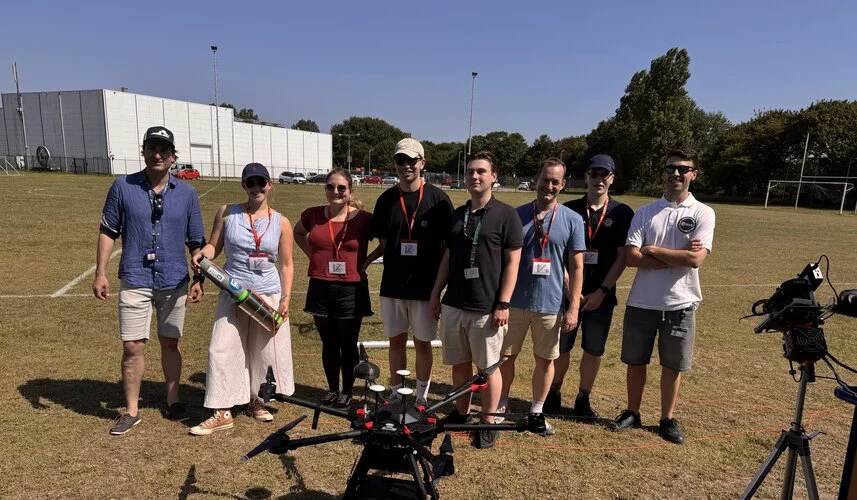
On a notably warm day at ESTEC, a robust drone, a familiar sight for the agency’s technical operations, ascended into the Dutch sky. Its unusual payload, suspended by a five-meter rope, was a meticulously crafted 50 cm long plastic tube housing the innovative radar retroreflector. The test aimed to simulate real-world conditions for the device, which is designed to significantly improve radar visibility without the need for active onboard electronics. ESA engineer Giovanni Serafini expertly maneuvered the drone, lifting it to an altitude of 120 meters before initiating a controlled descent. The payload was lowered to within three meters of the ground, demonstrating the system’s ability to function even at close proximity. Further maneuvers across the ESTEC football field allowed for comprehensive data collection and validation of the retroreflector’s performance under varying angles and trajectories. The team, seeking respite from the heat, ensured all equipment remained operational by keeping it close and protected from overheating, a testament to the meticulous planning involved in such outdoor tests.

The Genesis of Innovation: A Student-Led Initiative
The core of this technological advancement originates from a dedicated student team at Ruhr University Bochum in Germany. Their ingenuity was initially channeled into a competition organized by the Institute of Electrical and Electronics Engineers (IEEE). Daria Tsukanova, a key member of the university team, explained the fundamental concept behind their invention. "We are here to test a radar retroreflector, which we developed for a competition organised by the Institute of Electrical and Electronics Engineers (IEEE)," she stated.
A radar retroreflector is fundamentally a passive device engineered to reflect incoming radar signals directly back towards their source. This characteristic greatly enhances an object’s detectability by radar systems. Unlike active transponders that require power and transmit their own signals, retroreflectors are inherently simpler, more reliable, and consume no onboard energy. The student team’s design, a 28 cm long metal tube adorned with strategically placed cavities, is optimized for this precise function. The success of this technology could revolutionize how smaller payloads, such as drones or sounding rockets used for atmospheric research, are tracked. Sounding rockets, in particular, are launched to the edge of space to conduct experiments before returning to Earth. Their detection during ascent and descent is crucial for mission success and safety, and current radar systems, which primarily rely on the metallic composition of larger rockets, can sometimes struggle with smaller or less reflective objects, especially at certain viewing angles. The student-developed retroreflector aims to bridge this gap, extending the radar detection window and ensuring continuous visibility.
Cost-Effectiveness and Accessibility: Key Advantages
A significant aspect of the Ruhr University Bochum team’s retroreflector is its remarkable cost-effectiveness. Stephan Hauptmeier, another member of the student team, highlighted this crucial advantage. "What’s unique about this technology is that it’s very cheap. The reflector itself is passive, made by 3D printing and laser cutting," he explained. This manufacturing approach not only reduces production costs but also allows for rapid prototyping and customization.

Furthermore, the technology leverages existing, well-established radar infrastructure. "Another advantage is that to detect it, we can use a radar technology well-established in the automotive industry – the same one that is part of driver assistance systems and will, for example, cause a car to break automatically if an obstacle is detected. This means no special ‘space-grade’ radar is needed," Hauptmeier added. This integration with automotive radar technology, widely deployed and cost-efficient, significantly lowers the barrier to entry for its adoption in various applications.
Václav Valenta, an ESA microwave engineer, elaborated on the synergistic approach taken in this project. "This has been a unique opportunity to leverage hardware previously developed within ESA’s Technology Development Element programme for planetary and in-orbit missions, based on automotive radar technology," he commented. "By making one of these prototypes available to students, we enable them to gain practical experience with real radar technology and explore how such systems can be configured and optimized for specific applications." This collaboration exemplifies ESA’s commitment to nurturing emerging talent and integrating innovative student projects into its broader technological development framework. The reuse of existing ESA hardware, originally intended for more complex missions, further demonstrates the adaptability and cost-saving potential of the student-designed reflector.
From Competition to Launchpad: A Collaborative Journey
The successful drone test at ESTEC represents a significant milestone, validating the retroreflector’s functionality. This achievement paves the way for the next critical phase: a sounding rocket launch. Scheduled for later in the summer, the device will be deployed aboard a sounding rocket, ascending up to one kilometer above a field in Brno, Czech Republic. This upcoming launch will provide further data in a more dynamic, high-altitude environment.

Karol Masztalerz, an ESA Graduate Trainee, emphasized the project’s evolution. "This project is a great example of how student initiatives can evolve beyond the competition environment," he observed. What began as a university-led challenge has blossomed into an extensive international collaboration. This consortium now includes ESA, two prominent European universities – Ruhr University Bochum and Imperial College London – several industry partners, and the Czech Rocket Society. The latter is providing their newly developed Sherpa rocket, a testament to the growing interest and support for this innovative technology.
A Statement on Collaboration and Future Implications
This particular project gained significant traction after being selected as the winner of an International Microwave Symposium (IMS) competition, a prestigious event organized by the IEEE. The collaboration is being managed jointly by Václav Valenta from ESA and Markus Gardill from the Brandenburg University of Technology Cottbus-Senftenberg. Gardill, who served as co-chair and chair of IEEE’s Microwave Theory and Techniques Society’s technical committee for Microwave Aerospace Systems (TC-29), played a crucial role in organizing the competition.
The radar unit utilized in the ESTEC tests underwent initial modifications at Imperial College London. Engineer Václav Pavlíček adapted both the system configuration and operating parameters to suit the new terrestrial use cases, demonstrating the adaptability of the technology across different environments.

The implications of this student-developed radar retroreflector technology are far-reaching. For ESA and other space agencies, it offers a potential pathway to more affordable and reliable tracking of small satellites, CubeSats, and debris, contributing to better space situational awareness. In atmospheric research, it could enable more precise tracking of sounding rockets and high-altitude balloons, leading to enhanced scientific data. The automotive industry’s involvement suggests potential future applications in advanced driver-assistance systems, such as enhanced obstacle detection for autonomous vehicles, particularly in challenging weather conditions. The inherent low cost and passive nature of the retroreflector make it an attractive solution for a wide range of scenarios where robust and economical tracking is paramount. The successful collaboration between academia, space agencies, and industry partners highlights a promising model for accelerating technological development and innovation. As the project moves towards its next phase of testing with a sounding rocket launch, the scientific and engineering communities will be keenly observing its performance, anticipating its potential to redefine the future of object detection and tracking in both Earth’s atmosphere and the realm of space.