The advent of autonomous and electric vehicles is profoundly reshaping the automotive industry, particularly challenging engineers and designers to fundamentally rethink age-old interior design parameters. This transformation goes far beyond aesthetics, impacting everything from new types of displays, instrument panels, and lighting to seating configurations, steering wheels, colors, fabrics, and entirely novel features. No longer merely a collection of individual controls, the automotive interior is evolving into an active, integrated communication environment. Traditional components must still facilitate conventional driving scenarios, yet simultaneously be redesigned to intuitively convey to occupants what the vehicle is sensing, deciding, and actively doing, fostering trust and understanding in an increasingly automated world.
The Paradigm Shift: From Cockpit to Connected Cabin
For the vast majority of automotive history, interior architecture has placed the driver and the act of vehicle control at its absolute center. Interfaces were meticulously organized around principles of visibility, ergonomics, and easy access to controls. "Historically, the cockpit was organized around direct vehicle control," explains Shihao Fu, a technology analyst at IDTechEx. "The steering wheel, instrument cluster, center console and seat position were all designed around the driving task." This driver-centric paradigm is now undergoing a dramatic shift, driven by the increasing capabilities of electric powertrains and assisted or fully automated driving systems.
As vehicles progressively assume more responsibility for acceleration, braking, steering, and situational awareness, the cabin is tasked with presenting significantly more information without overwhelming occupants. The solution is not merely to install larger or more numerous screens; rather, it demands a sophisticated, multi-modal approach to information dissemination. Automakers are beginning to distribute critical data and experiential cues across the interior through sound, haptics (touch feedback), and adaptive environmental responses. Technologies once primarily deployed to distinguish luxury vehicles, such as ambient lighting, sophisticated audio systems, seat haptics, and personalized cabin settings, are now being leveraged to communicate an automated system’s status, capabilities, and limitations.

Evolution of Human-Machine Interface (HMI) Across Automation Levels
The evolution of autonomous driving capabilities, categorized by the SAE International’s Levels of Driving Automation (L0-L5), directly dictates the complexity and nature of interior communication. Each level presents unique challenges for human-machine interface (HMI) design, demanding a graduated approach to how information is conveyed and how occupants interact with the vehicle.
-
Level 2 (Partial Automation) and Level 2+: In these vehicles, the driver remains fully responsible for monitoring the driving environment and intervening when necessary, even when the vehicle actively assists with steering, acceleration, or braking. Interior interfaces must provide crystal-clear indications of when assistance is engaged, what the system can detect, and crucially, where its operational limits lie. Furthermore, they must issue timely and unambiguous alerts when the driver’s attention or direct intervention is required. "The cabin needs to help the driver understand whether the system is active, what the vehicle is detecting, where the functional boundary is and when human intervention may be required," emphasizes Fu. This often involves visual cues on instrument clusters, haptic feedback through the steering wheel, and audible warnings. The global market for automotive HMI solutions, including advanced displays and control systems, is projected to grow significantly, reaching an estimated $30 billion by 2028, reflecting this increasing demand for intuitive and informative interfaces.
-
Level 3 (Conditional Automation): This level introduces a more profound communication challenge. Under defined operating conditions (e.g., highway driving), the vehicle can perform the dynamic driving task, allowing the driver to disengage from active driving. However, the vehicle must return control to the human driver when it encounters situations beyond its operational design domain. Consequently, interior designers must develop a sophisticated hierarchy of alerts capable of distinguishing a routine status change from an urgent takeover request. "The challenge is to deliver the right information at the right time and with the right level of urgency," notes Fu. "The objective is to match the combination and intensity of cues to the situation, reducing cognitive load while helping drivers understand how quickly they must respond." This might involve escalating visual, auditory, and haptic warnings that intensify as the urgency for driver intervention increases, allowing sufficient time for a safe transition of control.
-
Level 4 (High Automation) and Level 5 (Full Automation): At Level 4, particularly in robotaxis and other vehicles designed to operate within defined areas without human driving, the cabin’s purpose changes dramatically. Occupants in these vehicles may have little to no interest in conventional instrumentation, instead prioritizing information related to route confirmation, pickup instructions, door operation, journey progress, and reassurance that the automated system remains in control. Level 5, the ultimate goal, envisions vehicles that can operate autonomously in all conditions, rendering traditional driving controls entirely optional or absent.

In these highly automated environments, interior design shifts from driver-centric to passenger-centric. Seats, displays, and interior sensors must accommodate passengers with diverse physical needs and varying levels of familiarity with autonomous vehicles. Fu highlights, "Lighting and sound may direct occupants toward the correct door, confirm that a journey has begun or explain why the vehicle has stopped. Displays may provide route transparency and reassurance without reproducing a driver-oriented instrument panel." This holistic approach sees displays, lighting, sound, seating, interior sensing, and interaction surfaces coalesce to form a sophisticated "cabin language" that reduces uncertainty and fosters passenger acceptance. The estimated market for interior sensors, including cameras for occupant monitoring and gesture control, is expected to exceed $5 billion by 2030, underscoring the growing importance of these technologies.
While more radical interiors featuring rotating seats, lounge configurations, or the complete absence of a steering wheel will likely emerge first in robotaxis, concept vehicles, and tightly defined Level 4 services, mainstream vehicles are expected to follow an evolutionary path. They will likely retain familiar controls while gradually integrating advanced monitoring systems, haptic feedback, smarter seats, and deeper digital integration. This evolution mandates that automakers and suppliers treat the interior as a coordinated, interconnected system. The fundamental design question pivots from how occupants control the vehicle to how occupants and increasingly automated vehicles understand and communicate with one another. "From cockpit layout and displays to seating and steering interfaces, the design priority is increasingly about making the vehicle’s automated capability understandable and usable inside the cabin," states Fu.
Manufacturing and Supply Chain Transformation
The shift towards EVs and higher levels of assisted driving is fundamentally transforming automotive interior manufacturing. The industry is moving away from discrete component assembly towards more integrated, system-level module delivery. This necessitates a closer collaboration between OEMs and suppliers, often involving long-term partnerships focused on clearly defined interfaces and standardized architectures.
"Suppliers are no longer simply providing seats, instrument panels, door panels or trim parts," warns Fu. "They are increasingly expected to deliver complete cockpit subsystems that are compatible with higher-level software-defined vehicle architectures, domain controllers, and the vehicle’s electronic and electrical platform." On EV platforms, the front cabin and cockpit architecture benefits from increased flexibility, allowing automakers to streamline production line complexity. This translates to instrument panel modules, seat assemblies, door modules, headliner modules, and display-centered front cabin modules moving towards higher levels of integration. Suppliers are now tasked with pre-integrating electronic modules, wiring harnesses, connectors, sensors, ambient lighting, display units, and decorative components into comprehensive subsystems that can be installed directly into the vehicle, reducing complexity at the final assembly stage.

Innovations in Interior Technologies: Immersive and Intuitive
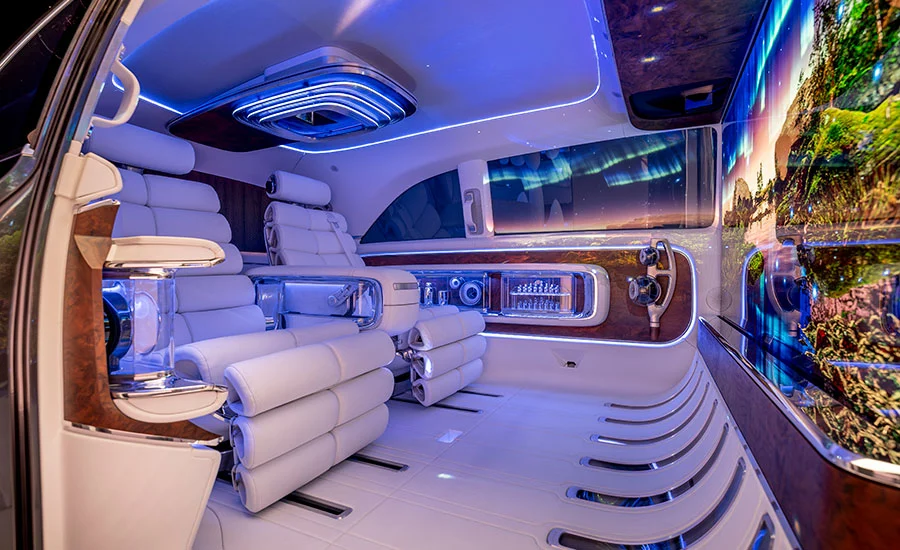
The vision for future automotive interiors is exemplified by concept vehicles and advanced technological solutions. Mercedes-Benz AG recently offered a glimpse into this future with its Vision V concept van, envisioned as a "private lounge on wheels." This futuristic EV concept meticulously separates the passenger compartment from the cockpit, equipping it with first-class seats that can recline into a flat position. A 65-inch cinema screen retracts into the floor, complemented by 42 speakers and seven projectors that create an immersive digital environment.
This concept highlights the significant added packaging, power, data, and mechanical requirements when a cabin becomes an adaptable space for entertainment, work, or relaxation. The overarching goal is to dissolve the traditional boundaries between interior trim, electronic hardware, and software, allowing displays, seats, controls, sensors, and sustainable surfaces to interact as part of a seamless, integrated, and coordinated system. "EVs and automated driving are transforming the interior from a driver-centric cockpit into a more flexible, experience-driven space," explains James Liu, head of infotainment platform and experiences at Mercedes-Benz. He adds that electrification enables new packaging opportunities, leading to more open layouts, while automated features shift the focus towards comfort, productivity, and entertainment, demanding closer integration of digital interfaces and interior architecture.
Liu stresses that "with increasing levels of autonomous driving, interiors will become more adaptive and multifunctional. This will require greater flexibility in manufacturing, including support for new seating concepts, additional sensors, and evolving safety and comfort requirements." Given that automation will not arrive in a single configuration, flexible assembly lines must accommodate different equipment levels and regional feature sets without creating unique production problems for every variant.
Mercedes-Benz’s CLA Shooting Brake sport utility vehicles already demonstrate the rapid evolution of interior manufacturing. They feature a "super screen" composed of a 10.25-inch driver display, a 14-inch central display, and a 14-inch passenger display, all housed beneath a continuous glass surface. This integration, powered by high-performance chips and real-time graphics, is balanced with the reintroduction of physical rollers and rocker switches on the steering wheel, a response to customer demand for tactile controls. This suggests a future that isn’t solely touchscreens, but an evolutionary design process that integrates broad glass surfaces and advanced computing hardware while retaining sensible tactile controls.

The dashboard, increasingly resembling an electronic subsystem wrapped in premium trim, sees the integration of large displays and advanced HMI technologies significantly increasing manufacturing complexity. "It requires very tight tolerances, seamless hardware-software integration, and robust thermal and structural solutions," says Liu, emphasizing the need to ensure premium look-and-feel and long-term durability across high production volumes. The tolerance stack is both mechanical and digital, requiring glass, bezels, and adjoining surfaces to align perfectly, while hardware communicates flawlessly with cameras, microphones, speakers, controls, and vehicle networks. End-of-line checks now extend to calibration, connectivity, and software behavior. "Production lines are adapting to higher levels of system integration and electronic complexity," Liu points out. "This includes more advanced calibration processes, increased integration of connectivity components, and extended testing procedures to ensure system reliability and consistent quality at scale."
Functional Electronics and Integrated Surfaces
As EV platforms unlock new packaging possibilities and autonomous driving reduces the cabin’s dependence on a conventional cockpit, interior components are expected to provide more illumination, sensing capabilities, communication functions, and software-controlled features. TactoTek, a Finnish company specializing in injection-molded structural electronics (IMSE) technologies, foresees significant changes as controls and information move beyond discrete screens and switches into the very surfaces surrounding vehicle occupants.
This approach allows contextual controls to remain hidden until relevant, while tactile feedback and integrated lighting can communicate information without permanently cluttering the cabin with visual interfaces. "The objective is to make technology available when needed, while allowing the cabin to remain calm, clean and intuitive at other times," explains Hasse Sinivaara, design architect at TactoTek. Vehicle type will also influence this evolution; privately owned vehicles may prioritize comfort, personalization, and emotionally engaging surroundings, whereas shared autonomous vehicles will likely value space efficiency, durability, and interactions easily understood by unfamiliar passengers.
The traditional division of decorative, electronic, and mechanical elements among separate engineering teams and suppliers is becoming unsustainable. When the visible surface itself must provide illumination, touch controls, proximity sensing, and software-driven feedback, these disciplines must converge much earlier in the product development cycle. "The biggest engineering change happens before the component reaches the assembly line," says Sinivaara. "Styling, mechanics, electronics, lighting, sensing, software, materials, tooling and validation can no longer be developed as largely separate workstreams." TactoTek’s IMSE technology integrates conductive circuitry, electronic components, lighting, and sensing functions into a thin, three-dimensional molded structure that also serves as the decorative and structural surface. This reduces the unit of production from a collection of related components to an integrated functional module, simplifying inventory, logistics, and assembly.

The Impact of Battery Packs on Assembly
Even components external to the interior can profoundly impact its assembly. BMW’s sixth-generation electric vehicle platform, for example, features a "pack-to-open-body" design where the high-voltage battery pack becomes an integral part of the vehicle’s structure. This means the body does not achieve its intended stiffness until the pack is installed. Consequently, the battery can no longer be treated as a component attached late in the assembly process; it must arrive much earlier, before much of the cabin is installed above it. A structural decision below the floor now dictates when seats, carpet, and other interior components can enter the body.
"The [pack-to-open-body affects] assembly, because the body has another stiffness than it has with a body we had before," says Kerim Kochti, head of product and process planning for electrical and electronic systems at BMW AG. This concept fundamentally reverses the traditional logic, requiring BMW assemblers to join the pack and body early in the process. "If you have pack-to-open-body and you need a certain stiffness, then the pack is one of the first things that needs to be assembled in the car," Kochti explains. This early installation significantly alters the trim assembly process, material handling, and the relationship between product engineering and manufacturing planning, demanding extensive rethinking of the assembly sequence.
Conversely, electrification can also simplify the cabin by removing components that once complicated it. The elimination of the transmission tunnel, for instance, opens up passenger space and simplifies the shape of interior parts, such as the floor covering. Fewer unique parts can lead to reduced mass and fewer assembly operations, aligning with broader manufacturing efficiency and quality goals. "The fewer steps you need to do, the more efficient it is, and at the end, you also have less room for error," notes Kochti. "Each step has potential for error. The fewer you have, the better."
Centralized Cabin Intelligence and Software-Defined Interiors

While instrument panels, door panels, consoles, and headliners are still physically installed in recognizable ways, the intelligence driving their displays, controls, audio, and comfort functions is migrating from numerous local controllers to centralized and zonal computing systems. "For interior, the change is not so much in the physical assembly sequence," says Joachim Fetzer, chief technology and innovation officer at Marelli. "What really changes, specifically in autonomous vehicles, is where the intelligence sits, as sensors, zonal control units and high-performance computing units move into the body."
Marelli’s technologies illustrate these implications, featuring concepts like a pillar-to-pillar display, MCU-free seat and door modules, distributed audio over Ethernet, and movable components designed for a less driver-centered cabin. Reducing wiring and hardware duplication necessitates tighter coordination of electronic architecture, mechanical integration, and software validation. Marelli’s HorizonView display, for instance, projects a continuous 44.8-inch image across the windshield base using high-brightness MiniLED picture-generation units. This approach, which distributes TFT units across the instrument panel and uses the windshield as the viewing surface, offers simpler assembly compared to integrating multiple screens into a single, large carrier that demands extremely tight tolerances.
The "MCU-Free" concept for door and seat modules is another example, where window, mirror, seat, and safety functions are managed through a zonal or central controller via a low-latency remote-control protocol, rather than by a microcontroller embedded in each module. While this removes local controllers, end-of-line testing remains crucial, with intelligence shifting into the test equipment itself. Audio distribution follows a similar architecture, utilizing class-D amplification over Ethernet without local processors, managed by a zone controller. This approach reduces cabling complexity and simplifies assembly through standardized network connections.
A passenger-focused cabin also introduces moving hardware, such as swivel speakers, motorized air vents, and retractable tables. These components, while enhancing comfort and functionality, must withstand repeated operation without rattles, pinch hazards, or interference with trim. Their motors and controls must seamlessly connect to the vehicle architecture and undergo rigorous functional testing. "In the past, all information and features were designed primarily around the driver," says Fetzer. "In future vehicles, the cabin will no longer be centered on the driver’s seat. Comfort during the ride will become more important, especially for passengers." The convergence of interior mechanisms, electronics, and software makes late-stage handoffs increasingly difficult, reinforcing the need for integrated design from the outset.
Sustainability and Circular Economy

Electrification is also intensifying scrutiny of the materials used inside vehicles. Mercedes-Benz, for example, incorporates four times as much secondary material in the thermoplastics of its battery-powered CLA model compared to its predecessor, with half originating from post-consumer sources. This commitment to circularity extends to every layer of the seat, including the cover, foam, substructure, and metal holders, pushing sustainable design into core component development rather than treating it as a decorative afterthought.
Mercedes-Benz’s "Tomorrow XX" technology initiative further explores this concept through over 40 component and material concepts, including monomaterial approaches, recycled inputs, and door-module carriers designed for a lower carbon footprint. Joining methods are also being re-evaluated to facilitate easier part separation and recycling. Automakers and suppliers face the challenge of industrializing these choices without compromising appearance, process stability, or service life. Designing for disassembly influences fasteners, adhesives, and the entire sequence of interior module construction and installation. "Our approach is to combine premium design with scalability from the very beginning," states Liu.
The Future of the Automotive Cabin
The emerging automotive cabin concept, particularly exemplified by Mercedes-Benz, is not defined by any single screen, seat material, or automated-driving feature. Instead, it represents a seamless integration between physical and digital design, vehicle and cloud, automaker and supplier, and assembly hardware and software validation. The biggest impact in the near future, according to Liu, will stem from the profound integration of hardware and software into unified, intelligent systems.
This holistic transformation demands a coordinated effort across the entire automotive value chain, from material science and component design to advanced manufacturing and software engineering. The automotive interior is no longer a static space but a dynamic, intelligent, and adaptive environment, ready to cater to the evolving needs of occupants in an electric and autonomous future. The journey from a driver-centric cockpit to a passenger-focused, immersive, and highly functional connected cabin is well underway, promising an unprecedented era of comfort, safety, and personalized experiences within our vehicles.