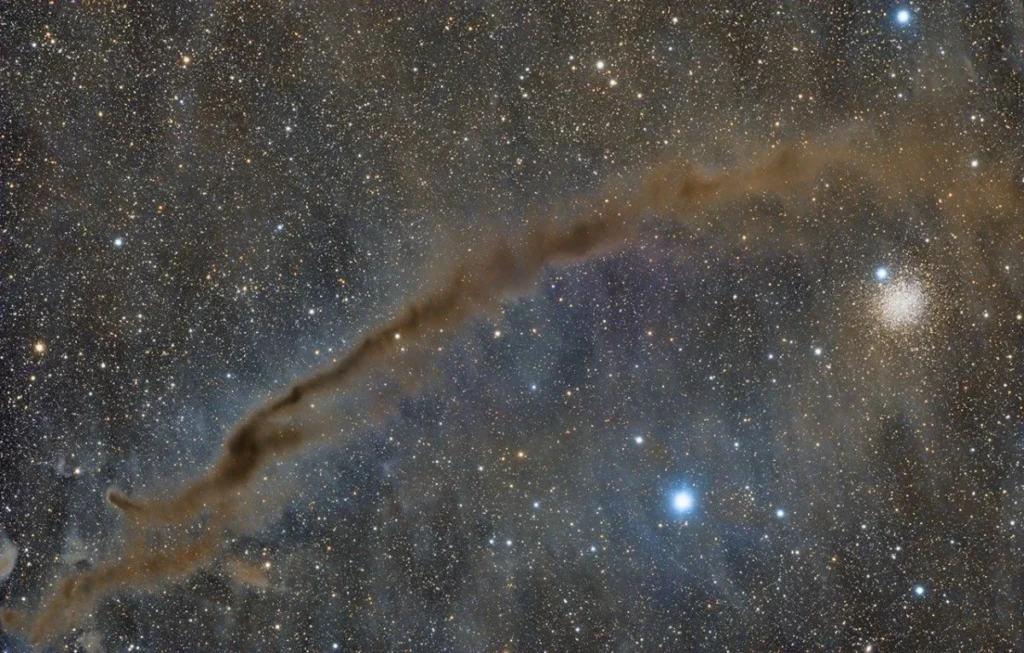
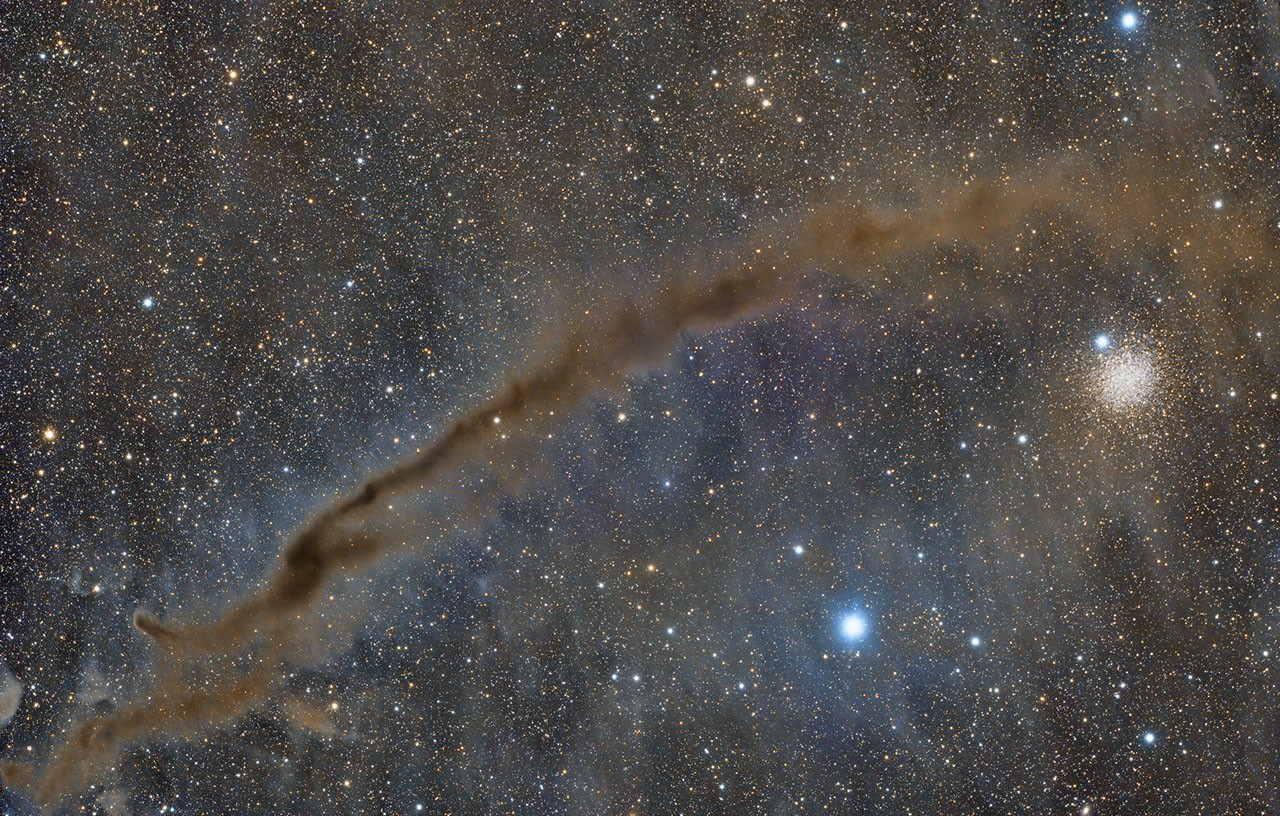
The Dark Doodad Nebula, a striking example of a dusty interstellar cloud, is currently gracing the southern celestial hemisphere, offering a captivating spectacle for astronomers and stargazers alike. This intriguing cosmic formation, located towards the constellation Musca, or The Fly, presents a stark silhouette against the luminous backdrop of our Milky Way galaxy. Its enigmatic presence, illuminated by the light of distant stars, provides a valuable window into the complex processes of star formation and the vastness of interstellar space.
Unveiling the Dark Doodad Nebula
The Dark Doodad Nebula, officially designated as a dark nebula, is characterized by its dense concentration of interstellar dust and gas. These clouds are inherently opaque, absorbing and scattering the light from stars behind them, thereby appearing as dark patches against the brighter galactic canvas. The nebula’s unique shape, often described as a "doodad" due to its somewhat irregular, elongated form, spans approximately three degrees in the sky, making it a noticeable feature for those equipped with binoculars or small telescopes. Its position in the southern sky places it in proximity to other well-known celestial landmarks, including the Coalsack Nebula and the Southern Cross, further enhancing its observational appeal.
The name "Dark Doodad Nebula" itself carries a touch of astronomical serendipity. It was first coined by renowned astro-imager and writer Dennis di Cicco in 1986. Di Cicco’s inspiration struck while he was observing Halley’s Comet from the stark beauty of the Australian outback. The alliterative and evocative moniker has since become widely adopted, adding a memorable character to this otherwise scientifically descriptive celestial object.
Composition and Formation: A Stellar Cradle
At its core, the Dark Doodad Nebula is a component of the Musca molecular cloud complex. Molecular clouds are the birthplaces of stars, vast reservoirs of cold, dense gas (primarily molecular hydrogen) and dust. Within these regions, gravity can overcome the outward pressure of the gas, leading to the collapse of denser pockets. As these pockets contract, their temperature and density increase, eventually reaching the point where nuclear fusion ignites in their cores, marking the birth of a star.
The Dark Doodad Nebula, estimated to be approximately 700 light-years away from Earth, stretches over a considerable distance, exceeding 30 light-years in length. This substantial size indicates a significant mass of material, sufficient to potentially fuel the formation of multiple stars. The nebula’s well-defined silhouette is a testament to the intricate interplay of gas, dust, and radiation within the interstellar medium.
Celestial Neighbors: NGC 4372 and the Milky Way Halo
Adding another layer of cosmic intrigue to the Dark Doodad Nebula is its apparent association with the globular cluster NGC 4372. This yellowish globular cluster is situated near the southern tip of the Dark Doodad, a celestial pairing that enhances the visual appeal of the region. Globular clusters are ancient, densely packed collections of hundreds of thousands to millions of stars, bound together by gravity.
However, the relationship between the Dark Doodad and NGC 4372 is one of cosmic coincidence. NGC 4372 is not an integral part of the Musca molecular cloud. Instead, it is a much older and more distant object, residing in the halo of our Milky Way galaxy. Its estimated distance is around 20,000 light-years from Earth, placing it far beyond the Dark Doodad. The fact that these two objects appear in close proximity in our line of sight is a remarkable illustration of the vast, three-dimensional structure of our galaxy and the serendipitous alignments that can occur in the cosmos. The Milky Way’s halo is a diffuse, spherical region surrounding the galactic disk, containing old stars, globular clusters, and dark matter.
Observing the Dark Doodad
For amateur astronomers, the Dark Doodad Nebula offers an accessible and rewarding target. Its location in the southern sky, coupled with its visibility to the naked eye or through binoculars, makes it a popular subject for observation. The constellation Musca, though small, is a distinctive feature in the southern celestial sphere. Observing the Dark Doodad requires clear skies and a location away from light pollution to fully appreciate its subtle beauty against the star-studded expanse.
Telescopic observations reveal more intricate details of the nebula, showcasing the varying densities of dust and gas, and the subtle interplay of light and shadow. The presence of NGC 4372 provides a bright counterpoint, highlighting the diverse celestial objects that inhabit the region.
The Astronomy Picture of the Day (APOD) Initiative
The recent feature of the Dark Doodad Nebula on NASA’s "Astronomy Picture of the Day" (APOD) program underscores its significance as a subject of astronomical interest. APOD, established in 1995, serves as a vital educational tool, presenting a different image or photograph of our universe each day, accompanied by a concise explanation written by a professional astronomer. This initiative has become a cornerstone for public engagement with astronomy, democratizing access to stunning cosmic imagery and scientific insights.
The APOD program’s mission is to "Discover the cosmos!" by showcasing the beauty and wonder of the universe. Each featured image is carefully selected for its scientific merit and aesthetic appeal, and the accompanying text provides context, interpretation, and relevant scientific background. The selection of the Dark Doodad Nebula for APOD highlights its role in illustrating fundamental astronomical concepts, such as interstellar dust, star formation, and the structure of our galaxy.
Broader Implications: Understanding the Interstellar Medium
The study of dark nebulae like the Dark Doodad is crucial for understanding the interstellar medium (ISM), the material that exists between stars. The ISM is not merely empty space; it is a dynamic and complex environment composed of gas, dust, magnetic fields, and cosmic rays. These components play a vital role in the evolution of galaxies, the formation of stars and planetary systems, and the distribution of elements in the universe.
Dark nebulae are particularly important because they represent regions where the conditions are ripe for star formation. By studying their composition, density, temperature, and internal structure, astronomers can gain valuable insights into the processes that trigger gravitational collapse and lead to the birth of new stars. The presence of molecular gas within these nebulae allows for the formation of complex molecules, some of which are considered the building blocks of life.
Furthermore, the dust within dark nebulae, though tiny, has a significant impact on the light that passes through it. It absorbs and scatters visible light, but it is also a source of infrared radiation as it absorbs starlight and re-emits it at longer wavelengths. Studying this infrared emission helps astronomers map the distribution of dust and understand its role in heating and shaping the surrounding gas.
Future Research and Exploration
The Dark Doodad Nebula, as a representative of a broader class of celestial objects, continues to be a subject of ongoing research. Advanced telescopes, both ground-based and space-borne, provide increasingly detailed observations of these regions. Instruments like the Atacama Large Millimeter/submillimeter Array (ALMA) can probe the cold molecular gas within nebulae with unprecedented resolution, while the James Webb Space Telescope (JWST) can peer through the dust to observe the formation of young stars in infrared light.
Future studies will likely focus on mapping the precise distribution of molecular species within the Dark Doodad, investigating the dynamics of gas flows, and identifying any nascent protostars that may be hidden within its depths. Understanding the early stages of star formation is fundamental to comprehending the overall lifecycle of stars and the enrichment of the universe with heavier elements.
The Dark Doodad Nebula, with its evocative name and visually striking appearance, serves as a powerful reminder of the vast and dynamic universe we inhabit. It is a celestial canvas upon which the grand processes of cosmic evolution are painted, offering endless opportunities for discovery and wonder. As astronomers continue to unravel its secrets, the Dark Doodad will undoubtedly contribute to our ever-growing understanding of the cosmos and our place within it.
A Timeline of Cosmic Observation and Naming
The journey of understanding and naming the Dark Doodad Nebula can be traced through several key points:
- Ancient Times: Southern hemisphere constellations like Musca have been observed by various cultures for millennia, though the specific details of nebulae were not discernible without telescopic aid.
- 1751-1752: Nicolas-Louis de Lacaille catalogs numerous southern celestial objects, including NGC 4372, though its connection to the dark nebula would not be understood for centuries.
- Early 20th Century: Astronomical surveys begin to map the distribution of interstellar dust and gas, identifying dark nebulae as significant features.
- 1986: Astro-imager and writer Dennis di Cicco observes the comet Halley from Australia and coins the informal, yet enduring, name "Dark Doodad Nebula" for the striking dark cloud he observed.
- Late 20th Century – Present: Advanced astronomical instruments and techniques allow for detailed studies of the Dark Doodad’s composition, structure, and its role within the Musca molecular cloud complex, confirming its potential as a star-forming region.
- June 2024 (inferred date based on image URL): The Dark Doodad Nebula is featured as NASA’s Astronomy Picture of the Day (APOD), bringing renewed public attention to this fascinating celestial object and its scientific significance.
This chronological perspective highlights how our understanding of cosmic objects evolves, from initial observations to detailed scientific analysis and the adoption of evocative names that capture the imagination. The Dark Doodad Nebula’s story is a testament to both scientific inquiry and the human appreciation for the beauty of the universe.