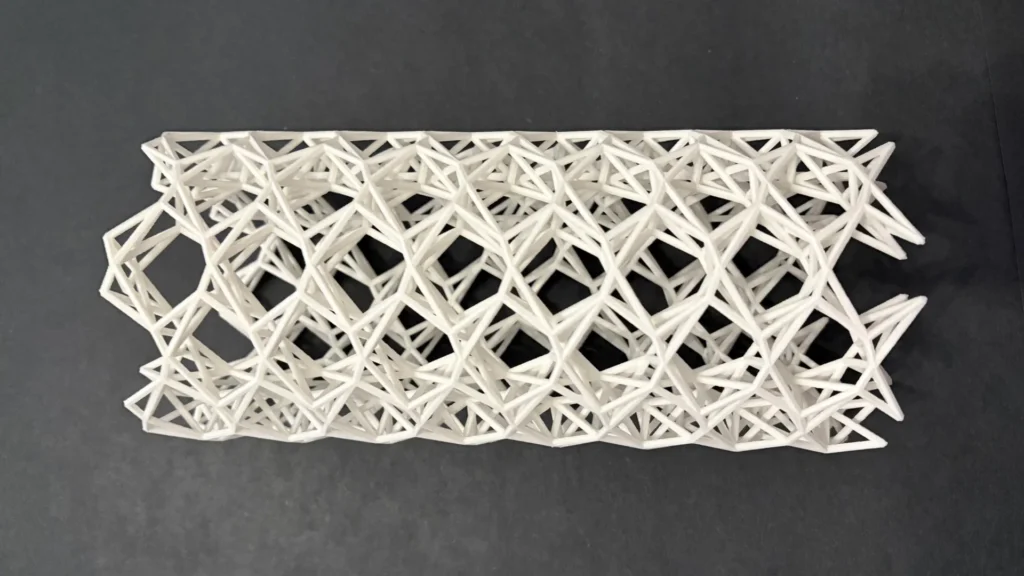
Scientific breakthroughs rarely happen all at once. More often, they evolve slowly, as researchers and engineers build on years of steady progress until the extraordinary eventually becomes routine. Now, scientists may be reaching a turning point in that gradual journey. Researchers from the University of Michigan and the Air Force Research Laboratory (AFRL) have demonstrated a way to 3D print intricate tubular structures whose unique internal geometry allows them to suppress vibrations in ways never seen in natural materials. These creations belong to a class known as mechanical metamaterials—engineered substances with properties that come entirely from their design rather than their composition.
The ability to block or reduce vibrations could be valuable across many industries, from transportation to construction and beyond. The team’s findings, published in Physical Review Applied, build on decades of theory and computer modeling to produce real-world structures that can passively disrupt vibrations traveling through them.
"That’s where the real novelty is. We have the realization: We can actually make these things," said James McInerney, a research associate at the AFRL. McInerney was previously a postdoctoral fellow at U-M working with Xiaoming Mao, a professor of physics, who is also an author of the new study. "We’re optimistic these can be applied for good purposes. In this case, it’s vibration isolation."
This pioneering work received partial funding from significant governmental bodies, including the Defense Advanced Research Projects Agency (DARPA) and the Office of Naval Research, underscoring its potential strategic importance. Additional support was provided by the U.S. National Research Council Research Associateship Program, administered by the National Academies of Sciences, Engineering and Medicine, highlighting a collaborative national effort. Contributors to this groundbreaking research included Serife Tol, an associate professor of mechanical engineering at U-M; Othman Oudghiri-Idrissi of the University of Texas; and Carson Willey and Abigail Juhl of AFRL, showcasing a multidisciplinary and multi-institutional approach.
Redefining Material Science Through Design
"For centuries, humans have improved materials by altering their chemistry. Our work builds on the field of metamaterials, where it is geometry—rather than chemistry—that gives rise to unusual and useful properties," Mao explained. "These geometric principles can apply from the nanoscale to the macroscale, giving us extraordinary robustness." This fundamental shift from chemical composition to structural design marks a significant paradigm shift in material engineering.
Structural Foundations: From Theory to Tangible Reality
According to McInerney, the study represents a powerful convergence of classical structural engineering principles, modern physics, and cutting-edge manufacturing technologies, most notably 3D printing. This integration is key to translating theoretical concepts into practical applications.
"There’s a real probability that we’re going to be able to manufacture materials from the ground up with crazy precision," McInerney stated, emphasizing the potential for highly controlled fabrication. "The vision is that we’re going to be able to create very specifically architectured materials, and the question we’re asking is, ‘What can we do with that? How can we create new materials that are different from what we’re used to using?’"
As Professor Mao elaborated, the team’s focus is not on altering a material’s intrinsic chemical makeup. Instead, they are exploring how meticulous control over shape and structure at a fine scale can unlock novel and advantageous mechanical properties. This approach draws inspiration from natural designs. For example, human bones and the shells of plankton exhibit remarkable strength and resilience, not due to exotic chemical compositions, but rather through their intricate geometries. By leveraging advanced technologies like 3D printing, scientists can now replicate and even enhance these natural design principles in a wide range of materials, including metals and polymers, to achieve effects that were previously unattainable.
"The idea isn’t that we’re going to replace steel and plastics, but use them more effectively," McInerney added. This suggests a future where existing materials are augmented with metamaterial components to enhance their performance in specific applications, rather than wholesale replacement.
A Legacy of Innovation: Connecting Past and Future
While the current research relies heavily on modern innovations, its conceptual roots extend back through scientific history. One crucial historical underpinning is the work of the eminent 19th-century physicist, James Clerk Maxwell. Though widely recognized for his groundbreaking contributions to electromagnetism and thermodynamics, Maxwell also delved into mechanics. He developed valuable design considerations for creating stable structures composed of repeating subunits, now known as Maxwell lattices.
Another pivotal concept that informs this new study emerged in the latter half of the 20th century. Physicists discovered that peculiar and often perplexing behaviors arose at the edges and boundaries of materials. This observation gave birth to a vibrant and still-active field of study known as topology, which seeks to explain these boundary phenomena and to harness them for practical real-world applications.
"About a decade ago, there was a seminal publication that found out that Maxwell lattices can exhibit a topological phase," McInerney noted. This discovery provided a theoretical framework for understanding how geometric arrangements could lead to robust, wave-blocking properties.
The Kagome Tube: A Tangible Manifestation of Theory
Over the past several years, McInerney and his colleagues have diligently explored the implications of this theoretical insight, particularly as it pertains to vibration isolation. The team successfully developed a comprehensive model explaining this behavior and outlining how to design a real-world object capable of exhibiting it. Their latest achievement is the proof of concept: the actual fabrication of such objects using 3D-printed nylon.
A cursory examination of these fabricated structures reveals the intricate challenges that previously hindered their creation. They bear a striking resemblance to a chain-link fence that has been meticulously folded and then rolled into a tubular form, featuring interconnected inner and outer layers. Physicists refer to these specific geometric configurations as "kagome tubes," a nomenclature derived from traditional Japanese basket weaving techniques that employed similar intricate patterns.
Addressing the Trade-offs: The Next Frontier
Despite this significant breakthrough, the researchers acknowledge that this is merely the initial step in fully realizing the potential of these novel structures. One critical challenge identified in the study is the inherent trade-off between a structure’s vibration-suppressing efficacy and its load-bearing capacity. The findings indicated that structures exhibiting superior vibration isolation might consequently possess reduced weight-bearing capabilities.
"This is a costly, potentially even unacceptable tradeoff in terms of applications," McInerney observed. However, he also highlighted that this limitation opens up intriguing opportunities and raises fundamental questions that warrant further investigation.
As such novel structures transition from theoretical models to tangible prototypes, scientists and engineers face the challenge of developing new standards and methodologies for their testing, characterization, and assessment. This need for new evaluation frameworks is a prospect that genuinely excites McInerney.
"Because we have such new behaviors, we’re still uncovering not just the models, but the way that we would test them, the conclusions we would draw from the tests, and how we would implement those conclusions into a design process," he stated. "I think those are the questions that honestly need to be answered before we start answering questions about applications."
Broader Implications and Future Directions
The successful demonstration of 3D-printed kagome tubes capable of unprecedented vibration suppression holds profound implications across a multitude of sectors.
Transportation: In the automotive and aerospace industries, these metamaterials could lead to quieter, smoother rides. By isolating sensitive components from engine vibrations, road noise, or aerodynamic buffeting, manufacturers could enhance passenger comfort and extend the lifespan of critical systems. Imagine aircraft cabins where engine hum is virtually eliminated, or high-speed trains that glide with remarkable serenity, all thanks to precisely engineered geometric structures within their chassis.
Construction and Infrastructure: The seismic resilience of buildings and bridges could be significantly improved. By incorporating vibration-dampening metamaterials into structural elements, engineers could design structures that are inherently more stable during earthquakes or high winds. This could lead to safer cities and reduced damage during natural disasters, saving lives and billions of dollars in reconstruction costs.
Advanced Manufacturing and Robotics: In the realm of precision manufacturing and robotics, even minute vibrations can compromise accuracy. Metamaterials could provide stable platforms for sensitive machinery, enabling higher tolerances and more intricate fabrication processes. Robotic arms could operate with greater steadiness, leading to more precise assembly lines and enhanced quality control in manufacturing.
Sensitive Equipment: From medical imaging devices like MRI machines to delicate scientific instruments in laboratories, the ability to isolate equipment from external vibrations is paramount for accurate operation. Metamaterial mounts and enclosures could offer a superior solution to traditional damping methods, leading to more reliable diagnostic tools and research outcomes.
Consumer Electronics: The ubiquitous presence of electronic devices in our lives means that even small improvements in vibration reduction can have a noticeable impact. Think of smartphones with enhanced haptic feedback that feels more refined, or audio equipment that delivers purer sound by minimizing internal and external vibrational interference.
The research team’s acknowledgement of the inherent trade-off between vibration suppression and load-bearing capacity highlights a crucial area for future research. This challenge underscores the need for continued innovation in metamaterial design and manufacturing. Future work will likely focus on:
- Optimizing Geometric Designs: Exploring a wider array of complex geometries and lattice structures to find designs that achieve a better balance between vibration isolation and structural integrity.
- Material Selection: Investigating the use of different base materials for 3D printing, such as advanced composites or metals, which might inherently offer better strength-to-weight ratios.
- Hybrid Approaches: Combining metamaterials with traditional damping techniques to create synergistic solutions that leverage the strengths of both.
- Computational Modeling: Further refining sophisticated computer models to predict the performance of new metamaterial designs under various conditions, thereby reducing the need for extensive physical prototyping.
- Scalability and Cost-Effectiveness: Developing manufacturing processes that can efficiently and affordably produce these complex structures at larger scales, making them viable for widespread industrial adoption.
The journey from theoretical concept to practical application for these vibration-suppressing metamaterials is ongoing. However, the successful demonstration by the University of Michigan and AFRL teams marks a significant milestone, opening a new chapter in the pursuit of materials engineered not by what they are made of, but by how they are intricately designed. The quiet revolution in material science has begun, promising a future where unwanted vibrations are no longer an unavoidable nuisance but a design challenge that can be elegantly overcome.