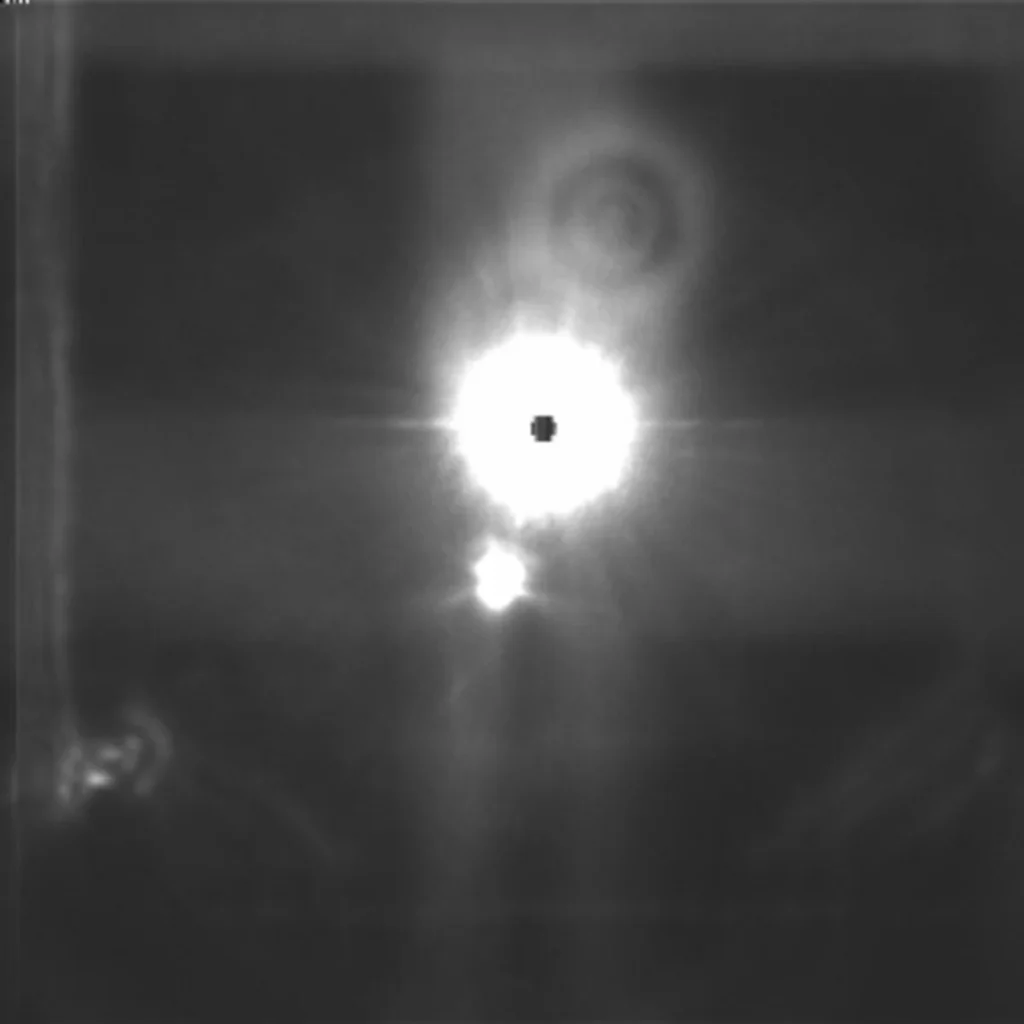
A striking satellite image, captured by the cutting-edge Trisat-S nanosatellite, presents a stark and compelling view of the Sun. At its center, a deep black dot dominates the otherwise blindingly bright solar disc, creating an effect that resembles a colossal, glaring eye piercing the cosmic darkness. This is not an artifact of a malfunctioning camera or a cosmic anomaly, but rather a scientifically significant phenomenon known as the "Black Sun effect." This effect, arising from the over-saturation of imaging sensor pixels under extreme illumination, causes intensely bright areas to appear dark, a visual paradox that has become a vital tool for the mission’s navigation capabilities.
The image, a testament to the ingenuity of the Trisat-S mission team, represents exactly the kind of data they were hoping to obtain. The Trisat-S nanosatellite, a marvel of miniaturized technology, carries six such specialized cameras, strategically positioned to provide a comprehensive 360-degree view of its surroundings.
From Artefact to Asset: The Black Sun’s Navigational Power
"The Black Sun effect might at first appear to be an unwanted imaging artefact, but for us it is a very useful visual feature," explains Iztok Kramberger, principal investigator of the Trisat programme at the University of Maribor, Slovenia. This sentiment underscores a fundamental shift in how scientific teams perceive and utilize what might initially seem like an imperfection. Instead of discarding or correcting for this phenomenon, Kramberger and his colleagues have harnessed it.
"Together with the observations of Earth and the Moon, the ‘Black Sun’ serves as a visual reference that can be used by a spacecraft to determine its attitude and orbit," Kramberger elaborates. This capability is crucial for spacecraft operating in the vast and often featureless expanse of space. By understanding its orientation relative to celestial bodies like the Sun, Earth, and Moon, a satellite can accurately ascertain its position and trajectory. This visual referencing system, leveraging the Black Sun effect, acts as a sophisticated celestial navigation tool, reducing reliance on more complex and potentially power-intensive sensor systems.
A Legacy of Innovation: Building on Trisat-R
The Trisat-S mission is not the first endeavor by the University of Maribor to explore and exploit the Black Sun effect. The team had previously investigated this phenomenon with their Trisat-R mission. This earlier mission, which benefited from the support of the European Space Agency’s (ESA) General Support Technology Programme (GSTP), laid the groundwork for the advancements seen in Trisat-S.
During the Trisat-R mission, when its camera was not focused on solar observation, it captured an equally remarkable image: the Earth, seen through the camera’s incredibly small 2-millimeter lens from thousands of kilometers away. This image, a breathtaking perspective of our home planet, highlighted the miniaturization capabilities of the camera technology and the potential for unique Earth observation from orbit. The Trisat-R mission provided crucial data from its medium Earth orbit, offering a distinct vantage point of Earth and the surrounding space environment, which complemented the ongoing research.
Trisat-S: A Leap Forward in Miniature Spacecraft Observation
Launched in early September, Trisat-S represents a significant evolution from its predecessor. This mission, a collaborative effort between the University of Maribor and the Slovenian space company SkyLabs, is specifically designed to collect simultaneous observations from its array of six miniature cameras. Operating in low Earth orbit, Trisat-S provides a richer, multi-directional dataset compared to the two-camera setup of Trisat-R.
"While Trisat-R provides observations from two cameras in medium Earth orbit, offering a different perspective of the Earth and the space environment, Trisat-S gives us the opportunity to collect simultaneous observations from six cameras in low Earth orbit," Iztok Kramberger explains, emphasizing the enhanced data acquisition capabilities.
The value of these simultaneous, multi-directional images extends beyond simple observation. "The resulting images are particularly valuable because we can compare them with our ground-based simulations to further refine and validate our visual awareness models, closing the loop between simulations, laboratory testing and actual spaceflight," Kramberger adds. This iterative process of comparing real-world space data with simulated models is fundamental to advancing the accuracy and reliability of autonomous navigation systems. It allows engineers to identify discrepancies, improve algorithms, and ensure that the technology performs as expected in the unforgiving environment of space.
Rigorous Testing: Ensuring Resilience in the Harshness of Space
The miniaturized imaging technology aboard Trisat-S has undergone extensive testing to ensure its robustness. Earlier this year, the cameras were subjected to an intense radiation environment at CERN’s Charm facility. This facility simulates the harsh conditions that spacecraft encounter in space, including high levels of radiation that can degrade electronic components and compromise sensor performance.
These tests were crucial for evaluating the effectiveness of radiation protection mechanisms developed by SkyLabs. The goal was to ensure that the camera sensors could maintain their functionality and imaging performance even under significant radiation exposure. Successful validation in such an extreme environment is a critical step towards deploying this technology on long-duration space missions where reliability is paramount.
Beyond Navigation: Advanced Hibernation Technologies
In addition to its groundbreaking imaging-based navigation experiments, Trisat-S is also serving as a platform for demonstrating advanced spacecraft hibernation technologies. These technologies are essential for future long-duration missions, particularly those venturing to distant celestial bodies. The ability for a spacecraft to enter a low-power hibernation state, conserving energy while maintaining critical systems, can significantly extend its operational lifespan and enable more ambitious exploration goals.
The ultimate objective of this research is ambitious: to equip spacecraft with the intrinsic ability to understand their position and orientation simply by observing their surroundings, utilizing highly miniaturized technology. "Ultimately, our goal is to give a spacecraft the ability to understand where it is and how it is oriented simply by looking at its surroundings using highly miniaturised technology, which is an important step towards autonomous navigation far beyond Earth," Kramberger concludes. This vision points towards a future where spacecraft can navigate the solar system and beyond with greater autonomy, reducing the need for constant ground control and opening up new frontiers for space exploration.
A Landmark Launch: Isar Aerospace’s Maiden Voyage
The Trisat-S mission was one of six commercial and educational CubeSats that embarked on their journey into orbit aboard Isar Aerospace’s Spectrum launcher. This launch, which took place in September 2026, marked a significant milestone for European space capabilities. Isar Aerospace became the first European company to successfully reach orbit with its own proprietary launch vehicle, a feat that underscores the growing strength and innovation within the European commercial space sector. Furthermore, this successful launch also saw Isar Aerospace become the first company to complete ESA’s demanding European Launcher Challenge, a testament to their technological prowess and operational excellence. The successful deployment of Trisat-S and its fellow CubeSats highlights the growing accessibility of space for scientific research and commercial ventures, facilitated by the development of new launch capabilities.
The Black Sun effect, once a curious visual anomaly, has been transformed into a powerful navigational asset. The Trisat-S mission, building upon the foundations laid by Trisat-R, is pushing the boundaries of miniaturized spacecraft technology, paving the way for more autonomous, efficient, and ambitious space exploration in the years to come. The stark beauty of the Sun’s "black eye" is a constant reminder of the ingenious ways in which scientists are learning to read the universe and chart humanity’s course among the stars.