NATIONAL HARBOR, Md. – The U.S. Air Force’s ambitious Collaborative Combat Aircraft (CCA) program is poised to make a significant leap forward as it prepares to participate in its first large-scale force exercise this December. This pivotal event marks a crucial step in integrating these advanced autonomous platforms alongside crewed fighter jets, signaling a transformative shift in aerial warfare capabilities.
Lt. Col. Lyndon Bartlett, commander of the Experimental Operations Unit tasked with defining the operational doctrine for the initial CCAs, described the upcoming exercise as the program’s "first tip dip of the toe in an actual force integration." Speaking on a panel at the Air, Space & Cyber Conference, Bartlett elaborated that this exercise will be the inaugural instance of CCAs being integrated "in a fourth- and fifth-gen combined OCA [offensive counter-air] push." This signifies a move beyond foundational testing to real-world operational scenarios where CCAs will directly contribute to offensive air operations alongside legacy and advanced manned aircraft.
The current testing phase for the CCA program has primarily focused on foundational aspects crucial for operational deployment. "Most of the unit’s CCA testing to date has been done for sortie generation, how easy they are to maintain, and how small a footprint could be operationally," Bartlett explained. This diligent groundwork in logistics, maintenance, and deployability is essential to ensure that these advanced systems can be effectively sustained and utilized in dynamic combat environments.
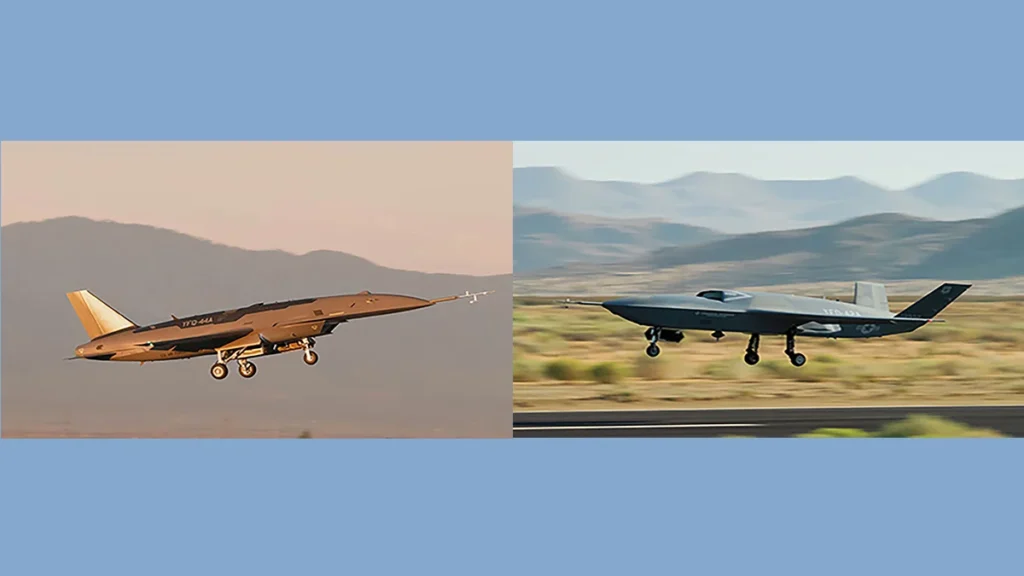
The CCA program envisions a fleet of "loyal wingman" drones designed to fly in close coordination with crewed fighter jets, acting as extensions of the pilot’s senses and capabilities. This concept aims to enhance the lethality, survivability, and operational reach of fighter formations. In June, the Air Force took a significant step in realizing this vision by awarding Increment 1 production contracts to two key industry partners: General Atomics Aeronautical Systems and Anduril Industries.
General Atomics is developing the FQ-42 Vengeance, previously known as the Dark Merlin, while Anduril Industries is producing the FQ-44 Fury. These contracts represent a commitment to moving from development to early-stage production, underscoring the program’s accelerated trajectory.
Industry Partners Advance Towards Key Milestones
The industry partners are making substantial progress towards achieving critical integration milestones. Jason Levin, senior vice president of engineering at Anduril, expressed optimism regarding the near-term realization of a key capability: "We expect the first flight where a Fury is controlled by a fighter jet pilot to happen in a matter of weeks or months." He further detailed the ongoing efforts, stating, "We’ve already begun doing quarterback integration"—the industry term for this critical control interface—"in our hardware-in-the-loop environments, and our software-in-the-loop environments, and even on the aircraft itself." This multi-pronged approach ensures robust testing and validation of the control systems.
General Atomics has also demonstrated tangible progress. The company announced on Tuesday that one of its test aircraft successfully flew in conjunction with an F-5 fighter jet in July. Michael Roberts, General Atomics’ advanced programs emerging technology director, highlighted the significance of this flight in a company release: "With this flight, we moved beyond simply flying an autonomous jet and showed how a manned fighter and an autonomous CCA can work together to find, track, and engage a target using passive sensors and shared autonomy." This achievement directly addresses the core objective of CCA: enabling seamless collaboration and task sharing between manned and unmanned platforms.
Software Autonomy: The "Secret Sauce" for Future Warfare
Beyond the airframes themselves, the intelligence and decision-making capabilities of the CCAs are paramount. In June, the Air Force identified a pool of six contractors for the development of the CCA’s mission autonomy software. This competitive approach aims to foster innovation and ensure the selection of the most advanced and reliable AI systems. The service plans to "execute a second competitive award period" in six months, with the selection of a primary autonomy provider for Increment 1 anticipated by summer 2027.
The selected contractors for this crucial software development include Anduril, General Atomics, Lockheed Martin, Northrop Grumman, Collins Aerospace (a division of RTX), and Shield AI. Notably, half of these vendors—Anduril, Collins Aerospace, and Shield AI—also received production options in June, indicating their strong standing in both airframe and software development.
Ryan Bunge, president of mission systems at Collins Aerospace, provided insights into their development focus during a roundtable in early September. He stated that the company’s recent work has centered on building up the software’s "initial warfighting capability." This involves "incorporating a lot of that tactics and mission extensibility to demonstrate how you would go prosecute a real mission scenario." The emphasis on tactical integration and mission adaptability is key to ensuring CCAs can perform complex tasks in contested environments.
Todd Wesley, an executive at Shield AI, echoed the drive for rapid iteration and improvement. Speaking at the same conference, he outlined an ambitious goal: "We’re trying to get to the point where we fly a sortie, update overnight and fly again the next day with updated software." While acknowledging, "We’re still proving that out," this objective highlights the pursuit of agile development cycles that can quickly incorporate lessons learned and adapt to evolving threats.
Lockheed Martin is leveraging its extensive experience in advanced flight control systems. An official from the company stated last week that they plan to merge their work developing artificial intelligence pilots for the crewed X-62A VISTA testbed into their CCA software. Ron Fehlen, vice president and general manager of Lockheed Martin Skunk Works, elaborated on this synergy, referencing a VISTA flight campaign earlier this year conducted in collaboration with the Air Force Test Pilot School. This campaign was "proofing out and building trust in the artificial intelligence that we’re employing on that system that we’re getting ready for Vectis," which is Lockheed Martin’s designation for both its CCA software and planned aircraft. The self-funded Vectis aircraft is reportedly "on schedule to fly by the end of 2027." While Lockheed Martin received an initial CCA study contract in 2024, they were not selected for the Increment 1 production contracts.
Northrop Grumman is also on track with its CCA platform, dubbed Talon Blue. A spokesperson confirmed that the platform "remains on track to fly in 2026" and "continues to advance autonomy software and mission capabilities."
Brig. Gen. Timothy Helfrich, who oversees the Air Force’s Fighters and Advanced Aircraft acquisition portfolio, emphasized the immense potential for growth in CCA capabilities. Speaking at the conference, he remarked, "There’s a huge room for growth in mission autonomy, just as you would expect a pilot to mature over their years." This analogy highlights the iterative development and learning process that AI systems will undergo, mirroring the progression of human aviators. Lt. Col. Bartlett further underscored the criticality of this development, stating, "Mission autonomy is going to be the secret sauce that lets these things become decisive or not."
The Strategic Imperative: A New Era of Air Superiority
The development of Collaborative Combat Aircraft is not merely a technological advancement; it represents a strategic imperative for the U.S. Air Force to maintain its edge in air superiority. The increasing sophistication and proliferation of advanced air defense systems and peer adversary capabilities necessitate a paradigm shift in how air power is projected. CCAs offer a way to saturate enemy defenses, conduct high-risk missions with reduced risk to human pilots, and exponentially increase the number of combat assets available.
The December exercise will provide invaluable insights into the practical challenges and successes of integrating these autonomous systems into existing combat air forces. The ability of CCAs to effectively operate in conjunction with fourth- and fifth-generation fighters, execute complex offensive counter-air missions, and demonstrate shared autonomy will be closely scrutinized.
Background and Context
The Air Force’s interest in unmanned combat air vehicles (UCAVs) dates back decades, but the CCA program represents a more integrated and accelerated approach. Driven by lessons learned from recent conflicts and the rapid pace of technological development, particularly in artificial intelligence and autonomous systems, the Air Force has prioritized the CCA program as a cornerstone of its future force structure. The "loyal wingman" concept, first publicly articulated with the development of the XQ-58A Valkyrie and its potential integration with F-35 and F-22 fighters, has evolved into a comprehensive program with multiple industry partners pursuing diverse design and operational concepts.
The Air Force’s foundational investment in advanced simulation and testing environments, such as the X-62A VISTA, has been crucial in de-risking the development of AI-driven autonomy. These testbeds allow for extensive validation of algorithms and operational concepts before deploying them on actual flight hardware, a critical step in building confidence and trust in AI-controlled systems.
Broader Implications and Future Outlook
The successful integration of CCAs into large force exercises and, subsequently, operational combat units will have profound implications for military strategy and defense industrial policy. It signals a move towards a more distributed, networked, and autonomous air combat capability. This could lead to:
- Increased Lethality and Survivability: CCAs can act as force multipliers, overwhelming adversaries with sheer numbers and providing enhanced situational awareness and defensive capabilities for manned platforms.
- Reduced Risk to Aircrews: High-threat missions, such as penetrating heavily defended airspace or conducting deep strikes, can be assigned to CCAs, significantly reducing the risk of pilot casualties.
- Enhanced Operational Flexibility: The ability to rapidly deploy and adapt autonomous systems could provide commanders with unprecedented flexibility in responding to evolving threats.
- Shifting Industrial Landscape: The success of the CCA program will likely drive significant investment and innovation in the defense aerospace sector, particularly in areas of AI, advanced materials, and low-cost, high-volume production of unmanned systems.
As the CCA program progresses through its development and testing phases, the upcoming December exercise stands as a critical benchmark. The insights gained from this large-scale integration will inform future program decisions, refine operational concepts, and pave the way for the U.S. Air Force to harness the full potential of collaborative, AI-driven aerial warfare. The journey from concept to combat readiness is complex, but the recent strides made by the Air Force and its industry partners indicate that the era of the "loyal wingman" is rapidly approaching.