In the mid-1980s, a seemingly modest advertisement in Scientific American offered a glimpse into a future where everyday objects could possess a dynamic duality, shifting between states of flexibility and rigidity. The Innovative Design Fund, in August 1985, put forth an open call for innovative concepts, promising up to $10,000 for compelling prototypes in areas like apparel, home furnishings, and textiles. It was within this landscape of nascent technological aspirations that William Freeman, then an electrical engineer at Polaroid and a graduate of MIT (Class of ’92), encountered the advertisement. His subsequent submission, a revolutionary concept for a three-sided zipper, laid the groundwork for a project that would lie dormant for nearly four decades before being revitalized by researchers at the MIT Computer Science and Artificial Intelligence Laboratory (CSAIL).
Freeman’s ingenious idea was a departure from the conventional zipper, which serves primarily to close flat surfaces. Instead, his triangular zipper was envisioned as a transformative mechanism, a “switch” capable of seamlessly transitioning objects like chairs, tents, and purses from a soft, pliable state to a rigid, structural form. This inherent adaptability promised to simplify packing and assembly processes, offering a novel approach to material manipulation. His initial blueprint, detailed in a patent application, described a design akin to a standard zipper but with three interlocking belts and triangular “teeth.” A slider, when moved along the device, would engage these belts, straightening them into a triangular tube and thus locking the object into its rigid configuration.
While the Innovative Design Fund ultimately did not select Freeman’s proposal for funding, his vision was far from abandoned. He proceeded to patent his prototype, storing it away with the prescient hope that its potential would one day be realized. This foresight proved to be remarkably accurate.
The Revival of a Tri-Folded Future
Nearly forty years after its inception, William Freeman’s three-sided zipper concept found its champion in the halls of MIT CSAIL. A team of researchers, driven by the ambition to create objects with “tunable stiffness” – the ability to alter their rigidity on demand – recognized the elegant simplicity and profound utility of Freeman’s design. Previous attempts to achieve such dynamic material properties often involved cumbersome manual assembly or irreversible transformations, posing significant limitations for practical applications.
The CSAIL team, inspired by Freeman’s foundational work, embarked on a mission to bring his idea into the 21st century. Their endeavor culminated in the development of an automated design tool and a sophisticated, adaptable fastener they have christened the "Y-zipper." This innovative system comprises two key components: a user-friendly software program and a sophisticated 3D printing process.
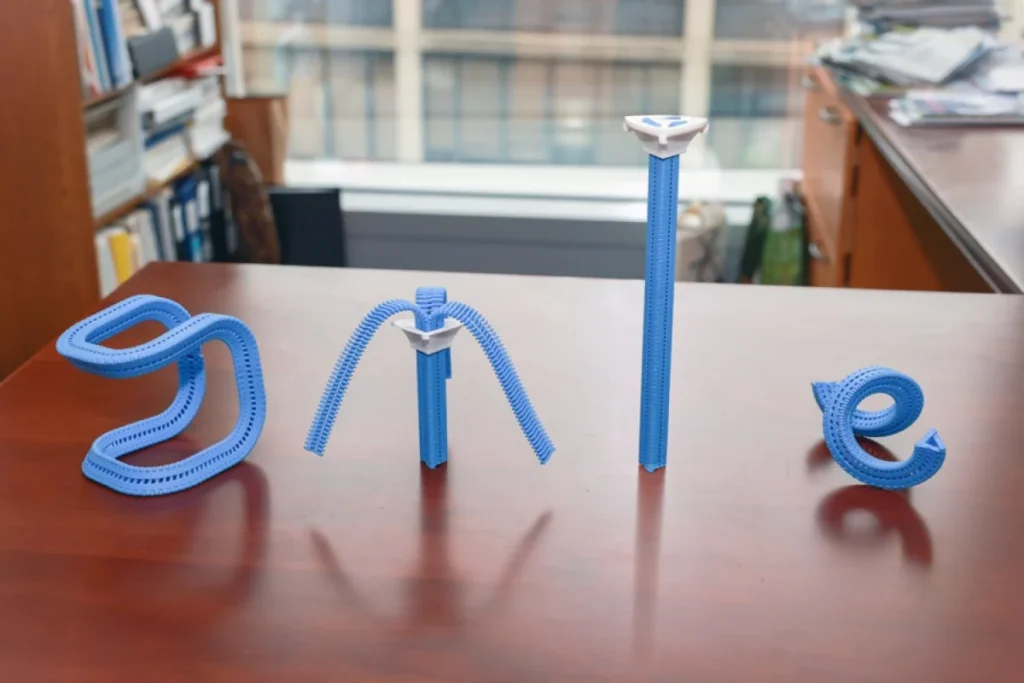
The software allows users to customize the geometry and functionality of the three-sided zippers, specifying parameters such as strip length, bending direction, and angular inclination. Furthermore, users can select from four distinct "motion primitives" to define the zipper’s appearance when engaged: a straight configuration, a bent or arched form, a coiled or spring-like structure, and a twisted or helical shape. This high degree of customization enables the creation of Y-zippers tailored to a vast array of specific needs and aesthetic preferences.
Once the design is finalized, the Y-zipper is fabricated using advanced 3D printing technology, typically employing plastics. These 3D-printed Y-zippers can then be integrated into a wide range of products and systems, from outdoor gear and medical equipment to robotics and intricate art installations, promising to revolutionize assembly and functionality across diverse fields.
The Science Behind Shape-Shifting Objects
The core innovation of the Y-zipper lies in its ability to enable rapid and reversible transitions between flexible and rigid states. Jiaji Li, an MIT postdoc and CSAIL researcher who served as a lead author on the open-access paper detailing the project, elaborated on the transformative nature of this technology. "A regular zipper is great for closing up flat objects, like a jacket," Li explained, "but Freeman ideated something more dynamic. Using current fabrication technology, his mechanism can transform more complex items. We’ve developed a process that builds objects you can rapidly shift from flexible to rigid, and you can be confident they’ll work in the real world."
The visual transformation of the Y-zipper is striking. When unzipped, it can unfurl into a configuration resembling a squid with three distinct tentacles, showcasing its potential for unfettered flexibility. Upon zipping, it compacts into a more rigid structure, such as a rod. This chameleon-like adaptability holds immense practical value, particularly in scenarios demanding efficient setup and portability.
Consider the process of pitching a tent. Traditional methods can be time-consuming and require multiple steps. With the Y-zipper, this task could be dramatically streamlined. By attaching each arm of a Y-zipper to the tent’s canopy and supporting the structure from above, the zipper’s engagement could effortlessly deploy the tent, potentially reducing setup time from several minutes to just over a minute. This efficiency is crucial in time-sensitive situations, such as disaster relief efforts or backcountry expeditions.
Beyond the Campsite: Medical and Robotic Applications
The implications of tunable stiffness extend far beyond recreational activities. In the medical field, the Y-zipper offers a pathway to more adaptable and user-centric assistive devices. The researchers demonstrated this potential by wrapping a Y-zipper around a wrist cast. This application allows users to adjust the cast’s tightness throughout the day, loosening it for comfort and then zipping it up at night to provide support and prevent further injury. This ability to fine-tune the rigidity of a medical device enhances patient comfort and compliance, ultimately contributing to more effective healing.
The Y-zipper’s capacity for controlled movement also opens doors for advanced robotics. By integrating a motor with the fabricated Y-zipper, the zipping and unzipping process can be automated, paving the way for highly adaptable robotic systems. One compelling example is an adaptive robotic quadruped. Such a robot could dynamically alter the length of its legs by tightening or loosening its Y-zipper components, allowing it to transition from taller limbs for navigating challenging terrain to shorter, more stable stances when needed. This agility could enable robots to explore diverse and complex environments, from rocky canyons to dense forests, with unprecedented efficiency.
The creative potential of actuated Y-zippers also extends to the realm of dynamic art installations. The CSAIL team successfully created a mesmerizing "blooming" flower, where a static motor engaged a Y-zipper to orchestrate its gradual unfurling, showcasing the technology’s capacity for both functional and artistic expression.
Durability Under Duress: Stress Testing the Y-Zipper
While the functional and aesthetic possibilities of the Y-zipper were evident, a critical question remained: its durability. Could these 3D-printed fasteners withstand the rigors of daily use and repeated actuation? To address this, the MIT researchers subjected their Y-zippers to a series of rigorous stress tests.
The team began by evaluating the mechanical properties of two common 3D printing plastics: polylactic acid (PLA) and thermoplastic polyurethane (TPU). Using a specialized machine designed to bend the Y-zippers, they determined that PLA offered superior load-bearing capacity, making it suitable for applications requiring significant structural support. Conversely, TPU demonstrated greater pliability, lending itself to designs where flexibility and elasticity were paramount.
Further experiments focused on the fatigue life of the Y-zipper. Researchers employed an actuator to continuously open and close the fasteners, meticulously recording the number of cycles before failure. The results were impressive: some Y-zippers endured approximately 18,000 cycles of zipping and unzipping before succumbing. 3D simulations revealed that the inherent elastic structure of the Y-zipper plays a crucial role in its durability, effectively distributing the stress of heavy loads and preventing premature breakage.
Future Horizons and Broader Impact
Despite these promising findings, the researchers are already looking towards the next frontier. Jiaji Li envisions the development of even more durable Y-zippers utilizing advanced materials, such as metals. Furthermore, scaling up the fabrication process to produce larger Y-zippers for more substantial projects is a key area of future development, though this is currently limited by the capabilities of their existing 3D printing platform.
The potential applications continue to expand with further consideration. In the unforgiving environment of space exploration, Y-zippers could be integrated into spacecraft, enabling robotic arms to precisely grasp and collect rock samples from distant celestial bodies. The rapid assembly capabilities of Y-zipper-embedded structures could also prove invaluable in humanitarian aid and disaster response. Relief workers could quickly deploy shelters and medical tents, providing essential resources to affected populations in the aftermath of natural disasters or during rescue operations.
The significance of this research has not gone unnoticed by the wider scientific community. Guanyun Wang, an assistant professor at Zhejiang University who was not involved in the study, offered a compelling endorsement. "Reimagining an everyday zipper to tackle 3D morphological transitions is a brilliant approach to dynamic assembly," Wang stated. "More importantly, it effectively bridges the gap between soft and rigid states, offering a highly scalable and innovative fabrication approach that will greatly benefit the future design of embodied intelligence."
The collaborative effort behind this groundbreaking research involved a diverse team of scientists and engineers. Jiaji Li and William Freeman co-authored the paper, alongside Tianjin University PhD student Xiang Chang. Other significant contributors from MIT CSAIL included PhD student Maxine Perroni-Scharf, undergraduate Dingning Cao, and recent visiting researchers Mingming Li (Zhejiang University), Jeremy Mrzyglocki (Technical University of Munich), and Takumi Yamamoto (Keio University). The project was further guided by MIT Associate Professor Stefanie Mueller, a CSAIL principal investigator and senior author on the work. Funding for this research was partially provided by a postdoctoral research fellowship from Zhejiang University and the MIT-GIST Program.
The culmination of this innovative research was presented at the ACM’s prestigious Computer-Human Interaction (CHI) conference on Human Factors in Computing Systems in April, where the Y-zipper was showcased as a testament to how foundational ideas, when revisited with cutting-edge technology, can unlock transformative solutions for a more adaptable and efficient future. The Y-zipper, born from a visionary idea in the 1980s, has now emerged as a tangible technology poised to redefine how we assemble, interact with, and build the world around us.