In a landmark achievement for the field of condensed matter physics and materials science, a collaborative team of Japanese researchers has successfully captured the near-instantaneous evolution of a "hidden" electronic state within a metal-organic framework (MOF). By utilizing cutting-edge ultrafast laser spectroscopy, the team observed a complex electronic transformation occurring on a timescale of just 30 femtoseconds—a duration so brief that it represents a millionth of a billionth of a second. This discovery, spearheaded by scientists from the Institute of Science Tokyo (Science Tokyo), Tohoku University, and the Nagoya Institute of Technology, provides the first clear glimpse into the intermediate stages of light-induced material changes, potentially paving the way for a new generation of light-controlled electronics.
The research, recently published in the prestigious journal Physical Review Letters, centers on the phenomenon of photoinduced phase transitions. Traditionally, the properties of materials—such as their electrical conductivity, magnetism, or transparency—are altered through thermal means, such as heating or cooling. However, light offers a much faster and more precise trigger. When certain materials absorb photons, they can be "pushed" into states that do not exist under equilibrium conditions. These are known as "hidden states," and understanding the pathway to their formation is critical for developing optoelectronic devices that operate at speeds far exceeding current semiconductor technology.
The Challenge of the Femtosecond Scale
The primary obstacle in studying these transitions has always been their extreme velocity. The initial steps of a photoinduced transformation involve the movement of electrons and the subsequent shifting of atomic nuclei, processes that occur in the femtosecond (fs) regime. To put this in perspective, one femtosecond is to one second what one second is to approximately 31.7 million years. Observing such an event requires not only incredibly fast "shutters" but also highly sensitive detection equipment capable of distinguishing between subtle electronic configurations.
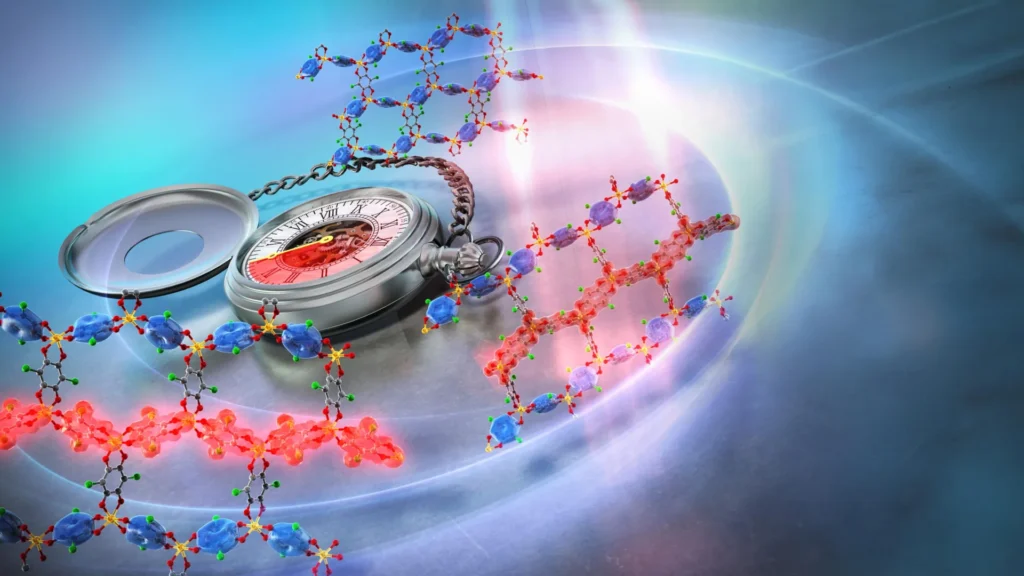
The research team, led by Assistant Professor Tadahiko Ishikawa of the Department of Chemistry at Science Tokyo, alongside former doctoral student Samiran Banu (now a Special Postdoctoral Researcher at RIKEN), sought to overcome this temporal barrier. They focused their efforts on a specific type of metal-organic framework. MOFs are porous materials composed of metal ions linked by organic ligands, creating a scaffold-like structure that is highly tunable. Because of their modular nature, MOFs are ideal candidates for studying how specific molecular arrangements respond to external stimuli like light.
Methodology: Time-Resolved Reflectance Spectroscopy
To witness the transformation, the researchers employed a technique known as time-resolved reflectance spectroscopy. This method involves a "pump-probe" setup. First, an extremely short "pump" laser pulse—lasting a mere six femtoseconds—is fired at the MOF sample to initiate the electronic change. Immediately following this, a second "probe" pulse is used to measure how the material’s reflectance properties have changed.
By varying the delay between the pump and the probe pulses in increments of a few femtoseconds, the team was able to stitch together a "movie" of the electronic evolution. The 6-fs duration of the laser pulses was the key to their success; it provided a fine enough resolution to see changes that previous experiments, using longer pulses, had simply blurred together.
As the MOF absorbed the light, the researchers noticed a dramatic shift in the reflectance spectrum within the first 30 femtoseconds. A new optical absorption band emerged, signaling that the material had entered a new state. However, the data suggested that the transition was not a simple jump from State A to State B. There was something happening in the middle.
Discovery of the Bond-Order Wave Intermediate
To interpret the complex signals captured during the experiment, the team combined their empirical findings with advanced theoretical calculations. This dual approach allowed them to reconstruct the microscopic behavior of the electrons and atoms within the MOF.
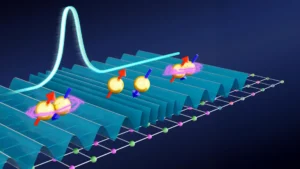
The analysis revealed that before the material reached its final "hidden" state, it passed through a fleeting intermediate electronic phase. In this brief moment, the electronic bonds between neighboring sites in the MOF began to oscillate in a specific pattern, alternating between stronger and weaker configurations. This phenomenon is known as a "bond-order wave" state.
The bond-order wave acts as a bridge. The researchers found that the initial absorption of light creates a high-energy electronic environment that destabilizes the original structure. The bond-order wave organizes this energy, creating a template that the atomic nuclei then follow. Within the 30-femtosecond window, the atoms in the framework shifted their positions slightly in response to the electronic pattern, eventually locking the material into the stable, photoinduced hidden state.
The Significance of Photoinduced Polar States
One of the most intriguing findings of the study involves the nature of the final hidden state. The theoretical models suggested that this new state might be polar. In a polar state, the distribution of positive and negative electrical charges is asymmetrical across the material.
The ability to induce polarity with light is a "holy grail" for materials scientists. Polar materials are essential for ferroelectric memory and various types of sensors. If a material can be switched from a non-polar to a polar state using a laser pulse—and if that switch happens in 30 femtoseconds—it could lead to memory storage devices that are thousands of times faster than current flash memory.
"By revealing these intermediate states, our method could help design materials that can be efficiently controlled using light," Assistant Professor Ishikawa explained. "The discovery of the bond-order wave as a precursor to the hidden state gives us a specific target for material engineering."
Chronology of a 30-Femtosecond Transformation
The sequence of events captured by the Science Tokyo-led team can be broken down into a precise timeline that illustrates the violence and precision of ultrafast chemistry:
- 0 to 6 Femtoseconds: The "Pump" pulse strikes the metal-organic framework. Electrons within the metal ions and organic ligands are excited to higher energy levels, breaking the equilibrium of the ground state.
- 6 to 15 Femtoseconds: The excited electrons begin to interact. Instead of returning to their original positions, they form the "bond-order wave." This is a purely electronic state where the density of electrons begins to fluctuate in a repeating, rhythmic pattern across the framework’s bonds.
- 15 to 25 Femtoseconds: The "lattice" (the physical structure of the atoms) begins to respond. Because the electronic bonds have changed strength, the atoms feel new forces pulling them out of their original alignment. This is the stage of atomic displacement.
- 25 to 30 Femtoseconds: The atoms reach their new positions. The reflectance spectrum stabilizes into a new pattern, confirming the birth of the photoinduced hidden state. The transformation is complete before a single vibration of many slower molecular bonds could even occur.
Broader Implications for Technology and Industry
The implications of this research extend far beyond the laboratory. We are currently approaching the physical limits of silicon-based electronics, where heat generation and electron tunneling prevent further increases in processing speed. "Light-wave electronics"—using the electromagnetic field of light to control electron flow—is seen as the next frontier.
The Japanese team’s work demonstrates that MOFs are viable platforms for this transition. Because MOFs are "soft" compared to traditional ceramics or metals, their structures can be more easily manipulated by light. Furthermore, the discovery that an intermediate electronic state (the bond-order wave) drives the process means that scientists can now look for ways to "tune" these intermediates. By changing the metal ion or the organic molecule in the MOF, they might be able to make the transformation even faster or more energy-efficient.
Industry experts suggest that this could impact several sectors:
- Telecommunications: Optical switches that operate at terahertz speeds could allow for data transmission rates far beyond current fiber-optic capabilities.
- Quantum Computing: Understanding fleeting electronic states is essential for maintaining and manipulating quantum bits (qubits) in solid-state systems.
- Energy Harvesting: MOFs are already used in solar cells; understanding their ultrafast dynamics could lead to more efficient light-to-electricity conversion.
Collaborative Success and Future Research
The success of this project highlights the importance of interdisciplinary collaboration. The synthesis and characterization of the MOF required the expertise of the Nagoya Institute of Technology, while the complex theoretical modeling was supported by Tohoku University’s long-standing history in condensed matter theory. Science Tokyo (the newly merged entity of Tokyo Institute of Technology and Tokyo Medical and Dental University) provided the advanced laser facilities necessary for the 6-fs measurements.
Looking ahead, the researchers plan to apply their "ultrafast movie" technique to other classes of materials. They are particularly interested in whether similar hidden states can be found in biological molecules or in superconductors. If the mechanism of the bond-order wave is universal, it could represent a fundamental principle of how light interacts with matter.
The study also raises new questions for the scientific community. For instance, how long does the hidden state persist before decaying back to the ground state? Can multiple hidden states be stacked or "braided" together using sequences of pulses? As the team at Science Tokyo and their partners continue to refine their laser techniques, the answers to these questions may redefine our mastery over the physical world at its most fundamental, and fastest, levels.
By exposing the previously invisible steps of ultrafast transformations, this research brings humanity one step closer to a future where light is not just a way to see the world, but the primary tool we use to command the behavior of the materials within it.