Professor Francois Barthelat, who leads the Laboratory for Advanced Materials & Bioinspiration, articulated the team’s excitement regarding this novel approach. "We’ve been playing around with the idea of building blocks and geometry for many years, but we started looking at interlocking, entangled particles only recently," Barthelat stated, underscoring the fresh perspective this research brings. He emphasized the profound potential of their discoveries, adding, "We are excited about the combination of properties we can get out of these systems and we believe this technology has the potential to go in many directions." The groundbreaking findings from this research were recently detailed in the esteemed Journal of Applied Physics, drawing the attention of the wider scientific community to the promising implications of entangled particle systems.
The Fundamental Principle: How Entangled Particles Create Strength
At the heart of this transformative research lies the phenomenon of entanglement, a state where individual particles become intricately intertwined, forging complex, interconnected networks with one another. This principle is not a foreign concept; rather, it is ubiquitously observed throughout the natural world, serving as a foundational mechanism for structural integrity in countless biological and geological formations. Consider, for instance, the humble bird’s nest. Its surprising resilience against wind and weather stems not from the strength of individual twigs, but from the elaborate, interwoven network of fibers and branches that collectively maintain its coherent structure. Similarly, the remarkable strength of bones is a testament to entanglement, deriving much of its robustness from the intricate interplay between its hard mineral components and more pliant protein matrices.
The CU Boulder team embarked on a mission to decipher how these pervasive natural principles could be harnessed and meticulously engineered to create advanced manufactured materials. Their extensive investigations consistently pointed towards one overwhelmingly critical factor: the intrinsic shape of the particles themselves. This realization marked a pivotal moment in their research, shifting the focus from mere material composition to the geometric design of its fundamental building blocks.
Youhan Sohn, a PhD student integral to the research, elucidated this concept with a vivid example. "Let’s take sand as an example. Sand is smooth and convex-shaped, meaning it cannot interlock from grain to grain," Sohn explained. This inherent lack of interlocking capability is precisely why sand, despite its individual hardness, flows easily and offers minimal resistance to shear forces when dry. He continued, "However, we found that if we change the shape of a grain of sand, we can drastically affect its behavior and mechanical properties, including the particle’s ability to link with other particles." This insight underscored the profound impact of particle geometry, suggesting that even subtle modifications to shape could unlock entirely new material behaviors.
To delve deeper into this hypothesis, the researchers employed sophisticated Monte Carlo simulations. This powerful computational technique allowed them to meticulously model and study the myriad ways different particle shapes might interact under various conditions. Monte Carlo simulations, which rely on repeated random sampling to obtain numerical results, are particularly adept at exploring complex systems where deterministic approaches are intractable. In this context, the simulations enabled the team to efficiently explore a vast design space of particle geometries, systematically identifying shapes that would maximize entanglement and, consequently, material strength. Their primary objective was to pinpoint a geometry that would yield the highest degree of particle interlocking, laying the groundwork for materials with unprecedented properties.
From Digital Models to Tangible Discoveries: The Research Journey
The research at CU Boulder followed a meticulous, multi-stage process, transitioning from theoretical exploration to empirical validation. This journey can be chronologically understood through several key phases:
- Initial Conceptualization (Pre-2020, inferred): The idea of "building blocks and geometry" had been a long-standing area of interest for Professor Barthelat’s lab. This foundational curiosity likely involved studying various forms of granular materials and biomimetic structures, observing how nature achieves strength and adaptability through intricate designs. The shift towards "interlocking, entangled particles" likely crystalized during this period, recognizing the distinct potential of such systems.
- Computational Exploration and Design (2020-2022, inferred): With the conceptual framework in place, the team leveraged advanced computational tools. The application of Monte Carlo simulations was crucial here, allowing them to rapidly iterate through hundreds, if not thousands, of particle geometries. This phase was focused on identifying theoretically optimal shapes that would maximize entanglement efficiency, minimizing the need for extensive and costly physical prototyping in the early stages. This systematic computational approach is a hallmark of modern materials science, significantly accelerating the discovery process.
- Empirical Validation and "Pickup Tests" (2022-2023, inferred): After identifying a series of promising designs through simulation, the research transitioned to the experimental phase. This involved fabricating physical prototypes of the particles and subjecting them to real-world tests. The "pickup tests" were a simple yet effective method to assess the degree of entanglement. Imagine trying to lift a handful of these particles; the more cohesive and solid-like the bundle, the higher the degree of entanglement. This phase was critical for confirming the predictive power of their simulations and identifying the most effective designs in practice.
- Data Analysis and Publication (Late 2023): The results from both simulation and experimentation were rigorously analyzed. The findings, particularly the standout performance of the staple-shaped particles, were then compiled and peer-reviewed, culminating in their recent publication in the Journal of Applied Physics. This publication formally introduced their discoveries to the global scientific community, setting the stage for future research and development.
- Next-Generation Design and Ongoing Research (Early 2024 – Present): The team is currently advancing their research, focusing on even more complex particle geometries, such as those with multiple "legs" inspired by natural burrs. This ongoing phase aims to push the boundaries of entanglement further, exploring new functionalities and applications.
Why Staple-Shaped Particles Stand Out: A Paradox of Properties
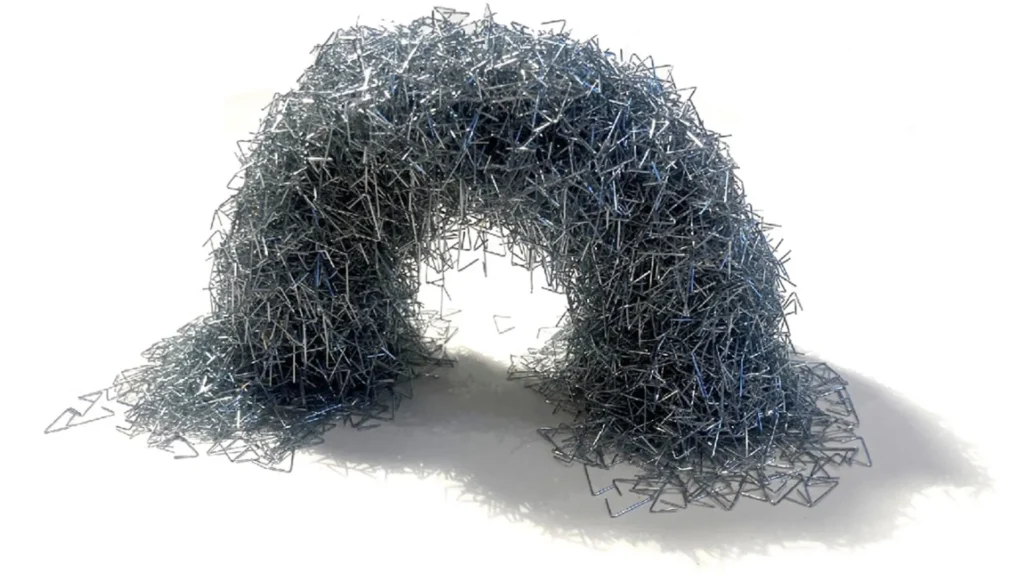
Following the rigorous phase of computational identification, the CU Boulder team moved to concrete experimentation, conducting "pickup tests" to directly observe the behavior of their promising particle designs under real-world conditions. The results were remarkably clear and conclusive: a "two-legged" particle, strikingly similar in form to a common office staple, consistently produced the highest degree of entanglement. This particular geometry emerged as the frontrunner, demonstrating an unparalleled ability to interlock and form cohesive structures.
What truly set this staple-like particle apart were its unexpected and highly beneficial characteristics. One of the most significant discoveries was its unique capacity to combine both high tensile strength and toughness – two properties that are notoriously difficult to achieve simultaneously in conventional materials. Tensile strength refers to a material’s ability to withstand forces that pull it apart, while toughness describes its capacity to absorb energy and deform plastically without fracturing. Typically, materials engineered for high strength often exhibit brittleness, lacking the ductility or energy absorption associated with toughness, and vice versa. The staple-like particles defied this conventional trade-off, presenting a material that could resist pulling forces while also being resilient to impact and deformation.
"Our entangled granular material using the staple-like particle demonstrates both high strength and toughness at the same time," confirmed PhD student Saeed Pezeshki, highlighting the groundbreaking nature of this dual performance. This paradoxical combination opens up vast new avenues for material design, potentially overcoming long-standing limitations in various engineering applications where both robust load-bearing capacity and resilience are crucial.
Beyond this impressive strength-toughness synergy, the staple-like particles exhibited another profoundly unusual characteristic: their dynamic reversibility. They possessed the ability to rapidly coalesce into a strong, solid-like structure and then, just as swiftly, separate and return to a loose, granular state. This controllable transformation is achieved through the precise application of different vibration patterns. Gentle, low-frequency vibrations were found to encourage the particles to interlock more tightly, strengthening the material and enhancing its cohesive properties. Conversely, stronger, higher-frequency vibrations caused the intricate network to unravel, allowing the particles to separate and the material to fluidize.
This exquisite control over the material’s state introduces a revolutionary dimension to its potential applications. Professor Barthelat captured the essence of this novelty, stating, "It’s a strange material because it’s obviously not a liquid. However, it’s also not quite solid. This opens new and intriguing engineering possibilities." He added, conveying the almost alien feel of this innovation, "Handling a bundle of these entangled particles feels very remote and exotic." This "not quite liquid, not quite solid" state positions these materials in a fascinating continuum, blurring traditional definitions and offering unprecedented functional adaptability. The ability to switch between a rigid, load-bearing state and a flexible, flowable state on demand could revolutionize everything from manufacturing processes to disaster response.
Broader Context: The Global Quest for Adaptive and Sustainable Materials
The research at CU Boulder arrives at a critical juncture in materials science, a field increasingly driven by the imperative to develop materials that are not only high-performing but also sustainable and adaptable to dynamic environments. Traditional manufacturing and construction practices often rely on materials with fixed properties, leading to significant waste, energy consumption, and environmental impact throughout their lifecycle. The global challenge of climate change, resource depletion, and the burgeoning circular economy movement have intensified the search for alternatives.
The global market for advanced materials, including smart and adaptive materials, is experiencing robust growth. Industry analyses frequently project this sector to reach multi-billion-dollar valuations within the next decade, driven by demand from aerospace, automotive, electronics, and medical industries. This growth is fueled by a desire for lighter, stronger, more durable, and increasingly "intelligent" materials that can respond to external stimuli, self-heal, or, as in the case of entangled particles, reversibly change their mechanical properties.
The concept of the circular economy, which advocates for minimizing waste and maximizing resource utility by designing products for durability, reuse, and recycling, provides a compelling backdrop for this research. Current demolition practices often result in vast quantities of landfill waste and significant carbon emissions. Materials that can be easily disassembled, recovered, and reassembled offer a pathway to drastically reduce this environmental footprint. The ability of staple-like particles to transition between solid and loose states makes them ideal candidates for materials that could support true circularity, moving beyond mere recycling to complete material recovery and reuse.
Transformative Applications: From Sustainable Construction to Adaptive Robotics
The potential applications stemming from this research are vast and transformative, touching upon critical sectors from urban infrastructure to advanced robotics. The CU Boulder team firmly believes their technology could fundamentally reshape how we approach construction, fostering more sustainable and environmentally responsible practices.
In the future, the very fabric of our built environment – bridges, buildings, and other monumental structures – might be composed of these entangled materials. Imagine a scenario where, instead of the destructive and resource-intensive process of demolition, structures could be "deconstructed." Entangled materials would allow components to be easily separated and disassembled at the end of their service life, rather than being crushed and carted away as waste. Such a paradigm shift would enable the complete reuse or full recycling of materials, significantly reducing landfill waste, conserving raw resources, and lowering the carbon footprint associated with construction and demolition. This concept aligns perfectly with the burgeoning principles of the circular economy, where materials are kept in use for as long as possible. The economic benefits are also substantial; reduced demolition costs, lower waste disposal fees, and the value retention of reusable components could lead to significant savings for municipalities and developers.
Beyond static structures, the dynamic nature of these materials holds immense promise for robotics. PhD student Saeed Pezeshki highlighted a fascinating application: "I was talking with other students who believe this technology can be used in swarm robotics – where small robots can entangle, do a task and then disentangle when they are done." This vision conjures images of autonomous systems capable of reconfiguring their physical form to adapt to various tasks or environments. Swarm robotics, where multiple simple robots cooperate to achieve complex goals, could be revolutionized by materials that allow individual units to temporarily fuse for increased strength or larger surface area, then separate to navigate tight spaces or distribute for broader coverage.
Professor Barthelat enthusiastically echoed this sentiment, drawing a captivating parallel: "Yes, kind of like that liquid metal T-1000 in Terminator 2 who can change shape to slide under a door and then transform back to a human’s size on the other side." While acknowledging the current technological and economic hurdles, he emphasized, "It’s expensive and scaling up is a challenge, but it’s something that’s on everybody’s mind." This vivid analogy underscores the aspiration for materials that exhibit unprecedented fluidity and adaptability, enabling robots to mimic biological organisms in their capacity for morphological change. Such capabilities could lead to breakthroughs in exploration (e.g., navigating complex planetary terrains), search and rescue operations (e.g., shape-shifting through debris), and even advanced manufacturing (e.g., self-assembling tools or reconfigurable factory floors).
Furthermore, the implications extend beyond these primary applications. One could envision adaptive medical implants that temporarily stiffen or soften based on biological cues, or smart protective gear that hardens on impact. Even temporary shelters or emergency infrastructure could be rapidly deployed and then just as easily packed away or reused. The military and aerospace sectors might also find value in materials that can dynamically adjust their properties for stealth, maneuverability, or impact resistance.
Challenges and the Path Forward: Refining the Design and Scaling Up
While the scientific promise of entangled granular materials is undeniably profound, the journey from laboratory discovery to widespread commercial application is invariably fraught with challenges. The CU Boulder team is keenly aware of these hurdles and is already proactively addressing the next phase of their research.
One of the most significant challenges lies in scaling up production. Manufacturing staple-like particles, especially with the precision required to ensure optimal interlocking, at an industrial scale will necessitate innovative engineering and cost-effective fabrication methods. Current micro- and nano-fabrication techniques can be expensive and slow, making them impractical for producing materials in the quantities needed for construction or even large-scale robotics. Researchers will need to explore new manufacturing paradigms, potentially leveraging advanced additive manufacturing (3D printing) or self-assembly processes, to bring down costs and increase throughput.
Another critical consideration is material composition and durability. While the focus has been on geometry, the choice of base material for the particles will impact their long-term performance, resistance to environmental factors (e.g., corrosion, UV degradation), and overall lifecycle. Developing materials that can withstand repeated cycles of entanglement and disentanglement without degradation will be crucial for practical applications.
The team is currently moving into the next, exciting stage of their research, directly tackling the challenge of enhancing entanglement further. Their latest experiments are centered on a new particle design that incorporates additional protruding "legs." The researchers draw a relatable analogy for this advanced shape: the spiky burrs commonly found in nature that cling stubbornly to shoes and clothing outdoors. These natural burrs demonstrate an extraordinary ability to attach and intertwine with other fibers due to their complex, multi-point contact geometry. By mimicking this natural design, the researchers believe these added features in their synthetic particles could create even stronger entanglement effects. This enhanced interlocking capability could unlock new possibilities for future materials, leading to even greater strength, toughness, and perhaps more nuanced control over the reversible properties. This iterative design process, continuously drawing inspiration from nature, is a testament to the dynamic and evolving nature of materials science.
A Concluding Outlook: Redefining the Fabric of Our World
The research emerging from the Paul M. Rady Department of Mechanical Engineering at CU Boulder represents a significant leap forward in our understanding and manipulation of granular materials. By unlocking the secrets of entanglement through ingeniously designed staple-shaped particles, the team has not only revealed a paradox of material behavior but also laid the groundwork for a new class of adaptive, sustainable, and highly functional materials.
This work challenges conventional notions of what a solid material can be, pushing the boundaries towards a future where structures can dynamically adapt, where waste is minimized through inherent recyclability, and where robots possess unprecedented flexibility. While practical implementation will require overcoming considerable engineering and economic hurdles, the vision of Barthelat, Sohn, Pezeshki, and their colleagues points towards a future where the very fabric of our built environment and our technological tools are inherently more intelligent, more efficient, and more harmonious with the natural world. The "strange material" they have discovered is poised to redefine our interaction with the physical world, promising innovations that are as profound as they are practical.