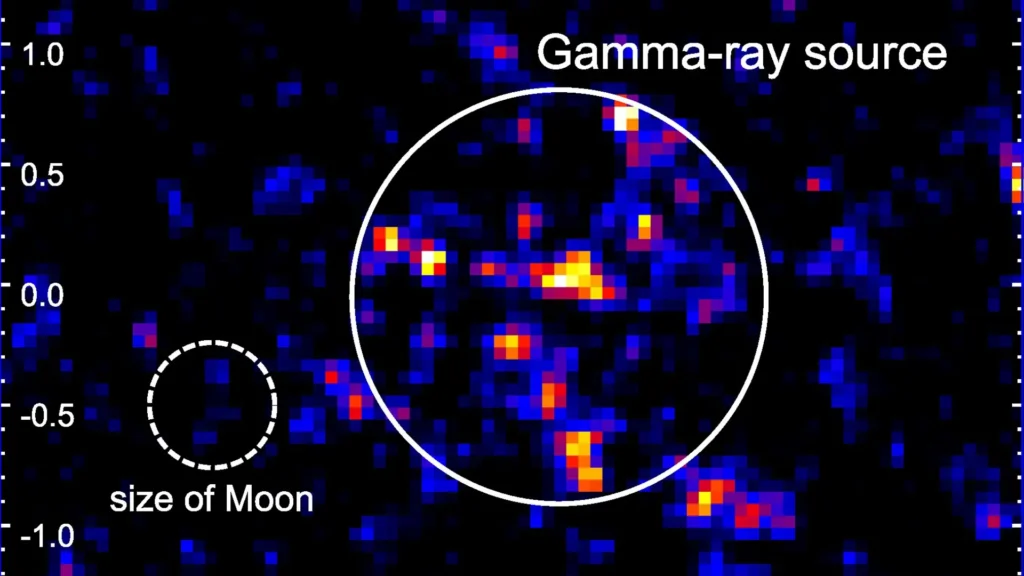
An international consortium of researchers has definitively identified a celestial object within the Milky Way galaxy that functions as a natural particle accelerator, propelling protons to energy levels that dwarf the capabilities of the most advanced human-engineered facilities. This landmark discovery, centered on the source known as LHAASO J1912+1014u, provides a critical missing link in the century-long effort to understand the origins of cosmic rays—the high-speed particles that permeate the interstellar medium and influence the chemical and physical evolution of our galaxy. Led by a team from Hiroshima University, the study utilized a sophisticated multi-instrument approach, combining data from ground-based observatories and space-borne telescopes to solve a mystery that has long challenged the limits of modern astrophysics.
The findings, published in the July 16, 2026, edition of The Astrophysical Journal, confirm that LHAASO J1912+1014u is a "proton PeVatron." This term refers to a natural engine capable of accelerating protons to energies exceeding one quadrillion (10^15) electron volts, or one peta-electron volt (PeV). While scientists have long theorized that such accelerators must exist within our galaxy to account for the observed spectrum of cosmic rays, distinguishing these proton-driven engines from those powered by high-energy electrons has historically proven to be an immense technical hurdle.
The Nature and Significance of Cosmic Rays
Cosmic rays are not rays in the traditional sense of light or radiation; rather, they are subatomic particles—primarily protons (the nuclei of hydrogen atoms), with a smaller percentage of helium nuclei and electrons—traveling through space at nearly the speed of light. Since their discovery in 1912 by Victor Hess, these particles have fascinated scientists because of their extraordinary kinetic energy.
To put the scale of a PeVatron into perspective, one must look at the Large Hadron Collider (LHC) on the border of Switzerland and France. As the world’s most powerful human-made particle accelerator, the LHC can boost protons to energies of approximately 6.5 to 7 tera-electron volts (TeV). A PeVatron, however, operates at energies at least 100 to 150 times greater than the LHC. Understanding how nature achieves such extreme acceleration is fundamental to plasma physics and high-energy astrophysics.
"This immense energy makes cosmic rays important in astronomy and astrophysics," explained Tsunefumi Mizuno, an associate professor at Hiroshima University’s Hiroshima Astrophysical Science Center and the lead author of the study. According to Mizuno, finding a proton PeVatron is one of the most sought-after goals in the field, as it helps explain the "knee" in the cosmic ray spectrum—a specific energy point where the intensity of cosmic rays arriving at Earth begins to drop off, suggesting a limit to what galactic sources can produce.
The Search for the Smoking Gun: Protons vs. Electrons
The primary difficulty in identifying a PeVatron lies in the ambiguity of the signals detected by telescopes. When high-energy particles interact with their environment, they produce gamma rays, the most energetic form of light. However, both high-energy protons and high-energy electrons can produce gamma rays, albeit through different physical processes.
Protons produce gamma rays through hadronic interactions—specifically, when a high-speed proton strikes a stationary atom in an interstellar gas cloud, creating a neutral pion that subsequently decays into two gamma rays. Electrons, conversely, produce gamma rays through leptonic processes, such as Inverse Compton scattering (where an electron transfers energy to a low-energy photon) or Bremsstrahlung (radiation emitted when an electron is deflected by an atomic nucleus).
To confirm a source as a proton PeVatron, researchers must prove that the observed gamma rays result from proton collisions rather than electron interactions. This requires a "multiwavelength" approach—observing the source across the entire electromagnetic spectrum, from radio waves and X-rays to high-energy gamma rays.
A Decades-Long Chronology of Discovery
The identification of LHAASO J1912+1014u is the culmination of decades of incremental progress in high-energy gamma-ray astronomy. The timeline of this discovery reflects the evolution of the technology required to peer into the highest energy corners of the universe:
- 1990: The Tibet AS gamma experiment, a collaboration between Japan and China, begins operations. It set the stage for detecting ultra-high-energy gamma rays from the ground by measuring the "air showers" created when cosmic rays hit the Earth’s atmosphere.
- 2008: NASA launches the Fermi Gamma-ray Space Telescope, carrying the Large Area Telescope (LAT). Hiroshima University played a key role in the development of this instrument, which provides a wide-field view of the sky in the giga-electron volt (GeV) range.
- 2021: The Large High Altitude Air Shower Observatory (LHAASO) in China begins reporting a new class of "ultra-high-energy" gamma-ray sources, those exceeding 0.1 PeV (100 TeV).
- 2024: LHAASO J1912+1014u is officially cataloged. Located in the constellation Aquila near the bright star Altair, it was initially suspected to be a supernova remnant (SNR)—the expanding shell of debris from a stellar explosion.
- 2025-2026: The research team led by Mizuno integrates data from Fermi-LAT, LHAASO, the Chandra X-ray Observatory, and the Nobeyama radio telescope to conduct a comprehensive analysis of the source.
The Three Arrows: A Multiwavelength Strategy
Mizuno utilized a metaphor from Japanese folklore to describe the team’s methodology: "One arrow is easy to break, but three arrows bundled together are not." In this context, the "three arrows" represented three distinct types of data that, when combined, provided an unbreakable case for the proton PeVatron.
The First Arrow: Fermi-LAT GeV Data
The Fermi Large Area Telescope provided observations in the giga-electron volt range. The researchers found that the gamma-ray signal from LHAASO J1912+1014u extended in a smooth, continuous power law from 400 MeV all the way up to over 100 TeV. This spectral continuity is a hallmark of proton acceleration. If electrons were the primary drivers, the spectrum would typically show a "cutoff" or a change in shape at lower energies due to the way electrons lose energy through radiation.
The Second Arrow: FUGIN Radio Observations
The FOREST Unbiased Galactic plane Imaging survey (FUGIN), conducted with the Nobeyama 45-meter telescope in Japan, provided high-resolution radio maps of interstellar gas. The researchers discovered that the spatial distribution of the GeV gamma rays detected by Fermi-LAT almost perfectly matched the distribution of molecular gas clouds in the region. This correlation is a "smoking gun" for hadronic interactions; it shows that the gamma rays are being produced exactly where high-energy protons are slamming into dense pockets of gas.
The Third Arrow: Chandra X-ray Data
NASA’s Chandra X-ray Observatory provided the final piece of the puzzle. High-energy electrons moving through magnetic fields produce "synchrotron radiation" in the X-ray band. When the researchers looked at LHAASO J1912+1014u with Chandra, they found only very weak, diffuse X-ray emissions. The absence of strong X-ray signals allowed the team to rule out a model dominated by electrons, as any electron population capable of producing the observed gamma rays would have inevitably produced much brighter X-rays.
Implications for the Future of Astrophysics
The confirmation of LHAASO J1912+1014u as a proton PeVatron has profound implications for our understanding of the "Galactic Engine." For decades, supernova remnants have been the leading candidates for the source of galactic cosmic rays. However, most observed SNRs do not seem to possess the magnetic field strength necessary to accelerate protons to PeV levels. The discovery of J1912+1014u suggests that either certain types of SNRs are more powerful than previously thought, or that other objects—such as pulsar wind nebulae or massive star-forming regions—are contributing to the PeV-scale flux.
The study also provides a roadmap for future discoveries. There are currently dozens of other unidentified ultra-high-energy sources detected by LHAASO and the Tibet AS gamma experiment. By applying the same "three arrows" methodology, the scientific community can begin to catalog the PeVatrons of the Milky Way, eventually building a complete map of where and how the galaxy’s most energetic particles are born.
"This research is achieved by team effort," Mizuno emphasized, noting the contributions of co-authors from Gifu University, Miyazaki University, and the University of Würzburg. The collaboration involves a massive international infrastructure, supported by funding agencies including NASA, the U.S. Department of Energy, and Japan’s MEXT and JSPS.
As the scientific community moves forward, the focus will shift toward characterizing the specific mechanisms of acceleration. Whether the energy is derived from the shockwaves of a supernova or the intense magnetic environment of a rapidly rotating neutron star, the identification of LHAASO J1912+1014u marks a definitive end to the era of speculation and the beginning of a new chapter in high-energy particle astrophysics. The "natural accelerators" of the Milky Way are finally coming into focus, revealing a galaxy far more violent and energetic than the serene band of light visible to the naked eye.