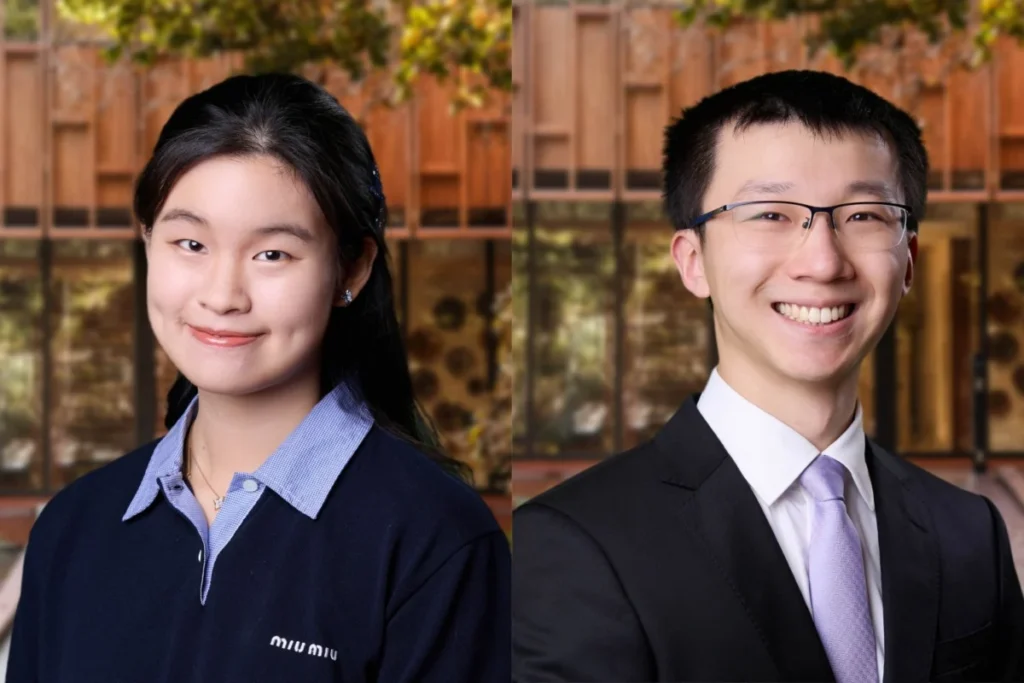
The Massachusetts Institute of Technology (MIT) has announced that two of its distinguished students, Sunshine Jiang and Rupert Li, have been selected as recipients of the 2024–2025 Knight-Hennessy Scholarship. Now entering its ninth year, the Knight-Hennessy Scholars program is one of the most competitive and prestigious graduate fellowships in the world, providing full financial support for up to three years of graduate study at Stanford University. This year’s selection reinforces MIT’s long-standing reputation for producing scholars who not only excel in technical and theoretical rigors but also demonstrate a profound commitment to leadership and social impact.
The Knight-Hennessy Scholarship was established in 2016 through a $400 million endowment from Phil Knight, the co-founder of Nike, and is named in honor of John L. Hennessy, the former president of Stanford University and current chairman of Alphabet Inc. The program aims to prepare a new generation of global leaders to address the increasingly complex challenges facing society through multidisciplinary collaboration and innovation. Jiang and Li join a cohort of scholars chosen from thousands of applicants globally, representing a diverse array of academic disciplines and cultural backgrounds.
Profile in Excellence: Sunshine Jiang and the Future of Embodied AI
Sunshine Jiang, a native of Hangzhou, China, represents the quintessential MIT polymath. Graduating in 2025 with a Bachelor of Science as a double major in Physics and Electrical Engineering and Computer Science (EECS), Jiang also completed minors in Mathematics and Economics. This multi-disciplinary foundation has been instrumental in her research into embodied artificial intelligence (AI) and robotics. Jiang is set to receive her Master of Engineering degree this month, after which she will transition to the Stanford School of Engineering to pursue a PhD in Computer Science.
Jiang’s research focus is at the cutting edge of modern technology: developing data-efficient, adaptive systems for general-purpose robots. Unlike traditional industrial robots that are programmed for specific, repetitive tasks in controlled environments, Jiang’s work aims to create "embodied AI"—systems that can learn from their physical surroundings and adapt to new, unpredictable scenarios. This research is vital for broadening the accessibility of robotics, moving the technology from high-cost manufacturing plants into everyday life and assistive roles.
Her contributions to the field have already gained international recognition. Jiang has presented her findings at several of the world’s most prestigious academic forums, including the Conference on Robot Learning (CoRL), the International Conference on Robotics and Automation (ICRA), and the International Conference on Learning Representations (ICLR). These venues are known for their rigorous peer-review processes, and for an undergraduate and master’s student to be featured prominently underscores the significance of her work.
Beyond the laboratory, Jiang has demonstrated a deep commitment to social equity and cultural preservation. She spearheaded the development of AI-powered systems designed to bring traditional Chinese art to rural classrooms, bridging the gap between high technology and traditional heritage. Additionally, she founded cross-country programs aimed at expanding STEM (science, technology, engineering, and mathematics) education access for girls, addressing the gender disparity in technical fields. Her versatility was further showcased during the pandemic when she created a documentary on the impact of Covid-19, amplifying community voices. The film received national attention and was featured on China Daily, highlighting her ability to use media as a tool for social observation.
Profile in Excellence: Rupert Li’s Mathematical Leadership
Rupert Li, hailing from Portland, Oregon, has established himself as one of the most promising young mathematicians of his generation. Li’s academic journey at MIT was marked by an extraordinary breadth of study; he graduated in 2024 with a double major in Mathematics and a combined degree in Computer Science, Economics, and Data Science. Simultaneously, he earned a Master’s degree in Data Science from MIT.
Following his graduation from MIT, Li was awarded the Marshall Scholarship, one of the most selective academic honors in the United States, which funded his graduate studies in the United Kingdom. He recently completed a Master’s degree in Mathematics from the University of Cambridge, an institution renowned for its historical and contemporary contributions to the field. Li is currently pursuing his PhD in Mathematics at the Stanford School of Humanities and Sciences, where the Knight-Hennessy Scholarship will support his continued research.
Li’s primary research interests involve probability, discrete geometry, and combinatorics—fields that form the backbone of modern computer science and statistical physics. His work often explores the underlying structures of complex systems, seeking to find order and predictability in seemingly random processes.
However, Li is perhaps equally well-known for his dedication to the mathematical community. He has served as a mentor for MIT PRIMES-USA, a national research program that pairs high school students with university researchers to work on unsolved problems in mathematics. He also served as an advisor for the Duluth Research Experience for Undergraduates (REU), widely considered the most prestigious undergraduate math research program in the United States.
The Knight-Hennessy Scholarship is the latest in a long list of accolades for Li. He is a recipient of the Hertz Fellowship, the P.D. Soros Fellowship for New Americans, and the Goldwater Scholarship. Furthermore, he received an honorable mention for the Frank and Brennie Morgan Prize, which is awarded annually to an undergraduate student in North America for outstanding research in mathematics.
A Chronology of Academic Achievement
The path to the Knight-Hennessy Scholarship for both Jiang and Li is characterized by a consistent trajectory of high-level academic performance and leadership.
- 2020–2021: Both students began their undergraduate careers at MIT during a period of global upheaval caused by the pandemic. Despite these challenges, they maintained a rigorous focus on their respective dual majors.
- 2022–2023: Jiang began presenting her robotics research at international conferences (ICRA and ICLR), while Li was recognized with the Goldwater Scholarship and began his intensive mentorship roles.
- 2024: Li graduated from MIT with two degrees and moved to the University of Cambridge as a Marshall Scholar. Jiang continued her integrated Master’s program at MIT while expanding her STEM outreach programs.
- 2025: Jiang completes her Master of Engineering at MIT. Both scholars are officially inducted into the ninth cohort of Knight-Hennessy Scholars as they prepare for or continue their doctoral studies at Stanford.
The Significance of the Knight-Hennessy Scholarship
The Knight-Hennessy Scholarship is more than a financial award; it is a community-driven program designed to foster collaboration across disciplines. Scholars reside at Denning House on the Stanford campus, a dedicated space for the cohort to engage in "King Global Leadership Program" workshops, lectures, and social events.
Supporting data reveals the competitiveness of the program. While Stanford does not always release exact acceptance rates for the Knight-Hennessy program, it is estimated to be below 2%, given that thousands of applicants from over 60 countries vie for approximately 70 to 80 spots each year. The selection criteria emphasize three primary traits: independence of thought, purposeful leadership, and a civic mindset.
For MIT, the success of Jiang and Li reflects the institute’s "mens et manus" (mind and hand) philosophy. Both scholars have moved beyond theoretical excellence to apply their knowledge to real-world problems—Jiang through robotics and social documentaries, and Li through high-level mentorship and complex problem-solving.
Broader Impact and Implications
The inclusion of scholars like Jiang and Li in the Knight-Hennessy program has significant implications for the future of their respective fields.
In the realm of Artificial Intelligence, Jiang’s focus on data-efficient robotics is critical. As the world moves toward more autonomous systems, the ability for robots to learn with less data and more adaptability is essential for sustainability and safety. Her work could lead to breakthroughs in how we deploy robots in disaster relief, healthcare, and domestic environments. Furthermore, her focus on accessibility ensures that the benefits of the AI revolution are not restricted to wealthy urban centers but can reach rural and underserved populations.
In Mathematics, Li’s research in combinatorics and probability provides the theoretical framework necessary for the next generation of algorithms and data analysis tools. As big data becomes increasingly central to governance, economics, and science, the work of mathematicians like Li ensures that these systems are built on robust, well-understood logical foundations. His role as a mentor also addresses the "leaky pipeline" in STEM, ensuring that younger students are encouraged and guided into high-level research careers.
The ongoing partnership between elite institutions like MIT and Stanford, facilitated by programs like Knight-Hennessy, creates a powerful pipeline of innovation. By funding the transition of top-tier talent from the East Coast’s premier engineering school to the West Coast’s leading research university, the scholarship helps maintain the United States’ edge in global scientific and technological competition.
As Sunshine Jiang and Rupert Li embark on their respective PhD journeys at Stanford, they carry with them the interdisciplinary spirit of MIT and the leadership mandate of the Knight-Hennessy program. Their future contributions are expected to resonate well beyond the ivory tower, influencing both the technological landscape and the social fabric of the decades to come.