The relentless friction between a vehicle’s tyres and the asphalt beneath them, a fundamental mechanism for safe road travel, has long presented a complex dilemma for tyre manufacturers. While wear is an inevitable consequence of this interaction, excessive tyre degradation is not only a drain on consumer finances but also a significant contributor to a pervasive environmental concern: the generation of microscopic particulates. These airborne particles, shed from both the tyre and the road surface, represent a growing emissions challenge that regulators and industry leaders are increasingly prioritizing. The very forces that enable a tyre to grip the road and facilitate crucial functions like braking and steering inherently lead to material loss, creating a delicate balancing act between performance, longevity, and environmental responsibility. As the automotive industry navigates stricter emissions standards and growing public awareness of non-exhaust particulate matter (PM), major players like Continental and Michelin are intensifying their research efforts, deploying sophisticated technologies to understand, quantify, and ultimately mitigate the impact of tyre wear particles.
The intricate nature of tyre wear extends far beyond simple abrasion. Continental, a leading global tyre manufacturer, highlights that while the direct contact between the tyre’s footprint and the road surface is the most obvious culprit, a multitude of interconnected factors contribute to the generation of tyre and road wear particles (TRWPs). According to Continental and the European Tyre and Rim Technical Organisation (ETRTO), these influencing factors, ranked by their increasing impact on wear, encompass a broad spectrum. Weather conditions, for instance, can significantly affect rubber properties and road surface integrity. Temperature fluctuations can alter the elasticity of the tyre compound, influencing its susceptibility to wear. The inherent design of a tyre, including its tread pattern, compound formulation, and structural integrity, plays a critical role. The vehicle itself, its weight, its suspension system, and the torque applied to the wheels, all contribute to the forces exerted on the tyres. The condition and composition of the road surface, whether it is smooth asphalt, coarse gravel, or worn concrete, directly impacts the rate of wear. The topology of the route, characterized by inclines, declines, and cornering intensity, further exacerbates wear. However, the most significant determinant, consistently identified by industry experts, is driving behaviour. Aggressive acceleration, hard braking, and sharp cornering dramatically increase the forces acting on the tyres, leading to accelerated wear and higher particle emissions.
The Regulatory Imperative and Industry Response
The growing recognition of TRWPs as a substantial source of air pollution has spurred regulatory bodies to take action. The European Union, in particular, is at the forefront of this movement, with the forthcoming Euro 7 emissions regulations poised to introduce specific limits on tyre wear emissions. Expected to be implemented from 2028, these regulations will place significant pressure on tyre manufacturers to develop solutions that not only meet performance demands but also demonstrably reduce particulate shedding. This regulatory deadline has acted as a powerful catalyst, accelerating years of research and development within the tyre industry. Major global tyre manufacturers, including Continental and Michelin, have been diligently studying the complex phenomenon of tyre wear for years, recognizing its multifaceted implications for both product performance and environmental sustainability. The challenge lies in developing tyres that offer optimal grip, durability, and fuel efficiency while simultaneously minimizing the release of harmful particulates into the atmosphere.
Advanced Sensing and Analysis: Unveiling the Origin of Particles
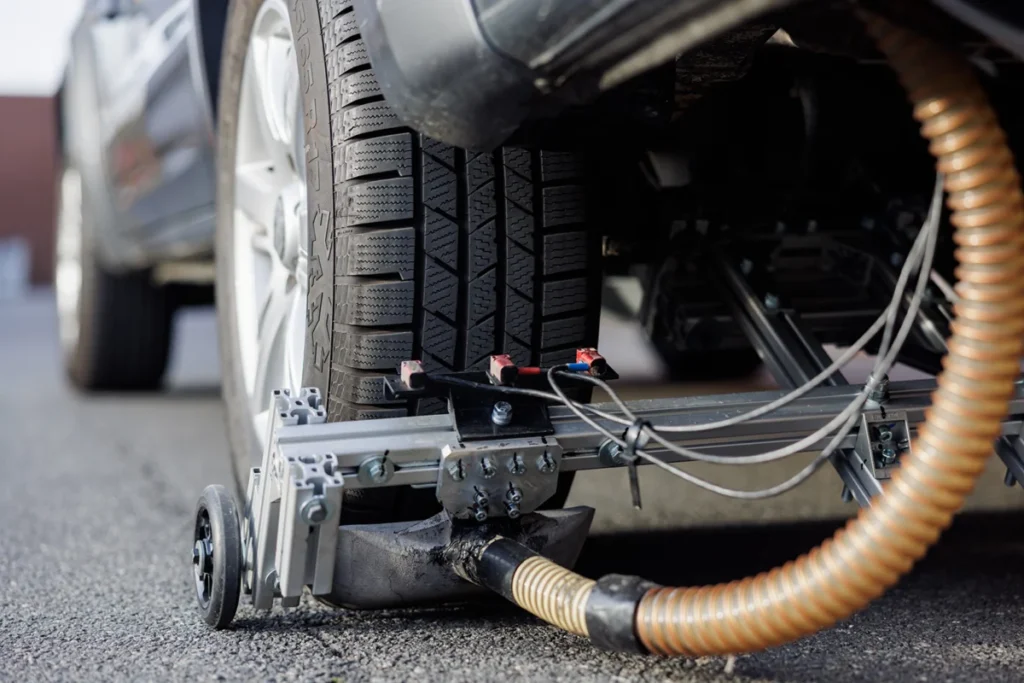
In response to these escalating challenges, innovative technological solutions are emerging. Michelin, in 2024, publicly detailed its advancements in vacuum systems designed to meticulously measure small emitted particles directly from tyres. More recently, Continental has provided insights into a significant project completed at the end of last year, codenamed ‘Online analysis of airborne tyre wear particles at the point of origin and differentiation from other sources’ (OLRAP). This sophisticated system represents a paradigm shift in understanding tyre wear emissions.
The OLRAP system, at its core, employs a vacuum device strategically mounted at road level, directly behind a driven wheel. Its primary function is to actively capture airborne particles generated during vehicle operation. This vacuum mechanism works in conjunction with advanced particle sensors, capable of detecting even the finest airborne particulates emanating from the wheels. Crucially, the system possesses the intelligence to differentiate the source of these particles, discerning whether they originate from the tyres, the road surface, or the vehicle’s braking system. This granular level of analysis is vital for targeted mitigation strategies.
The data gathered by the OLRAP system is not analyzed in isolation. It is meticulously correlated with a comprehensive array of other relevant factors. These include real-time driving dynamics, such as acceleration, braking, and cornering forces, as well as the prevailing surface conditions and weather patterns. By integrating these diverse data streams, researchers can build a holistic picture of the conditions that contribute to particle generation. This holistic approach allows for a more accurate assessment of the impact of different driving styles, road types, and environmental variables on tyre wear and subsequent emissions.
Technological Evolution: From Measurement to Material Optimization
Continental’s commitment to tackling tyre wear extends to its collaboration with the Technical University of Braunschweig. This partnership has yielded a technique for accurately measuring tyre wear and quantifying the generation of airborne particles with unprecedented precision. The data collected by these advanced systems encompasses critical details about the quantity, size, and structural characteristics of the emitted particles. This rich dataset is then fed directly back into Continental’s tyre development programs.
This iterative process of data collection, analysis, and application allows for the highly precise optimization of tyre design and compound formulation. By understanding the precise nature of the particles generated under various conditions, engineers can fine-tune rubber mixtures and tread designs to reduce wear rates and minimize the release of harmful microplastics and other particulate matter. The goal is to create tyres that are not only safer and more durable but also significantly more environmentally benign.
The ‘Multisampler Device’: Capturing Specific Driving Scenarios
Further enhancing the analytical capabilities, Continental has developed a sophisticated ‘multisampler device’. This innovative tool enables the capture of particles associated with specific types of driving maneuvers. For instance, it can differentiate particles collected during cornering from those generated while driving in a straight line. This granular distinction is crucial for identifying the unique wear characteristics associated with different driving styles and road conditions.
The research team has reported identifying clear correlations between particle concentration and speed profiles, as well as the pronounced effect of longitudinal and lateral acceleration on tyre wear. This empirical evidence underscores the significant role of driving behaviour in particle generation and provides valuable insights for developing driver education programs aimed at promoting more sustainable driving practices. By understanding these relationships, manufacturers can also design tyres that are more resilient to the stresses of aggressive driving, further contributing to reduced wear.
The Unavoidable Trade-off: Safety and Performance
Despite the intensive efforts to reduce particulate emissions from tyre and road wear, a fundamental principle remains paramount: safety. As Continental rightly emphasizes, the primary function of a tyre is to "transfer vehicle forces." This capability is intrinsically linked to the concept of grip, which is achieved through friction between the tyre and the road surface. This friction, while essential for safe braking, steering, and acceleration, inevitably leads to the wear of both the tyre and the road. A certain level of wear is therefore unavoidable to ensure that safety-critical features of the vehicle remain uncompromised.
The challenge for engineers and material scientists lies in finding the optimal balance. Reducing particulate levels must not come at the expense of compromised tyre performance, particularly in wet conditions or during emergency maneuvers. The development of advanced tyre compounds that offer superior grip with reduced wear rates is a key area of ongoing research. Furthermore, advancements in tyre construction and tread design are being explored to distribute forces more evenly, thereby reducing localized stress points that can accelerate wear.
Broader Implications and Future Outlook
The implications of these advancements in tyre wear analysis and mitigation are far-reaching. Beyond meeting regulatory requirements, the drive for reduced particle emissions has the potential to significantly improve urban air quality. TRWPs are a major component of non-exhaust emissions, which are increasingly recognized as a significant contributor to particulate pollution in cities, impacting respiratory health and contributing to environmental degradation.
The ongoing research also holds the promise of extended tyre life, leading to economic benefits for consumers through reduced replacement costs. Moreover, a deeper understanding of tyre-road interaction could lead to innovations in road surfacing materials and maintenance strategies that also contribute to reduced wear.
As the Euro 7 regulations loom and public awareness of environmental issues continues to grow, the tyre industry is entering a new era of innovation. The sophisticated technologies being developed for particle capture and analysis are not merely compliance tools; they are fundamental to reimagining tyre design and manufacturing for a more sustainable future. The collaborative efforts between tyre manufacturers, research institutions, and regulatory bodies signal a strong commitment to addressing this complex environmental challenge head-on, ensuring that the journey towards cleaner air does not compromise the safety and performance we rely on every day. The future of tyre technology will undoubtedly be shaped by the pursuit of this delicate equilibrium between the forces that move us and the environment we inhabit.