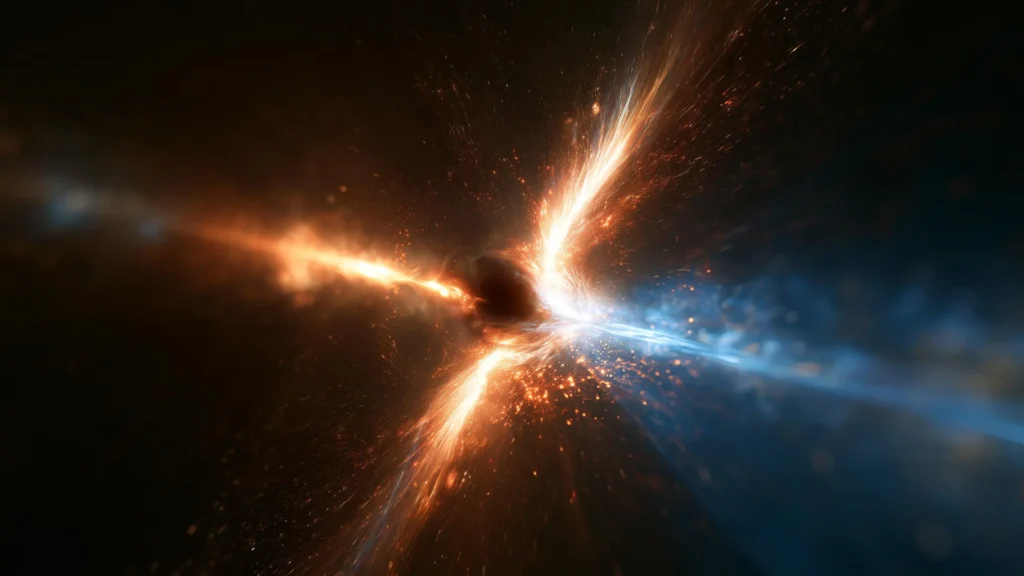
Physicists at the University of California, Santa Barbara (UCSB) have significantly expanded the parameters of the search for microscopic black holes, utilizing the immense data-gathering capabilities of the Large Hadron Collider (LHC) at the European Center for Nuclear Research (CERN). This research, conducted within the framework of the Compact Muon Solenoid (CMS) experiment, represents a sophisticated attempt to bridge the gap between quantum mechanics and general relativity—the two pillars of modern physics that remain stubbornly unreconciled. By analyzing trillions of high-energy particle collisions, the team has established new "exclusion limits," effectively narrowing the field where these exotic phenomena might exist and providing a roadmap for the next generation of particle physics experiments.
The search for microscopic black holes is not merely a quest for an exotic astronomical curiosity; it is a fundamental inquiry into the fabric of the universe. Unlike the gargantuan black holes found at the centers of galaxies, which are formed by the gravitational collapse of massive stars, the hypothetical black holes sought at the LHC would be extraordinarily small and short-lived. Their existence is predicted by certain theoretical models that involve extra spatial dimensions—concepts central to string theory. If these tiny voids in spacetime could be produced and detected, they would offer the first direct evidence of quantum gravity, potentially unifying the four fundamental forces of nature: electromagnetism, the strong nuclear force, the weak nuclear force, and gravity.
The Quest for Quantum Gravity and the Hierarchy Problem
At the heart of this research lies the "hierarchy problem," one of the most persistent mysteries in fundamental physics. The problem stems from the staggering disparity between the strength of gravity and the other fundamental forces. For example, a simple refrigerator magnet can overcome the entire gravitational pull of the Earth to lift a paperclip. This suggests that gravity is trillions of times weaker than electromagnetism. In the Standard Model of particle physics, this discrepancy is difficult to explain without fine-tuning the theory to an improbable degree.
One proposed solution involves the existence of extra spatial dimensions beyond the three we perceive (length, width, and height) and the one dimension of time. Theoretical models, such as those proposed by UCSB theorist Steven Giddings and others, suggest that gravity might appear weak because its strength is "leaking" into these hidden dimensions. If these dimensions exist and are large enough, the fundamental scale of gravity—known as the Planck scale—could be much lower than previously thought, potentially within the energy reach of the LHC.
"Basically, the gravitational force gets stronger, faster, as you go to shorter distances," explained Giddings. If gravity becomes sufficiently strong at the tiny distance scales probed by the LHC, the energy of colliding protons could be compressed into a volume small enough to trigger the formation of a quantum black hole.
Methodology: Probing the Energy Frontier
The Large Hadron Collider, located in a 27-kilometer tunnel beneath the Franco-Swiss border, is the world’s most powerful particle accelerator. It smashes protons together at velocities nearing the speed of light, creating conditions similar to those that existed just fractions of a second after the Big Bang. The CMS experiment, one of the two general-purpose detectors at the LHC, acts as a massive, 14,000-ton digital camera, capturing the debris of these collisions to look for signatures of new physics.
To search for microscopic black holes, the UCSB team, including postdoctoral researcher Tamas Vami and graduate researcher Danyi Zhang, analyzed data collected by the CMS detector between 2016 and 2018. The search focused on two primary signatures:
- Sphericity: When a microscopic black hole forms, it is expected to evaporate almost instantaneously through a process known as Hawking radiation. This decay would produce a "spherical" burst of particles flying out in all directions, a distinct pattern compared to the "jets" of particles typically seen in standard proton collisions.
- Total Transverse Energy: Because black holes are high-energy objects, their decay products should carry a significant amount of total energy. By summing the energy of all particles produced in a collision, researchers can identify "high-mass" events that might signal the presence of a black hole.
Advanced Analytics: Machine Learning at the Energy Frontier
A significant contribution of the UCSB study was the implementation of a new analytical technique known as "phase-space distance." Developed by UCSB particle theorist Nathaniel Craig and his collaborators, this method utilizes a Support Vector Machine (SVM)—a type of supervised machine learning algorithm—to distinguish potential signals from the overwhelming background noise of standard particle interactions.
In physics, "phase space" is a mathematical framework that describes all possible states of a system, incorporating variables such as position, momentum, and energy. The SVM was trained to recognize the specific "shape" of a black hole decay within this multi-dimensional space. By calculating the distance between observed events and the predicted signal in phase space, the researchers could assign an "SVM score" to each collision. Events with higher scores represented a closer match to the theoretical profile of a quantum black hole.
"We compared phase space distance with the sphericity variable, and our conclusion is that phase space distance outperforms sphericity," noted Danyi Zhang. This study marks the first time this specific machine learning approach has been applied to LHC data analysis, providing a new tool for future searches for rare and exotic particles.
Interpreting the Null Result: The Value of Exclusion
The analysis of the 2016-2018 dataset did not reveal evidence of microscopic black holes. However, in the realm of high-energy physics, a "null result" is far from a failure. Instead, it provides what is known as an "exclusion limit."
The team’s findings, published in the journal Progress in High Energy Physics (PHEP), indicate that quantum black holes are unlikely to exist at energy levels up to approximately 12 Tera-electron volts (TeV). This result constrains various theoretical models, including those involving extra dimensions. For instance, while string theory often requires ten dimensions, the parameters tested in this study suggest that certain configurations with more than two extra dimensions are ruled out at these specific energy scales.
"Theories don’t predict one exact answer," Zhang explained. "They predict a whole range of places a particle could be hiding. Each search clears out part of that range and says ‘not here,’ and over time the map of where new physics could still be, shrinks." This process of elimination is a cornerstone of the scientific method, famously exemplified by the decades-long search for the Higgs boson, which was eventually discovered in 2012 after years of excluding other energy ranges.
Investigating the Matter-Antimatter Asymmetry
The UCSB researchers extended their analysis to another profound mystery: the matter-antimatter asymmetry problem. Standard cosmological theory suggests that the Big Bang should have produced equal amounts of matter and antimatter. Since the two annihilate each other upon contact, the universe should have consisted of nothing but pure energy. The fact that we inhabit a universe made of matter suggests a fundamental imbalance occurred in the early universe.
The team searched for evidence of "sphalerons"—theoretical, non-particle configurations of fields that could facilitate transitions between different types of subatomic particles. Like quantum black holes, sphalerons would produce spherical energy signatures. Detecting them could explain how matter came to dominate over antimatter. While no evidence of sphalerons was found, the study allowed physicists to set new upper limits on the frequency of these processes, further refining our understanding of early-universe dynamics.
Safety and Public Perception
The prospect of creating black holes on Earth has historically sparked public concern, with some fearing that such objects might be stable and eventually "consume" the planet. However, the scientific community has repeatedly addressed these concerns through rigorous safety reports.
Quantum black holes, if they exist, are predicted to be governed by the laws of quantum mechanics, meaning they would evaporate via Hawking radiation in roughly $10^-27$ seconds. Furthermore, Earth is constantly bombarded by ultra-high-energy cosmic rays from space. These naturally occurring collisions occur at energies far exceeding those reached at the LHC and have been happening for billions of years without creating stable black holes. This empirical evidence confirms that high-energy particle collisions do not pose a catastrophic threat.
The Road to High-Luminosity: The Next Frontier
As the LHC continues its mission, the search for new physics is entering a more intensive phase. The accelerator is currently undergoing upgrades to become the "High-Luminosity LHC" (HL-LHC). This upgrade will significantly increase the number of collisions, providing researchers with a much larger dataset to analyze.
With more data, physicists can search for even rarer events and probe higher energy scales with greater precision. For the team at UC Santa Barbara, the recent study is a foundational step toward these future endeavors. The validation of the phase-space distance method ensures that when the HL-LHC begins its next run, researchers will have more powerful, machine-learning-enhanced tools to sift through the data.
"The best guide is experimental data," said Steven Giddings. "Theorists will continue to generate ideas, but it is difficult to progress without experimental confirmation."
The search conducted by Vami, Zhang, and Incandela reinforces the role of the LHC as a premier laboratory for testing the limits of the Standard Model. While microscopic black holes remain hypothetical for now, the rigorous exclusion of their existence at current energy levels brings physicists one step closer to understanding the ultimate nature of gravity and the architecture of the cosmos. Whether the answer lies in extra dimensions, undiscovered symmetries, or a completely new framework of physics, the path forward is paved by the systematic elimination of the impossible, leaving behind only the truth of how the universe functions at its most fundamental level.