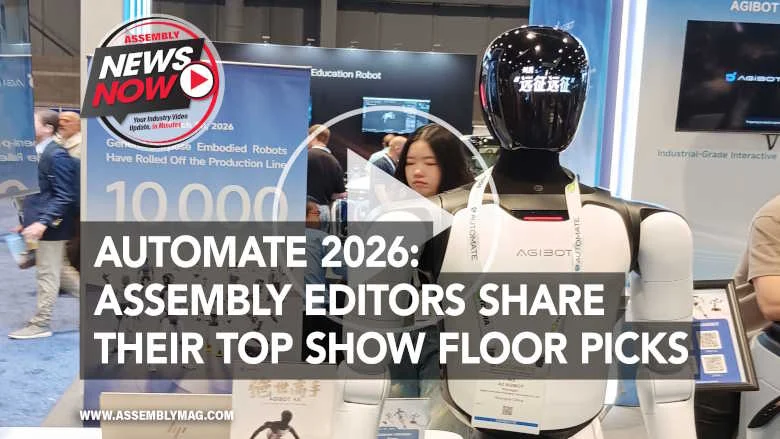
Automate 2026, North America’s largest automation trade show, concluded with a resounding affirmation of the accelerating trajectory of robotics, artificial intelligence, and advanced automation systems. The event served as a pivotal platform for unveiling groundbreaking innovations poised to reshape global manufacturing and industrial processes. John Sprovieri, Chief Editor of ASSEMBLY News Now, highlighted several transformative technologies in Episode 32 of the series, emphasizing a significant leap towards more intelligent, adaptable, and human-centric automation solutions. Among his top picks were the burgeoning presence of humanoid robots, Epson’s strategic entry into the collaborative robot market, Universal Robots’ advancements in AI-powered cobots, and intuitive new software that streamlines robot programming through natural language and simple demonstrations. These developments collectively underscore a shift towards greater accessibility, efficiency, and flexibility within automated environments.
Automate’s Enduring Legacy: A Nexus for Industrial Innovation
Automate has historically served as a critical biennial gathering for industry leaders, engineers, researchers, and manufacturers seeking to explore the cutting edge of automation. Since its inception, the trade show, organized by the Association for Advancing Automation (A3), has evolved from a niche event into a comprehensive exhibition showcasing the full spectrum of automation technologies, from industrial robots and machine vision to motion control and AI. Automate 2026, held against a backdrop of increasing global demand for enhanced productivity, labor optimization, and supply chain resilience, reinforced its reputation as a crucial barometer for future industrial trends. The event typically attracts tens of thousands of attendees and hundreds of exhibitors, providing a unique ecosystem for networking, knowledge exchange, and deal-making. This year, the focus was undeniably on the convergence of hardware advancements with sophisticated software, particularly in artificial intelligence, marking a new era of smart automation.
The Emergence of Humanoid Robotics: A Paradigm Shift
One of the most captivating categories at Automate 2026 was the significant progress and growing visibility of humanoid robots. While still in their nascent stages for widespread industrial deployment, the demonstrations at the show indicated a rapid advancement in their capabilities. These robots, designed to mimic human form and movement, are increasingly seen as a long-term solution to address complex labor challenges, particularly in tasks that are dull, dirty, dangerous, or require human-like dexterity in unstructured environments. Companies, some of which have been quietly developing this technology for years, showcased prototypes capable of navigating factory floors, grasping diverse objects, and even performing intricate assembly steps that traditionally demanded human hands.

Experts at the show discussed how improvements in balance, locomotion, and especially artificial intelligence-driven perception and decision-making, are bringing humanoids closer to commercial viability. Analysts project that the global market for humanoid robots, though small today, could see exponential growth in the coming decade, potentially reaching over $50 billion by 2035 as manufacturing and logistics companies begin piloting and integrating these advanced machines. Their potential applications range from assisting in warehouses and logistics centers to performing maintenance tasks in hazardous environments and eventually aiding in direct manufacturing assembly. The discussions also touched upon the ethical and societal implications, including the imperative for robust safety protocols and comprehensive workforce training programs to prepare for a future where humans and humanoids collaborate.
Collaborative Robotics: Enhanced Intelligence and Accessibility
The collaborative robot (cobot) sector, already a rapidly expanding segment of the robotics market, demonstrated significant evolution at Automate 2026, focusing on increased intelligence, precision, and ease of use.
-
Epson’s Strategic Entry into Cobots: A notable development was the unveiling of Epson’s first collaborative robot. Known for its precision industrial robots, particularly SCARA and 6-axis models, Epson’s move into the cobot space signifies a strategic response to market demand for flexible, safe, and easily deployable automation. While specific model details were under wraps, the industry anticipates Epson’s cobot to leverage the company’s established expertise in high-precision motion control and compact design. Initial reports suggest Epson’s cobot will target applications requiring high accuracy in confined spaces, such as electronics assembly, intricate material handling, and quality inspection, areas where traditional industrial robots might be over-specified or lack the necessary human-robot interaction safety features. This entry is expected to intensify competition and further drive innovation in the collaborative robotics segment, which is projected to grow at a compound annual growth rate (CAGR) of over 20% through 2030, reaching a market value exceeding $10 billion.
-
Universal Robots’ AI-Powered Evolution: Universal Robots (UR), a pioneer and market leader in collaborative robotics, showcased its latest generation of AI-powered cobots, marking a significant step forward in making these machines even more autonomous and adaptive. These new models integrate advanced AI algorithms for improved real-time decision-making, enhanced vision system capabilities, and more sophisticated force feedback. Key AI functionalities include:

- Adaptive Task Execution: Cobots can now learn and adapt to variations in product placement or environmental changes, reducing the need for rigid fixturing and reprogramming.
- Predictive Maintenance: AI-driven analytics monitor the cobot’s health, predicting potential failures before they occur, thereby minimizing downtime and extending operational life.
- Enhanced Vision and Perception: Integrated AI vision systems allow for more accurate object recognition, quality control, and picking tasks, even in complex scenarios with mixed parts or poor lighting.
- Faster Learning from Demonstration: Building on their user-friendly interface, the AI enhancements allow cobots to learn new tasks more quickly and accurately from human demonstrations, minimizing the programming curve.
Universal Robots’ innovations reinforce the trend towards cobots becoming truly intelligent assistants, capable of handling a broader range of applications and integrating more seamlessly into dynamic production environments.
Democratizing Automation: Natural Language and Demonstration-Based Programming
Perhaps one of the most impactful software innovations showcased at Automate 2026 was the advent of new programming tools that allow manufacturers to teach robots using natural language and simple demonstrations. This technology represents a monumental leap in democratizing automation, making sophisticated robotic systems accessible to a much wider user base, including small and medium-sized enterprises (SMEs) that may lack dedicated robotics engineers.
The software platforms presented leverage advanced AI, specifically large language models (LLMs) and machine learning algorithms, to interpret human instructions. Users can now simply speak commands to a robot, describing the desired task in plain English (or other natural languages), and the robot’s control system translates these into executable code. Furthermore, the demonstration-based teaching allows operators to physically guide a robot through a sequence of movements, or perform the task themselves while the robot observes and learns via embedded vision systems and force sensors. The software then automatically generates the robot program, significantly reducing the time and complexity associated with traditional text-based or graphical programming interfaces.
This development addresses a critical bottleneck in robot adoption: the steep learning curve and specialized skills traditionally required for programming. By enabling intuitive, human-like interaction, these tools empower frontline workers to quickly redeploy robots for different tasks, enhancing production flexibility and reducing the total cost of ownership. Industry experts predict that such user-friendly programming interfaces will accelerate robot adoption across various sectors, particularly in industries characterized by high-mix, low-volume production where frequent task changes are common. The ability to quickly retask robots without extensive downtime could lead to significant productivity gains and greater agility in responding to market demands.
Beyond the Headlines: Other Noteworthy Trends

While humanoid robots, advanced cobots, and intuitive programming stole much of the spotlight, Automate 2026 also featured significant advancements in several other critical automation domains:
- Advanced Vision Systems: The integration of AI with machine vision has led to unprecedented levels of accuracy and speed in quality inspection, defect detection, and object recognition. New systems showcased capabilities for 3D vision, hyperspectral imaging, and deep learning-based anomaly detection, enabling robots to "see" and interpret their surroundings with human-like, or even superhuman, precision.
- Autonomous Mobile Robots (AMRs) and Automated Guided Vehicles (AGVs): The exhibition featured an expanded array of AMRs and AGVs, demonstrating enhanced navigation capabilities, payload capacities, and fleet management software. These robots are becoming indispensable for internal logistics, material transport, and optimizing warehouse operations, contributing to more agile and efficient supply chains.
- Digital Twins and Simulation: The concept of digital twins, virtual replicas of physical assets and processes, was prominently featured, with software solutions enabling comprehensive simulation, optimization, and predictive maintenance for entire factory floors. This technology allows manufacturers to test new layouts, robot programs, and production scenarios in a virtual environment before physical implementation, saving time and resources.
- Edge AI in Manufacturing: The trend of bringing AI processing closer to the data source, or "edge computing," was evident in many exhibits. Edge AI enables faster decision-making, reduced latency, and enhanced cybersecurity for automation systems, moving critical analytics from centralized cloud servers to the factory floor.
- Sustainable Automation Solutions: An increasing emphasis was placed on automation solutions designed for energy efficiency, waste reduction, and sustainable manufacturing practices, aligning with global efforts towards greener industrial operations.
Industry Reactions and Expert Perspectives
The innovations unveiled at Automate 2026 elicited strong reactions from industry stakeholders. John Sprovieri, reflecting on the show, remarked, "This year’s Automate was a clear indicator that the future of manufacturing is not just automated, but intelligently automated. The advancements in AI-driven robotics and the sheer accessibility of programming tools are democratizing automation in ways we could only imagine a few years ago. This isn’t just about doing things faster; it’s about doing things smarter, with greater flexibility and a reduced barrier to entry for smaller manufacturers."
Dr. Anya Sharma, a leading robotics analyst at GlobalTech Insights, commented, "The progress in humanoid robotics, though still niche, signals a long-term vision for automation that goes beyond repetitive tasks. Combined with the immediate impact of AI-powered cobots and natural language programming, we are entering a phase where robots are not just tools, but collaborative partners. This will fundamentally alter workforce dynamics, demanding new skills and fostering unprecedented human-robot synergy."
A spokesperson from Universal Robots, speaking on the advancements, stated, "Our focus remains on making automation accessible and beneficial for all manufacturers. The integration of AI into our cobots, coupled with intuitive programming methods, empowers businesses to quickly adapt to changing market conditions, enhance productivity, and improve the quality of life for their employees by taking over strenuous or monotonous tasks."

The Road Ahead: Implications for Manufacturing and Beyond
The technologies showcased at Automate 2026 carry profound implications for the manufacturing sector and the broader economy.
- Productivity and Efficiency: The increased intelligence and adaptability of robots, coupled with easier programming, will undoubtedly lead to significant boosts in productivity, higher quality output, and reduced operational costs. Manufacturers can expect faster changeovers, less downtime, and optimized resource utilization.
- Workforce Transformation: While concerns about job displacement often arise, the dominant narrative at Automate 2026 was one of workforce augmentation and transformation. Robots are increasingly taking on dangerous, repetitive, or physically demanding tasks, allowing human workers to focus on more complex problem-solving, creative endeavors, and supervisory roles. This shift necessitates investment in upskilling and reskilling programs to prepare the current workforce for collaboration with advanced automation systems.
- Supply Chain Resilience: The ability to rapidly deploy and reconfigure automation, particularly with flexible cobots and AMRs, contributes significantly to building more resilient and localized supply chains. Manufacturers can respond more swiftly to disruptions, re-shore production, and achieve greater control over their operations.
- Economic Impact: The widespread adoption of these technologies is expected to drive economic growth, foster innovation, and enhance global competitiveness for nations that embrace intelligent automation. It enables companies to produce higher-quality goods more efficiently, creating new market opportunities and driving down consumer costs in the long term.
- Challenges and Considerations: Despite the immense promise, the path forward is not without challenges. These include the significant initial capital investment required for advanced automation, the complexity of integrating diverse systems, the ongoing need for robust cybersecurity measures to protect connected factories, and the ethical considerations surrounding AI and robotics. Addressing these challenges through collaborative industry efforts, government support, and educational initiatives will be crucial for realizing the full potential of these transformative technologies.
In conclusion, Automate 2026 cemented its status as a bellwether for the industrial future. The advancements in humanoid robotics, the intelligent evolution of collaborative robots, and the revolutionary simplification of robot programming signal a new era where automation is not just a tool for efficiency, but a partner in innovation, poised to drive unprecedented growth and redefine the human-machine interface in manufacturing. The emphasis on AI-driven intelligence and user-friendliness suggests that the future of automation will be more accessible, more flexible, and more integrated into the fabric of human work than ever before.