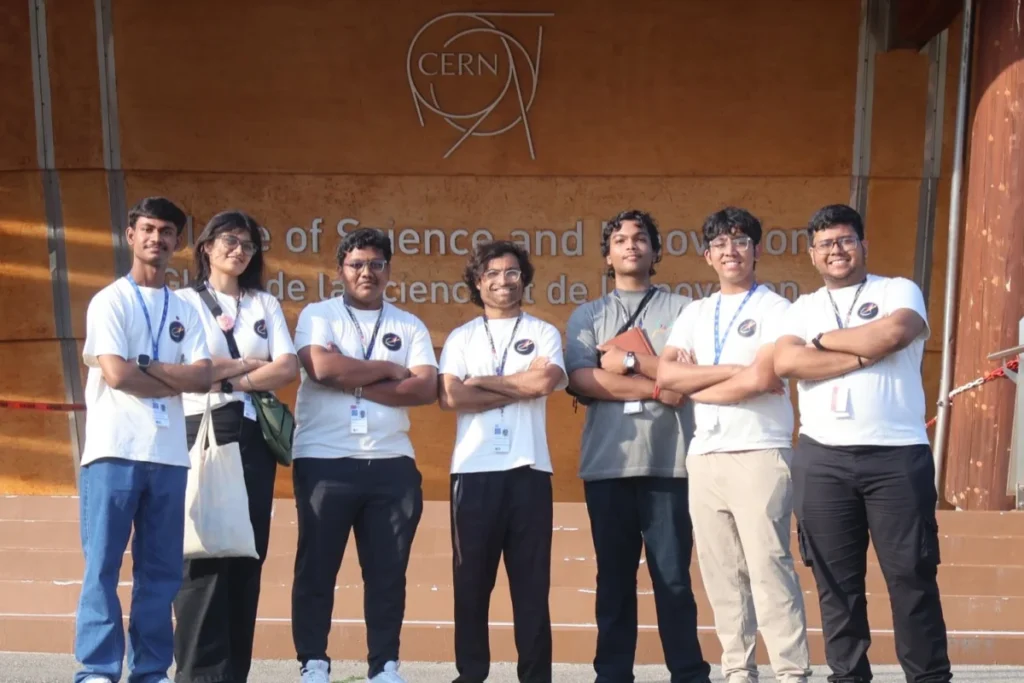
The convergence of elite academic mentorship and high-level secondary education reached a significant milestone this year as a team of high school students from India, guided by a researcher from the Massachusetts Institute of Technology (MIT), secured a prestigious victory in the 13th annual Beamline for Schools competition. Organized by CERN, the European Organization for Nuclear Research, the competition provides a rare opportunity for pre-university students to conduct professional-grade experiments at one of the world’s leading particle physics laboratories. The Indian team, known as Team attoPION, was selected from a record-breaking global pool of applicants to execute their proposal at CERN’s facilities in Geneva, Switzerland.
The success of the project highlights a growing trend in the democratization of high-level scientific research, where digital connectivity allows students from diverse geographical backgrounds to access world-class mentorship. For Team attoPION, the journey began not in a laboratory, but through a speculative "cold email" sent to Manu Srivastava, a physics graduate student at MIT. Srivastava, a PhD candidate at the MIT Center for Theoretical Physics—a part of the Leinweber Institute—specializes in the complex field of quantum gravity under the supervision of Professor Hong Liu.
The Genesis of a Global Collaboration
The partnership between Srivastava and the students was born out of an unusual direct appeal. In the academic world, researchers at prestigious institutions like MIT are frequently inundated with requests for mentorship, many of which are facilitated by commercial third-party companies that charge families high fees for access to scientists. Srivastava noted that he typically declines such solicitations. However, the message from the Indian students stood out due to its sincerity and the clear intellectual merit of their aspirations.
Srivastava, who grew up in India before pursuing his advanced studies in the United States, recognized the ambition in the students’ request. Having navigated the early stages of a scientific career himself, he understood the difficulty of securing guidance without established institutional connections. After several rounds of correspondence, he agreed to mentor the group, helping them refine their scientific ideas into a proposal capable of competing on the international stage.
The students, who attend four different schools across four different cities in India, had met through various science competitions and mutual interests. Their collaboration was conducted primarily through digital platforms, bridging the thousands of miles between Cambridge, Massachusetts, and their respective homes in India.
The Beamline for Schools Competition: A Global Benchmark
The Beamline for Schools (BL4S) competition has established itself as the premier international platform for high school particle physics. Launched in 2014 to celebrate CERN’s 60th anniversary, the program aims to inspire the next generation of scientists by giving them the same tools and resources available to professional researchers.
The 13th edition of the competition saw unprecedented participation. A record 712 teams from 89 countries submitted proposals, representing more than 4,500 students globally. From this massive field, only five teams were selected as winners. Alongside Team attoPION from India, the other winning teams hailed from Bangladesh, Türkiye, the United Kingdom, and the United States.
The selection process is rigorous, requiring teams to submit a detailed written proposal and a video explaining their experimental goals. Proposals are evaluated by a committee of CERN scientists based on their feasibility, scientific method, and educational value. For Team attoPION, the selection was a validation of months of preparatory work and theoretical refinement.
Scientific Objectives: Pion Charge Exchange and Neutrino Research
The core of Team attoPION’s experiment focuses on a specific subatomic interaction known as pion charge exchange. Pions, or pi mesons, are short-lived subatomic particles that play a crucial role in mediating the strong nuclear force that binds protons and neutrons together in atomic nuclei. These particles can carry a positive, negative, or neutral electric charge.
The specific reaction the students proposed to study involves a positively charged pion ($pi^+$) interacting with a neutron ($n$) within a target material. In this "charge exchange" process, the positive pion transfers its charge to the neutron, resulting in the production of a neutral pion ($pi^0$) and a positively charged proton ($p$). The goal of the experiment is to characterize the cross-section of this reaction—essentially measuring how frequently this specific interaction occurs under controlled conditions.
Srivastava’s role was critical in steering the students toward an experiment that was both "practical and scientifically interesting." While the students initially had several ideas, Srivastava helped them narrow their focus to an area that could contribute meaningful data to the broader scientific community.
The Connection to DUNE: Advancing Global Particle Physics
The scientific significance of the students’ work extends beyond the classroom, potentially impacting one of the most ambitious physics projects currently under development: the Deep Underground Neutrino Experiment (DUNE). DUNE is an international flagship experiment designed to study the properties of neutrinos, the most abundant yet least understood particles in the universe.
Based at the Long-Baseline Neutrino Facility (LBNF) in the United States, DUNE involves firing a high-intensity neutrino beam from Fermilab in Illinois to a massive detector located 800 miles away and a mile underground at the Sanford Underground Research Facility in South Dakota. One of the primary challenges in neutrino physics is quantifying the uncertainties in measurements. Neutrinos are detected through their interactions with matter, which often produce secondary particles, including pions.
Dave Newbold, a co-spokesperson for the DUNE collaboration, emphasized the importance of the students’ research. He noted that understanding how pions interact with matter is essential for researchers to accurately estimate a neutrino’s "flavor" and energy. If the interactions of secondary pions are not well-understood, it can lead to errors in the data that might obscure new physical phenomena.
Newbold remarked that the students’ proposal was "real experimental particle physics," rather than a mere reproduction of known results. He suggested that if successful, the team’s work could lead to a publishable result, contributing to the "test beam" experiments that remain vital for refining detector designs.
The Experimental Challenge: Navigating Technical Complexity
Conducting high-energy physics experiments is fraught with technical difficulties, a reality the students faced during their preparation. Working with Berare Göktürk, a support scientist for Beamline for Schools, the team realized that the charge-exchange process they sought to observe is extremely rare.
Detecting neutral pions is particularly challenging because they have a very short lifespan—approximately $8.4 times 10^-17$ seconds—and they do not leave tracks in traditional detectors because they lack an electric charge. Instead, they decay almost immediately into two high-energy photons (gamma rays). The students had to design a detection system capable of identifying these photons to infer the presence of the neutral pion.
With only 12 days of scheduled "beam time" at CERN, the margin for error was slim. Göktürk noted that the primary educational goal was for the students to "understand the journey of a scientist," which includes managing limitations, troubleshooting equipment failures, and maintaining humility in the face of complex data.
The CERN Experience: From Theory to High-Energy Reality
In late 2024, the members of Team attoPION traveled to Geneva to begin their two-week residency at CERN. During this period, the students transitioned from theoretical modeling to hands-on experimental execution. They worked directly with advanced detectors and data-acquisition systems, learning how to calibrate sensitive instruments and filter out "noise" from the particle beam.
The students attended lectures by CERN staff and collaborated with international peers, experiencing the collaborative atmosphere that defines modern "Big Science." For many of the students, the experience was a transformative introduction to the professional scientific world, moving beyond the idealized versions of physics found in textbooks.
Srivastava’s participation also represented a departure from his usual work. As a theoretical physicist focused on the abstract mathematics of quantum gravity, the hands-on nature of the beamline experiment forced him to engage with the practicalities of experimental hardware and data analysis. He credited the interdisciplinary culture at MIT for preparing him to step outside his specialty and support the students in a different branch of physics.
Mentorship and the Democratization of Science
The success of Team attoPION serves as a case study in the impact of accessible mentorship. Srivastava’s decision to respond to the students’ email reflects a commitment to fostering scientific talent regardless of institutional pedigree or financial background.
For the students in India, the opportunity to work with an MIT researcher and a CERN scientist provided a pathway that is often unavailable to those outside of elite Western preparatory schools. Srivastava noted that when he was in high school in India, he was not even aware of CERN’s existence. He praised the students for their proactive approach and their ability to compete at a level far exceeding typical high school standards.
The mentorship provided by Srivastava and the CERN staff also highlights the importance of institutional support for outreach. The MIT Center for Theoretical Physics and the Leinweber Institute provide an environment where researchers are encouraged to engage with the global community, a philosophy that bore fruit in the form of this successful international collaboration.
Conclusion: Future Implications for Particle Physics
As Team attoPION concludes its experimental run at CERN, the focus shifts to data analysis. The results of their measurements on pion charge exchange will be scrutinized to see if they can indeed provide new insights for the DUNE collaboration. Regardless of the final data set, the project has already achieved its primary goal: demonstrating that high school students, when properly mentored and resourced, can contribute to the frontier of human knowledge.
The implications for the students are profound. Many are now expected to pursue degrees in fundamental science and engineering, carrying with them the experience of having worked at the world’s most famous laboratory. For the scientific community, the project reinforces the value of "test beam" experiments and the necessity of detailed subatomic data to support the next generation of neutrino research.
In an era where scientific challenges are increasingly global, the story of an MIT physicist and a group of Indian high schoolers at CERN serves as a powerful reminder of the importance of curiosity, mentorship, and the borderless nature of scientific inquiry. The work of Team attoPION stands as a testament to the fact that the next major discovery in physics could begin with a single, well-crafted email.