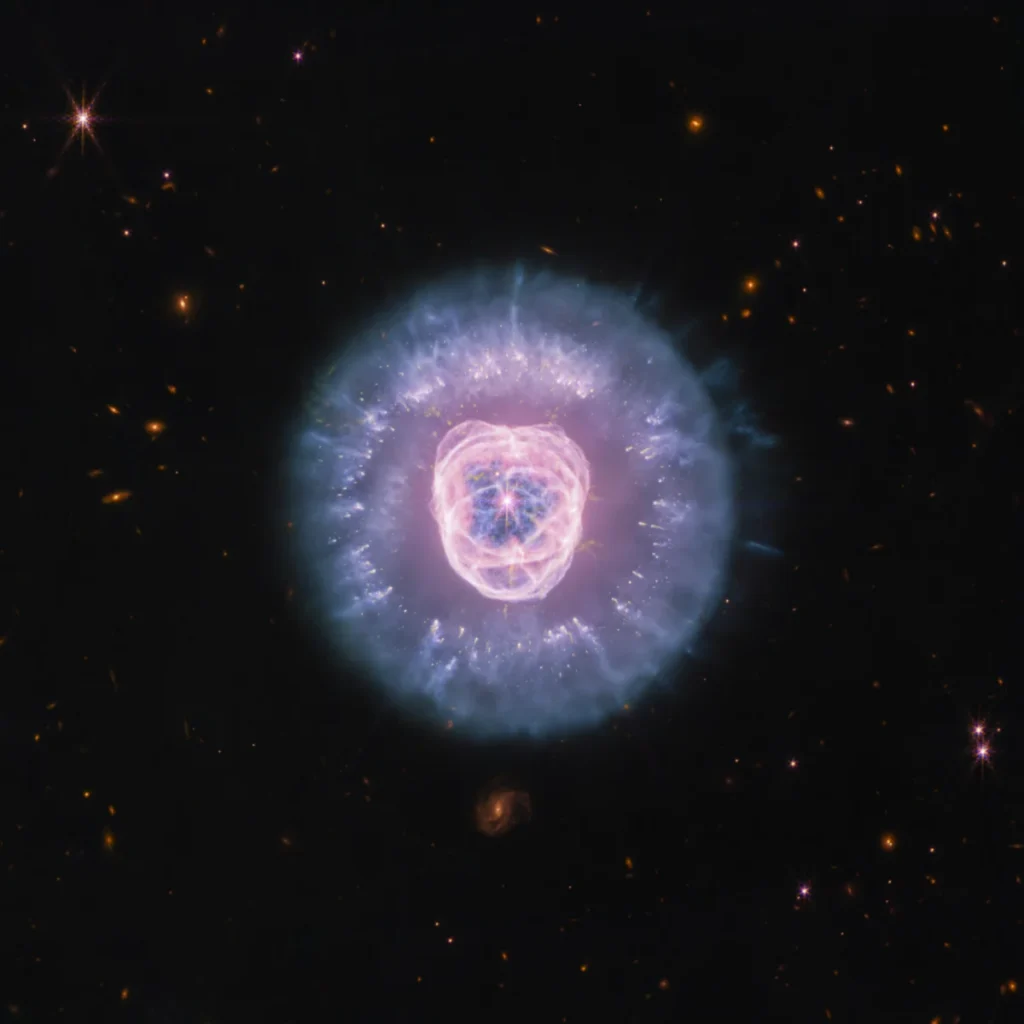
NASA’s James Webb Space Telescope has unveiled a breathtaking, composite image of the planetary nebula NGC 2392, popularly known as the Lion’s Head Nebula. This celestial spectacle, captured by Webb’s Near-Infrared Camera (NIRCam) and Mid-Infrared Instrument (MIRI), offers an unprecedentedly detailed look at the dying throes of a Sun-like star, providing invaluable insights into stellar evolution and the future of our own Sun. The image, released on August 26, 2026, has captivated astronomers and the public alike, igniting discussions about the life cycles of stars and the universe’s profound beauty.
A Stellar Swan Song: The Anatomy of the Lion’s Head Nebula
The Lion’s Head Nebula, located approximately 4,200 light-years away in the constellation Coma Berenices, presents a striking resemblance to the face of a lion, complete with a mane. This visual illusion is the result of a Sun-like star reaching the end of its life. Unlike massive stars that explode as supernovae, stars with masses similar to our Sun evolve into planetary nebulae. This process involves the star shedding its outer layers of gas and dust into space, gradually illuminating the expelled material.
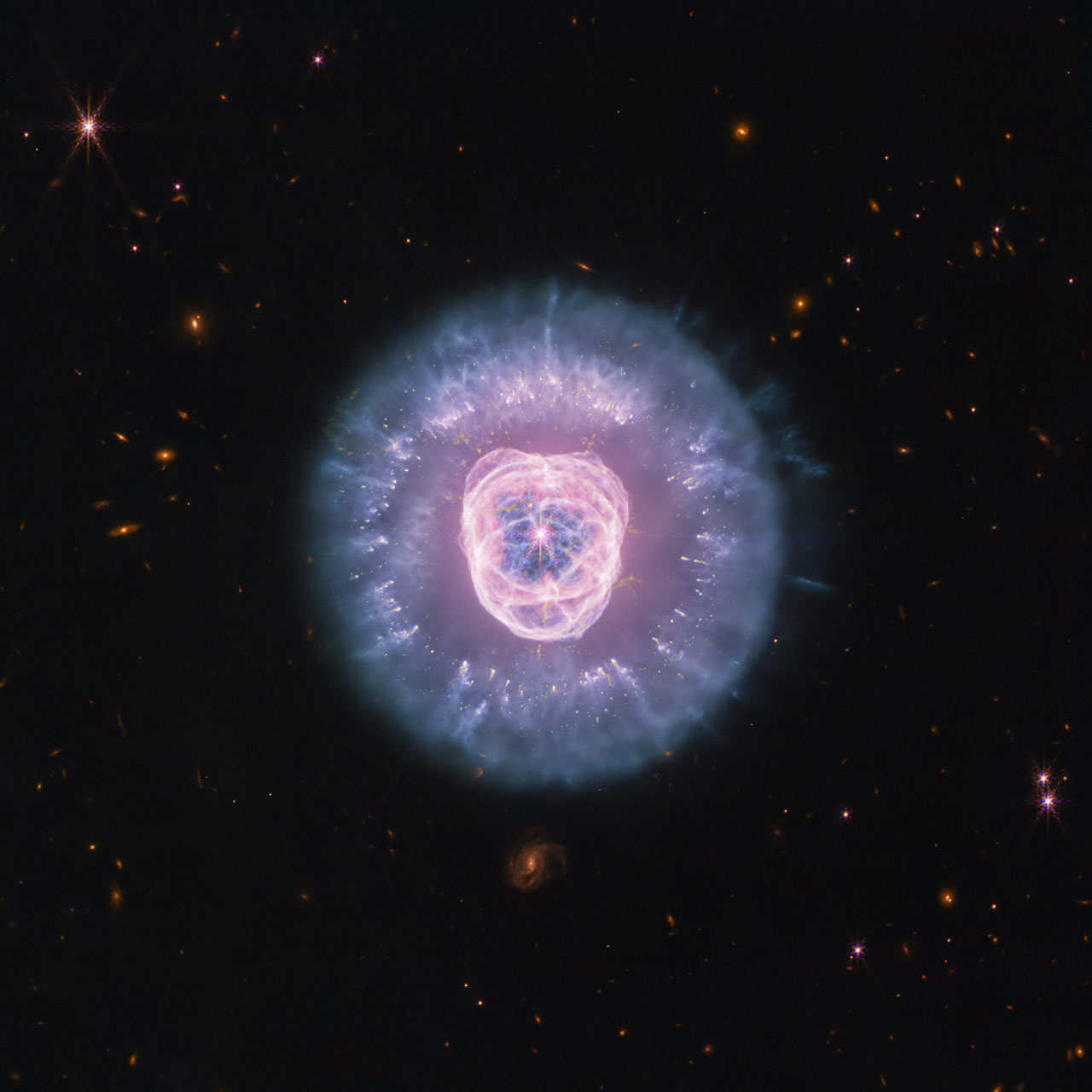
At the heart of the nebula, resembling the "nose" of the lion, lies a small, intensely hot white dwarf star. This stellar remnant, the core of the once-luminous star, is the source of powerful radiation that ionizes the surrounding gas. This ionization process is what causes the nebula to glow, creating the intricate and vibrant structures observed. The nebula’s circular shape, adorned with purple-pink cavernous bubbles and shell-like rings, collectively forms the lion’s "face." These features are a testament to the complex interplay between the expelled material and the energetic radiation emanating from the central white dwarf.
The "mane" of the lion is particularly intriguing, appearing as a thick ring of purple-blue material surrounding the face. This is composed of dust clumps that have withstood the intense radiation from the white dwarf, along with a cloud of ionized gas. The detailed resolution provided by the Webb telescope allows scientists to observe features like comet-like tails extending from these dust clumps, hinting at dynamic processes occurring within the nebula. The background of the image is populated with distant galaxies and stars, further emphasizing the vastness and richness of the cosmos.
Webb’s Advanced Instruments: Unveiling New Details
The precision and sensitivity of the James Webb Space Telescope’s instruments have been crucial in capturing this remarkable image. NIRCam, which observes in the near-infrared spectrum, and MIRI, which operates in the mid-infrared, work in tandem to provide a comprehensive view of celestial objects. Near-infrared light can penetrate dust clouds that often obscure visible light, revealing hidden structures. Mid-infrared light, on the other hand, is emitted by cooler objects, such as dust and gas, allowing scientists to study the chemical composition and thermal properties of the nebula.
The combination of data from these instruments has produced a composite image that is both aesthetically stunning and scientifically rich. This new, detailed perspective is expected to significantly advance our understanding of how gas and dust interact within planetary nebulae and how these interactions are influenced by the radiation from the central white dwarf.
A Glimpse into Our Sun’s Future
The Lion’s Head Nebula serves as a poignant reminder of the inevitable life cycle of stars, including our own Sun. Scientists estimate that our Sun will continue to fuse hydrogen into helium in its core for approximately another five billion years. As it exhausts its nuclear fuel, the Sun will begin to expand into a red giant, engulfing the inner planets, including Earth. Following this phase, it will shed its outer layers, forming a planetary nebula, and eventually contract into a white dwarf.
The detailed study of nebulae like NGC 2392 provides astronomers with a vital preview of our Sun’s ultimate fate. By analyzing the structure, composition, and dynamics of these stellar remnants, scientists can refine their models of stellar evolution, helping to predict the timescale and nature of our Sun’s transformation. This knowledge is not only fundamental to astrophysics but also to our understanding of planetary habitability and the long-term future of life in the solar system.
Background and Chronology of Discovery
Planetary nebulae have been a subject of astronomical interest for centuries. NGC 2392 was first discovered by astronomer William Herschel in 1784. Its distinctive appearance has led to various nicknames over time, including the "Clown-faced Nebula" and the "Blue-Snowflake Nebula," before the "Lion’s Head" moniker became widely adopted.
Early observations of NGC 2392 were made using ground-based telescopes and later by the Hubble Space Telescope. However, the limitations of these instruments in certain wavelengths and their resolution capabilities meant that many intricate details remained obscured. The launch of the James Webb Space Telescope in December 2021 marked a significant leap forward in observational astronomy. Its unparalleled sensitivity, resolution, and infrared capabilities allow it to peer deeper into the universe and capture celestial phenomena with unprecedented clarity.
The processing of the Webb image was undertaken by Alyssa Pagan of the Space Telescope Science Institute (STScI), a key partner in the Webb mission. The collaborative effort involved contributions from NASA, the European Space Agency (ESA), and the Canadian Space Agency (CSA).
Expert Reactions and Scientific Implications
Dr. Keighley Rockcliffe, one of the authors and editors of the APOD explanation, stated, "This new image from Webb is truly remarkable. It allows us to see the Lion’s Head Nebula with a level of detail we’ve never had before. This will help us unravel the complex processes that occur as a star like our Sun reaches the end of its life. Understanding these processes is fundamental to understanding our place in the universe."
Robert Nemiroff and Jerry Bonnell, also listed as authors and editors, added in a joint statement, "The beauty of this image is matched only by its scientific significance. The intricate structures within the nebula, the patterns of gas and dust, and the influence of the central white dwarf all provide crucial data points for refining our astrophysical models. It’s a testament to human ingenuity and our enduring quest for knowledge."
The implications of this new imagery extend beyond understanding stellar death. Planetary nebulae are significant in the chemical evolution of galaxies. The material ejected by dying stars enriches the interstellar medium with heavier elements, which are then incorporated into new generations of stars and planets. Therefore, studying nebulae like NGC 2392 contributes to our understanding of the origins of the elements that make up everything around us, including ourselves.
Broader Impact and Future Research
The "Astronomy Picture of the Day" (APOD) program, a collaboration between NASA’s Goddard Space Flight Center, NASA Science Activation, and Michigan Technological University, plays a vital role in disseminating astronomical discoveries to the public. The image of the Lion’s Head Nebula, as featured on APOD, is expected to inspire a new wave of interest in astronomy and space exploration.
The detailed data captured by Webb will fuel ongoing research for years to come. Astronomers will meticulously analyze the spectral data to determine the precise chemical composition of the nebula, map the distribution of gas and dust, and study the kinematics of the expelled material. This could lead to a deeper understanding of the mechanisms driving the formation of the intricate structures observed, such as the "mane" and the "face" of the lion.
Furthermore, the advanced capabilities of the Webb telescope are paving the way for future discoveries. By studying the life and death of stars, scientists are not only unraveling cosmic mysteries but also gaining a profound appreciation for the dynamic and ever-evolving nature of the universe. As the APOD team teases, tomorrow’s picture promises "a waterfall of light," hinting at further celestial wonders to be revealed by this groundbreaking observatory. The ongoing exploration of the cosmos, illuminated by the powerful gaze of the James Webb Space Telescope, continues to push the boundaries of human knowledge and imagination.