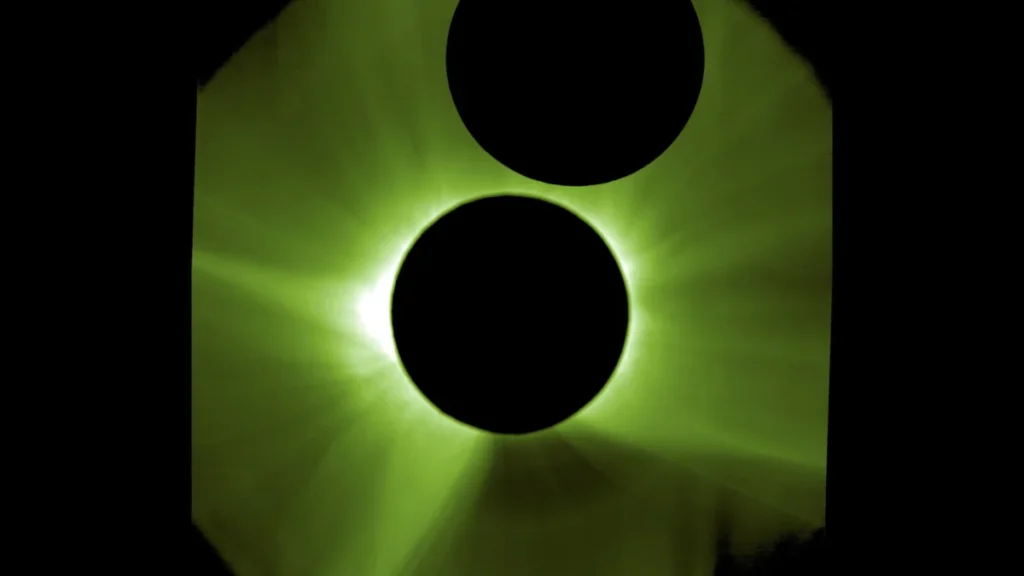
On August 12, 2026, as parts of Europe prepared to be plunged into twilight by the Moon’s shadow during a total solar eclipse, a unique celestial ballet unfolded 60,000 kilometers above Earth. The European Space Agency’s (ESA) Proba-3 mission, comprised of two sophisticated spacecraft, found itself in an unprecedented "front-row seat" to a cosmic phenomenon that mirrored its own scientific objectives. Hours before the Moon’s disc obscured the Sun for terrestrial observers, Proba-3’s instruments captured a breathtaking "double eclipse," an event that not only provided stunning imagery but also offered invaluable calibration data for its cutting-edge solar coronagraph.
The Proba-3 mission, launched with the ambitious goal of creating artificial eclipses, was ideally positioned to observe the natural event. Its primary function involves the precise orbital alignment of two satellites: the Occulter and the Coronagraph. The Occulter spacecraft is designed to act as an artificial Moon, eclipsing the Sun and thereby allowing the Coronagraph spacecraft to achieve an unobstructed, prolonged view of the Sun’s ethereal outer atmosphere, the corona. This meticulously orchestrated celestial dance, performed at a distance of 60,000 kilometers from Earth, allows scientists to study the corona in unprecedented detail, free from the blinding glare of the solar disc.
However, on August 12, 2026, the Moon itself intervened, adding a natural layer to Proba-3’s carefully constructed artificial eclipses. The mission’s coronagraph instrument, ASPIICS (Advanced Space-borne Polarimetric and Heliometric Imaging Coronagraph), captured a remarkable series of images over a three-hour period in the morning. These images documented the Moon’s majestic passage across Proba-3’s field of view, a celestial encounter that was significantly longer and more impactful for the spacecraft than the natural eclipse was for observers on Earth.
A Celestial Coincidence: The Double Eclipse
The Moon’s shadow, cast across the Proba-3 spacecraft, was slightly larger than the occulting disc of the Occulter satellite. This created a prolonged period where both the Sun’s direct light and the light diffracted by the Occulter were significantly diminished. The Moon fully obscured the solar disc for a remarkable 8 minutes and 40 seconds. This duration is more than three times the maximum totality experienced on Earth during the 2026 event, which lasted a mere 2 minutes and 18 seconds, primarily observed off the coast of Iceland.
While Proba-3 maintained its own artificial eclipse operation during this period, the Moon’s natural eclipse provided a unique opportunity for scientific observation. The extended period of darkness, a "double eclipse" in essence, offered a rare moment of freedom from parasitic light. This unwanted light, typically generated by the diffraction of sunlight off the edges of the Occulter spacecraft, can interfere with detailed observations of the corona. For scientists working with the ASPIICS instrument, this natural celestial alignment was akin to a cosmic calibration event.
The prolonged darkness allowed for the precise calibration of the ASPIICS coronagraph’s optical performance. By observing the corona under such pristine conditions, researchers could fine-tune the instrument’s sensitivity and accuracy, ensuring that future scientific data would be of the highest quality. Furthermore, the brief period of exceptional clarity provided an opportunity to gather novel data on the corona itself, potentially revealing subtle features or dynamics that are often obscured.
The Proba-3 Mission: Mimicking the Moon
The Proba-3 mission is a testament to human ingenuity in space exploration. It represents a significant advancement in our ability to study the Sun’s corona, a region crucial for understanding space weather phenomena that can impact Earth. Unlike traditional coronagraphs that use a physical occulter within a single spacecraft to block the Sun, Proba-3 employs a unique two-satellite formation flying technique.
The Occulter spacecraft positions itself precisely between the Sun and the Coronagraph spacecraft. This separation of functions allows for a larger occulting disc and a more stable formation, minimizing stray light and enabling longer observation times. The spacecraft maintain their relative positions with remarkable precision, flying in formation 60,000 kilometers above Earth. This precise formation flying is achieved through sophisticated onboard navigation and control systems, constantly adjusting to maintain the desired alignment.
The Proba-3 mission’s primary scientific objective is to observe the Sun’s corona, particularly its inner regions, which are incredibly difficult to study due to the overwhelming brightness of the solar disc. By artificially creating an eclipse, Proba-3 aims to capture high-resolution images and spectral data of the corona, providing insights into its temperature, density, and magnetic field structure. This information is vital for understanding solar flares, coronal mass ejections, and the solar wind, all of which have profound implications for Earth’s technological infrastructure and astronaut safety.
A Once-in-a-Lifetime Opportunity
The double eclipse witnessed by Proba-3 on August 12, 2026, is considered a "once-in-a-lifetime event" for the mission. While Proba-3 is designed to create artificial eclipses on a regular basis, the coincidence of a natural total solar eclipse occurring during its operational phase, and at such a close proximity in its observational trajectory, is exceptionally rare.
Looking ahead, Proba-3 is scheduled to witness two more natural partial solar eclipses during the remaining two on-ground total solar eclipses within its mission lifetime: one on August 2, 2027, and another on July 22, 2028. During these future events, the Moon will pass through the ASPIICS field of view. However, it is not anticipated that the Moon will fully obscure the solar disc for Proba-3 during these subsequent eclipses. This means that the prolonged, nearly nine-minute period of near-perfect darkness experienced on August 12, 2026, will likely remain a unique occurrence.
Broader Context and Scientific Implications
The 2026 total solar eclipse was a widely anticipated event, with millions of people across Europe and beyond preparing to witness this celestial spectacle. Numerous space missions, both active and ground-based observatories, were dedicated to capturing data and images of this rare alignment. The Proba-3 mission’s unique vantage point provided a complementary perspective, offering insights that would be impossible to obtain from Earth.
The data gathered during the double eclipse has significant implications for solar physics research. By calibrating the ASPIICS instrument against a natural, albeit prolonged, eclipse, scientists can gain a more precise understanding of its capabilities. This improved calibration can lead to more accurate measurements of coronal plasma properties, such as temperature, velocity, and density. Such precise measurements are crucial for refining models of solar activity and improving our ability to predict space weather events.
Space weather, driven by solar phenomena like flares and coronal mass ejections, can have a disruptive impact on Earth. These events can interfere with satellite communications, GPS systems, and power grids, and pose a radiation hazard to astronauts in space. By studying the corona in greater detail, missions like Proba-3 contribute to a better understanding of the Sun’s behavior and, consequently, to improved space weather forecasting and mitigation strategies.
Official Reactions and Future Prospects
While specific official statements directly following the Proba-3 double eclipse event are not detailed in the provided information, it can be inferred that the ESA would view this occurrence as a significant success. Mission controllers and scientists involved with Proba-3 would have recognized the immense scientific value of this fortunate coincidence. The opportunity to calibrate instruments and gather unique data during such a rare event would have been met with considerable enthusiasm.
The Proba-3 mission, a collaborative effort involving numerous European nations and research institutions, exemplifies the power of international cooperation in space science. Its success in demonstrating novel formation flying techniques and its ability to provide unprecedented views of the solar corona underscore the importance of continued investment in space-based observatories.
The data collected by Proba-3, particularly from the double eclipse event, will undoubtedly contribute to a growing body of knowledge about our Sun. This knowledge is not only fundamental to our understanding of the cosmos but also increasingly vital for safeguarding our technologically dependent society from the Sun’s inherent power. The mission’s legacy will be measured in the scientific discoveries it enables, pushing the boundaries of our understanding of the star that sustains life on Earth.
The images captured by ASPIICS during the double eclipse, showcasing the Moon gracefully traversing the sky, serve as a powerful reminder of the interconnectedness of celestial bodies and the unexpected opportunities that arise when scientific ambition meets cosmic serendipity. Proba-3’s unique perspective on the 2026 solar eclipse has not only enriched our scientific understanding but also provided a visually stunning testament to the wonders of the universe.