For centuries, humanity has looked to the stars to understand the fundamental laws that govern the physical world. From the falling apple that supposedly inspired Sir Isaac Newton to the complex curvature of spacetime envisioned by Albert Einstein, gravity has remained the primary architect of the cosmos. However, as modern telescopes have peered deeper into the universe, a troubling discrepancy has emerged: stars and galaxies appear to move with a vigor that suggests the presence of far more gravity than the visible matter can provide. This "cosmic ledger" imbalance has forced a choice between two radical conclusions: either the universe is filled with an invisible substance known as dark matter, or our understanding of gravity itself is flawed.
A landmark study led by researchers at the University of Pennsylvania has now provided a definitive answer to part of this mystery. Utilizing data from the Atacama Cosmology Telescope (ACT), an international team of over 40 scientists has conducted the largest-scale test of gravity to date. Their findings, published in the prestigious journal Physical Review Letters, confirm that the laws of gravity established by Newton and refined by Einstein hold true even across distances of hundreds of millions of light-years. By validating the inverse square law at these unprecedented scales, the research effectively narrows the field of alternative gravitational theories and provides the strongest evidence yet that the missing mass in our universe is indeed dark matter.
The Discrepancy in the Cosmic Ledger
The necessity for this study stems from a century-old observation that the universe does not behave as it should under the traditional laws of physics. In the 1930s, Swiss astronomer Fritz Zwicky observed the Coma Cluster of galaxies and noticed they were moving much faster than the visible mass of the stars within them should allow. Decades later, Vera Rubin and Kent Ford observed the rotation curves of individual galaxies, finding that stars at the outer edges of galaxies were orbiting at the same speeds as those near the center.
Under Newtonian physics, gravity should weaken as one moves away from the center of mass, causing outer stars to move more slowly. The fact that they do not suggests either a massive amount of "dark" matter providing extra gravitational pull or a fundamental change in how gravity works at low accelerations or great distances.
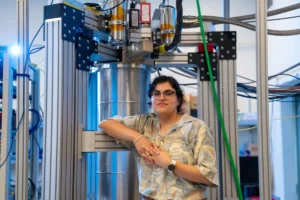
"Astrophysics has been plagued by a massive discrepancy in the cosmic ledger," explains Patricio A. Gallardo, a research associate in the Department of Astronomy and Physics at the University of Pennsylvania and the study’s lead author. "When we look at how stars orbit within galaxies or how galaxies move within galaxy clusters, some appear to be traveling way too fast for the amount of visible matter they contain."
The Two Paths: Dark Matter vs. Modified Gravity
To solve this discrepancy, two major schools of thought emerged. The first is the Dark Matter hypothesis, which suggests that the universe is permeated by a type of matter that does not interact with light—making it invisible to telescopes—but does exert gravitational force. This theory is a cornerstone of the Lambda-CDM model, the current standard model of cosmology.
The second path is Modified Newtonian Dynamics, or MOND. Proponents of MOND argue that we do not need to invent a new, invisible particle to explain the universe. Instead, they suggest that Newton’s second law of motion or the law of gravity needs to be adjusted when gravitational acceleration becomes extremely weak, such as at the edges of galaxies or between galaxy clusters. For decades, MOND has remained a resilient alternative, as it elegantly explains the rotation of individual galaxies without the need for dark matter.
The study led by Gallardo sought to put these two possibilities to the test by observing gravity on a scale where the differences between Einsteinian gravity and modified gravity would be most apparent: the vast voids between galaxy clusters.
A High-Altitude Laboratory: The Atacama Cosmology Telescope
The data required for such a massive undertaking came from the Atacama Cosmology Telescope (ACT), a six-meter diameter instrument situated at an elevation of 5,190 meters (17,030 feet) on Cerro Toco in the Chilean Andes. The site was chosen for its extremely dry and thin atmosphere, which is essential for detecting the faint signals of the Cosmic Microwave Background (CMB).
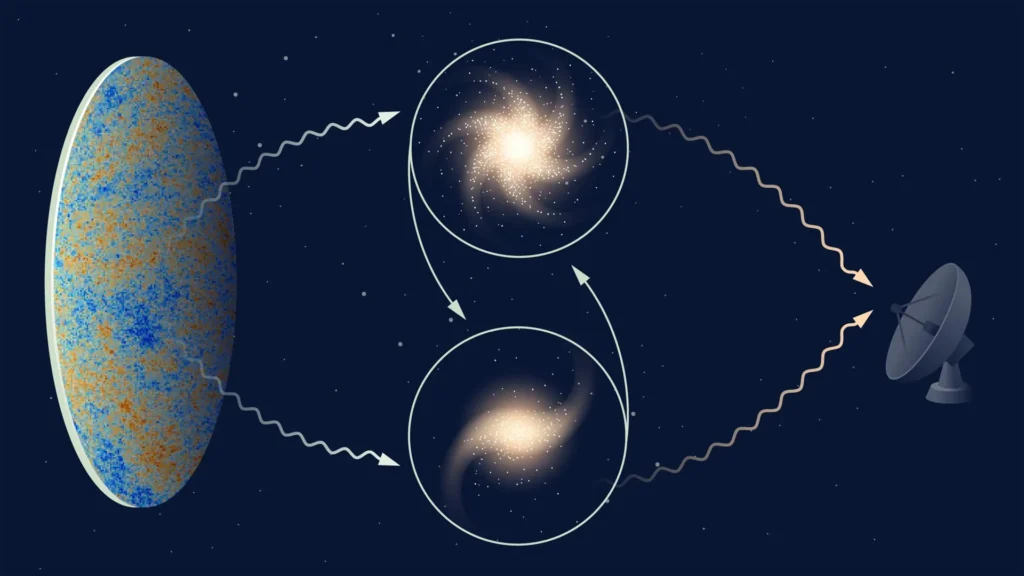
The ACT was developed largely by researchers at the University of Pennsylvania, led by Professor Mark Devlin. It is designed to map the CMB—the "afterglow" of the Big Bang—with high resolution. This ancient light has traveled through the universe for 13.8 billion years, carrying with it a record of every gravitational structure it has passed.
To test gravity, Gallardo and his team focused on how this ancient light interacts with massive galaxy clusters. As CMB photons pass through the gravitational wells of these clusters, their paths are slightly altered. Furthermore, the motion of the clusters themselves creates tiny shifts in the temperature of the CMB light through a process known as the Sunyaev-Zeldovich effect. By analyzing these signatures across hundreds of thousands of galaxy clusters, the researchers could measure the "strength" of the gravitational pull acting on those clusters.
The Methodology: Scaling Newton’s Legacy
The team’s primary objective was to test the "inverse square law." This principle, first proposed by Newton in the 17th century, states that the force of gravity between two objects is inversely proportional to the square of the distance between them. If you double the distance, the gravity becomes four times weaker.
While this law has been tested extensively within our solar system and through the observation of binary pulsar systems, testing it across the "cosmic web"—the large-scale structure of the universe—presents a different challenge. The researchers examined clusters separated by tens of millions and even hundreds of millions of light-years.
"It is remarkable that the law of the inverse of the squares—proposed by Newton in the 17th century and then incorporated by Einstein’s theory of general relativity—is still holding its ground in the 21st century," says Gallardo.
If MOND or other modified gravity theories were correct, the ACT data should have shown gravity declining more gradually over these immense distances. Instead, the measurements aligned almost perfectly with the predictions of General Relativity. The gravity observed was exactly as strong as Einstein and Newton predicted it should be, provided there is extra mass (dark matter) present to account for the speed of the clusters.
Chronology of Gravitational Milestones
The success of this study represents the latest chapter in a long history of gravitational exploration:
- 1687: Isaac Newton publishes Philosophiæ Naturalis Principia Mathematica, introducing the Universal Law of Gravitation.
- 1915: Albert Einstein presents General Relativity, describing gravity not as a force but as a curvature of spacetime.
- 1933: Fritz Zwicky identifies the "missing mass" problem in the Coma Cluster.
- 1970s: Vera Rubin provides robust evidence for dark matter through galaxy rotation curves.
- 1983: Mordehai Milgrom proposes MOND as an alternative to dark matter.
- 2007-2022: The Atacama Cosmology Telescope conducts multiple surveys of the sky, collecting the data used in the current study.
- 2024: The UPenn-led team publishes findings in Physical Review Letters, confirming Einstein’s gravity at the largest scales ever tested.
Implications for the Standard Model of Cosmology
The confirmation that gravity behaves predictably on large scales has profound implications for the Standard Model of Cosmology (Lambda-CDM). This model relies on three main components: ordinary matter, dark matter, and dark energy. By ruling out large-scale modifications to gravity, the study reinforces the necessity of dark matter.
"This finding supports one of the foundations of modern cosmology," Gallardo notes. "Demonstrating that established theories of gravity continue to work over enormous distances strengthens the standard model and sharply limits a class of alternatives."
While MOND may still find ways to explain the behavior of individual galaxies, it faces a mounting challenge in explaining the large-scale structure of the universe. If gravity follows the inverse square law across hundreds of millions of light-years, then the "extra" gravity observed in the universe must come from a source of mass that we cannot see, rather than a "boosted" version of gravity.
The Persistence of the Dark Matter Mystery
Despite the success of the study in validating Einstein’s equations, it leaves one major question unanswered: what is dark matter? We now know more certainly than ever that it exists, as its gravitational footprint is exactly where General Relativity says it should be. However, despite decades of searching with underground detectors and the Large Hadron Collider, scientists have yet to detect a dark matter particle directly.
Candidates range from WIMPs (Weakly Interacting Massive Particles) to axions and even primordial black holes. By narrowing the possibilities for modified gravity, the ACT study effectively "clears the field" for particle physicists to focus on these dark matter candidates.
Future Research and Global Collaboration
The study was a massive international effort, involving more than 40 researchers from institutions across the globe, including the University of Chicago, Princeton University, the University of Toronto, and agencies in Chile and South Africa. This level of collaboration highlights the complexity of modern cosmological research, which requires both massive hardware (the ACT) and sophisticated statistical analysis.
Looking ahead, the search for answers will continue with even more sensitive instruments. The Simons Observatory, also located in the Atacama Desert, and the planned CMB-S4 project will provide even higher resolution maps of the early universe. These future surveys will allow scientists to test the laws of physics with even greater precision, perhaps finally revealing the nature of the dark matter that the ACT has so clearly pointed toward.
As Gallardo concludes, "With so many unanswered questions, gravity remains one of the most fascinating areas of research. It’s a naturally attractive field." For now, the universe appears to be playing by the rules laid down by Newton and Einstein, leaving us to solve the mystery of the invisible matter that fills the gaps in their ancient equations.