Nearly 90 years ago, theoretical physicist Werner Heisenberg posited a groundbreaking concept: vacuum birefringence, a strange quantum effect where even seemingly empty space can alter the behavior of light. This profound idea stems from the understanding that a perfect vacuum is not truly devoid of matter, but rather a dynamic realm teeming with "virtual particles" that spontaneously materialize and vanish. Despite decades of advanced research in nuclear physics and extensive work with powerful particle accelerators, conclusive confirmation of this elusive phenomenon has remained beyond reach. Now, a recent study observing one of the Universe’s most extreme objects—a magnetar—may finally deliver the long-sought evidence, potentially opening a new frontier in the investigation of quantum physics under conditions previously inaccessible to human experimentation.
Unveiling the Quantum Vacuum: Heisenberg’s Enduring Legacy
The concept of vacuum birefringence is deeply rooted in quantum electrodynamics (QED), one of the most rigorously tested and successful theories in modern physics. Developed in the mid-20th century, QED describes how light and matter interact, treating the electromagnetic field and charged particles as quantum entities. A cornerstone of QED is the existence of "virtual particles" – ephemeral particles and antiparticles (like electron-positron pairs) that briefly pop into existence from the vacuum, interact, and then annihilate each other, all within the constraints of Heisenberg’s uncertainty principle. These fleeting entities are not directly observable, but their indirect effects are crucial for understanding various quantum phenomena.
Heisenberg, along with Hans Euler, predicted in 1936 that an incredibly strong magnetic field could influence these virtual particles, causing them to temporarily align. This alignment, in turn, would alter the optical properties of the vacuum itself, making it behave like a birefringent material. In such a material, light traveling through it would split into two components, each with a different polarization and speed, depending on its orientation relative to the magnetic field. For light, this means its plane of oscillation (its polarization) could be rotated or stretched.
The challenge, however, has always been the sheer magnitude of the magnetic field required to make this effect detectable. Earth-based laboratories, despite their sophistication, can only generate magnetic fields orders of magnitude weaker than what theory predicts is necessary to induce observable vacuum birefringence. For instance, even the most powerful pulsed magnets on Earth can achieve fields of only a few hundred Tesla for fleeting moments, whereas the theoretical threshold for a discernible effect is estimated to be in the range of 10^9 to 10^10 Tesla – a staggering difference that seemed to render direct observation impossible.
Magnetars: Nature’s Extreme Quantum Laboratories
This observational hurdle has driven scientists to look beyond Earth for natural laboratories capable of hosting such extreme conditions. The answer lies in magnetars, a rare and exotic subclass of neutron stars. Neutron stars are the super-dense remnants of massive stars that have undergone supernova explosions, packing the mass of our Sun into a sphere only about 20 kilometers (12 miles) in diameter. They are so dense that a teaspoon of neutron star material would weigh billions of tons.
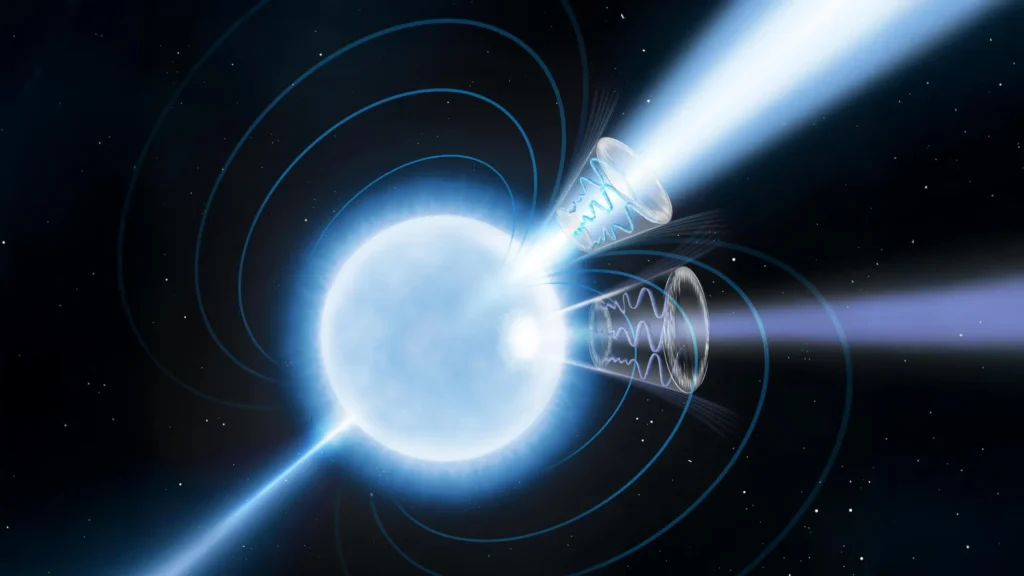
Magnetars, however, possess an additional, mind-boggling characteristic: magnetic fields of unparalleled strength, vastly exceeding those of typical neutron stars. These fields can be more than a quadrillion times stronger than Earth’s magnetic field, reaching values up to 10^15 Gauss (10^11 Tesla). This makes them the most magnetic objects known in the Universe. Such immense fields are thought to arise from a powerful dynamo effect within the star’s rapidly spinning, super-dense, and fluid interior, amplified during the supernova collapse. Their intense magnetism drives powerful bursts of X-rays and gamma rays, making them observable across vast cosmic distances.
It is precisely these extraordinary magnetic fields that make magnetars the ideal candidates for observing vacuum birefringence. Dr. Marcus Lower, an Australian Research Council DECRA Fellow at the Center for Astrophysics and Supercomputing (CAS) at Swinburne University of Technology, eloquently summarizes this cosmic convenience: "Detecting vacuum birefringence requires a magnetic field that is over 100 million times stronger than any we’ve ever made on Earth. Thankfully, nature has provided us with magnetars, which are the perfect cosmic laboratories to go looking for this effect."
The Study: Watching an Extreme Magnetar
The recent groundbreaking research involved a large international collaboration, bringing together scientists from institutions across the globe. Key contributors included the Center for Space Sciences and Technology, the South African Radio Astronomy Observatory (SARAO), the Los Alamos National Laboratory, NASA’s Marshall Space Flight Center, the Center for Research and Exploration in Space Science & Technology (CRESST), and the Astrophysics Science Division at NASA’s Goddard Space Flight Center, alongside numerous universities. The study, led by Rachael E. Stewart, a Graduate Student of Physics at George Washington University, was recently published in the prestigious journal Nature, highlighting its significance within the scientific community.
The team focused their observational efforts on a specific magnetar designated 1E 1547.0-5408 (often shortened to 1E1547). This particular magnetar is known for its extreme properties and has been a subject of interest for astronomers due to its highly active nature. Dr. Lower led the crucial radio observations using CSIRO’s Murriyang, also known as the Parkes radio telescope, a 64-meter steerable dish located in New South Wales, Australia. This iconic telescope, renowned for its sensitivity and versatility, allowed the researchers to capture the magnetar’s radio emissions with exquisite detail. The vast datasets collected were then processed and analyzed using Swinburne University’s Ngarrgu Tindebeek supercomputer, a powerful computational resource essential for sifting through complex astronomical data.
To gain a comprehensive understanding, the radio observations were synergistically combined with measurements from two cutting-edge NASA X-ray observatories: the Imaging X-ray Polarimetry Explorer (IXPE) and the NICER (Neutron star Interior Composition Explorer) X-ray telescope, which is mounted on the International Space Station. IXPE, launched in late 2021, is specifically designed to measure the polarization of cosmic X-rays, providing unique insights into the physics of extreme celestial objects. NICER, on the other hand, provides precise timing and spectral information of X-ray sources, crucial for understanding the magnetar’s rotational dynamics and emission properties.
As the team meticulously monitored 1E1547’s radio emissions, they tracked the orientation of the waves’ oscillations – their "polarization state" – as the magnetar rotated. Polarization is a fundamental property of light (and other electromagnetic waves) that describes the direction of its electric field oscillation. Changes in polarization can reveal interactions with intervening matter or fields.
The detailed measurements revealed two critical characteristics of 1E1547 that made it exceptionally well-suited for this study. Firstly, the magnetar’s magnetic axis and its rotational axis were found to be almost perfectly aligned. Secondly, the object is observed from a nearly "pole-on" perspective, meaning we are looking down almost directly onto one of its magnetic poles. These specific geometric alignments are crucial because they simplify the interpretation of the polarization data. If the axes were misaligned or the viewing angle was equatorial, the complex interplay of rotation and magnetic field geometry would make it much harder to isolate the subtle signature of vacuum birefringence from other astrophysical effects.
X-Rays Reveal a Possible Quantum Signature
The most compelling evidence emerged from the X-ray data, particularly those gathered by IXPE. The X-rays emanating from the magnetar showed an extremely high degree of polarization, far beyond what might be expected from standard astrophysical processes alone. Furthermore, researchers discovered that the direction of this polarization remained consistently aligned with 1E1547’s magnetic field, mirroring the behavior observed in its radio waves.
Both of these observations – the unusually high X-ray polarization and its precise alignment with the magnetar’s magnetic field – are considered strong indicators that vacuum birefringence may indeed be occurring in the extreme environment surrounding the magnetar. In a vacuum without an external field, virtual particles appear and disappear isotropically, meaning they have no preferred orientation, and light travels unimpeded. However, in the presence of a powerful magnetic field, the virtual particles become "polarized" or aligned with the direction of the field. This alignment then influences how light propagates, effectively rotating its plane of polarization.
Dr. Lower elaborated on this crucial point: "Because of the magnetic field’s strength, Heisenberg’s virtual particles become aligned with the direction the field is pointing. By carefully tracking the direction the radio waves and X-rays oscillate as the magnetar rotates, the team found that the alignment of 1E1547’s magnetic and rotational poles was ideal for detecting vacuum birefringence. With these future data on hand and our updated simulations, we may finally be able to complete the quest started by Heisenberg nearly 90 years ago." The consistency across different wavelengths (radio and X-ray) further strengthens the case, suggesting a fundamental process is at play rather than a phenomenon specific to one emission mechanism.
The Broader Impact and Future Outlook
If these results are definitively confirmed, they would represent a monumental achievement in physics, marking the first direct observational evidence of vacuum birefringence. Such a confirmation would not only validate a nearly century-old prediction from quantum theory but also provide an unprecedented window into the behavior of fundamental physical laws under conditions that are utterly impossible to replicate on Earth.
The implications for quantum physics are profound. It would offer a robust empirical test of quantum electrodynamics in an extreme, astrophysical setting, pushing the boundaries of its experimental verification. This could lead to a deeper understanding of how virtual particles interact with intense gravitational and magnetic fields, potentially revealing new aspects of quantum field theory that are currently only theoretical. It might also inform our understanding of other extreme astrophysical phenomena, where such strong fields play a crucial role.
For astrophysics, this breakthrough would establish magnetars not just as fascinating cosmic objects, but as indispensable natural laboratories for fundamental physics research. It could open new avenues for studying the properties of matter at ultra-high densities and in super-strong magnetic fields, conditions that exist nowhere else in the Universe. This could refine our models of neutron star interiors, their evolution, and their role in cosmic events.
However, the scientific community emphasizes that "more evidence is still needed." The current observations are highly suggestive, but conclusive proof requires further validation. This will involve additional observations of 1E1547 and potentially other suitable magnetars. Future studies will leverage advanced instrumentation and increasingly sophisticated computer simulations to meticulously rule out alternative astrophysical processes that might mimic the observed polarization signatures. While the alignment and strength of polarization are strong indicators, other mechanisms, such as scattering within the magnetar’s magnetosphere or relativistic beaming effects, need to be carefully modeled and excluded.
The scientific journey initiated by Werner Heisenberg nearly nine decades ago has now reached a pivotal moment. With the promise of future data and refined theoretical models, scientists are poised to potentially complete this quest, unlocking secrets of the quantum vacuum and expanding our understanding of the Universe’s most fundamental laws. This collaborative endeavor, spanning continents and disciplines, underscores the power of both theoretical foresight and cutting-edge observational technology in unraveling the cosmos’ deepest mysteries.