On August 12, 2026, as parts of Europe prepared to witness a breathtaking total solar eclipse, a remarkable feat of space engineering unfolded approximately 60,000 kilometers above Earth. The European Space Agency’s (ESA) Proba-3 mission, a pioneering duo of spacecraft, successfully generated its 65th artificial solar eclipse, a meticulously orchestrated event that provided an unprecedented glimpse into the Sun’s elusive corona. This artificial celestial alignment occurred mere hours before the Moon’s shadow would sweep across the continent, offering a unique scientific opportunity to study the Sun’s outer atmosphere without the interference of atmospheric conditions or the need for natural alignment.
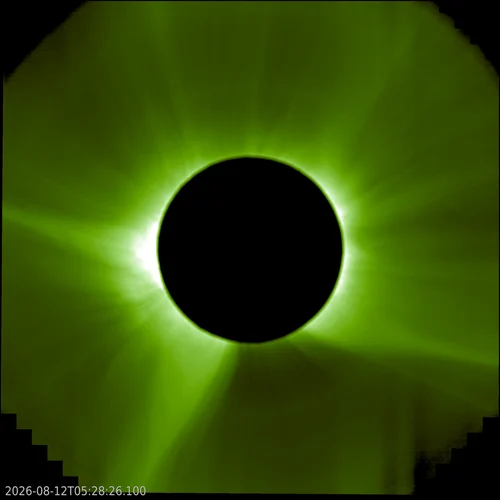
The images captured by the ASPIICS (Advanced Spaceborne Polarimetric Coronagraph) instrument aboard Proba-3’s Coronagraph spacecraft revealed the Sun’s inner corona as a delicate, greenish halo. This specific hue, as observed in the morning of August 12, 2026, closely mirrors the appearance of the corona as it would be seen by ground-based observers during a total solar eclipse, particularly when viewed through a green filter. The Proba-3 mission, therefore, not only achieved a scientific objective but also served as a predictive model for the natural spectacle that would soon captivate millions.
The Art of Artificial Eclipse: Proba-3’s Ingenious Design
The Proba-3 mission’s ability to create an artificial eclipse hinges on a sophisticated formation flying technique. The mission comprises two independent satellites: the Occulter and the Coronagraph. These spacecraft maintain a precise separation of approximately 150 meters, aligning themselves in a perfect formation. The Occulter spacecraft is ingeniously positioned to act as an artificial Moon, precisely blocking the Sun’s intensely bright disc. This deliberate obscuration shields the Coronagraph spacecraft’s sensitive instruments, granting it an unobstructed and continuous view of the Sun’s corona for extended periods. This controlled environment allows scientists to study the dynamic processes occurring in the corona, such as solar flares and coronal mass ejections, with unparalleled clarity.
Unlike natural eclipses, which are fleeting and depend on celestial mechanics, Proba-3’s artificial eclipses are repeatable and controllable. This capability is crucial for accumulating a comprehensive dataset on the solar corona, enabling researchers to analyze its structure, temperature, and magnetic field over time. The mission’s success in achieving its 65th such event underscores the reliability and precision of its operational capabilities.
A Celestial Coincidence: The Double Eclipse
Adding a poetic touch to the day’s astronomical events, on August 12, 2026, the Moon itself decided to participate in the celestial drama. Shortly after Proba-3’s artificial eclipse was captured, the Moon gracefully traversed the mission’s field of view, creating a rare and visually stunning "double eclipse." This unique occurrence, where an artificial eclipse is immediately followed by a natural one, provided an extraordinary opportunity for comparative studies. Scientists could analyze how the corona appeared under both controlled and natural obscuration, potentially revealing subtle differences or confirming existing observations. ESA documented this remarkable event in a video titled "A double eclipse for Proba-3," highlighting the serendipitous alignment of human ingenuity and cosmic events.
Predictive Power: Proba-3 as a Solar Forecaster
The Proba-3 mission’s scientific utility extends beyond its ability to create eclipses. Approximately two weeks prior to the August 12th event, the mission was positioned on the opposite side of the Sun relative to its August observation. During this period, Proba-3 captured images of the Sun from this alternative vantage point. Given that the Sun completes half a rotation on its axis in roughly two weeks, the coronagraphy images obtained earlier served as a remarkably accurate prediction of the solar corona’s appearance for the August 12th eclipse. This predictive capability is invaluable for astronomers and space weather forecasters, allowing them to anticipate solar activity and its potential impact on Earth. The mission’s ability to mimic the views of the upcoming natural eclipse was highlighted in an ESA image titled "Proba-3 mimics the 2026 total solar eclipse."
The Natural Spectacle: Millions Witness the Lunar Eclipse
While Proba-3 was conducting its sophisticated observations, millions of people across Europe and beyond were preparing to witness the awe-inspiring natural total solar eclipse of August 12, 2026. This celestial event, a rare and anticipated occurrence, traced a path across various European countries, drawing crowds of skygazers, amateur astronomers, and scientific observers. The path of totality, where the Sun is completely obscured by the Moon, offered a unique opportunity to observe the Sun’s corona with the naked eye, albeit with appropriate protective eyewear. Many scientific missions, both ground-based and space-borne, were dedicated to observing this natural phenomenon, contributing to a global effort to understand our star. ESA itself published a compilation of observations under the title "A look back at the 2026 total solar eclipse," showcasing the collective scientific and public engagement with the event.
Supporting Data and Technical Details
- Mission Name: Proba-3 (Project for On-Board Autonomy)
- Launch Date: December 2023
- Orbital Altitude: Approximately 60,000 kilometers above Earth
- Spacecraft Separation: 150 meters
- Instruments: ASPIICS (Advanced Spaceborne Polarimetric Coronagraph) on the Coronagraph spacecraft; Occulter spacecraft
- Artificial Eclipse Frequency: 65 successful events as of August 12, 2026
- Corona Appearance: Greenish hue, consistent with ground-based observations through a green filter during a total solar eclipse.
Background Context: The Significance of Solar Corona Research
The Sun’s corona, its outermost atmospheric layer, is a region of extreme temperature and dynamic activity, reaching millions of degrees Celsius. Studying the corona is crucial for understanding fundamental astrophysical processes, including the acceleration of the solar wind, the generation of solar flares, and the behavior of magnetic fields in stars. However, the corona’s faintness compared to the Sun’s brilliant disc makes it incredibly difficult to observe from Earth without artificial means. Natural solar eclipses provide a temporary window, but their infrequent and geographically limited nature restricts the scope of study.
Space-based coronagraphs, like ASPIICS on Proba-3, are designed to overcome this challenge by artificially blocking the Sun’s disc. Proba-3’s unique formation-flying approach, where one spacecraft acts as an occulting disk for another, represents a significant advancement in this field. This method allows for sustained and high-resolution observations of the corona, providing data that is vital for space weather forecasting and for unraveling the mysteries of solar physics.
Timeline of Events: August 12, 2026
- Morning (European Time): Proba-3 mission initiates its 65th artificial solar eclipse. The ASPIICS coronagraph captures detailed images of the Sun’s inner corona, revealing its characteristic greenish glow.
- Shortly After Artificial Eclipse: The Moon enters Proba-3’s field of view, creating a rare "double eclipse" – a simultaneous artificial and natural obscuration.
- Later in the Day (European Time): The natural total solar eclipse sweeps across parts of Europe, captivating millions of viewers and researchers.
Official Responses and Scientific Reactions
"The Proba-3 mission continues to exceed expectations, providing us with unparalleled insights into the Sun’s corona," stated a spokesperson for ESA’s Science Directorate. "The successful execution of its 65th artificial eclipse, coinciding with the natural event, is a testament to the ingenuity and dedication of the engineering and scientific teams involved. This mission is not just about observing the Sun; it’s about understanding our star and its influence on our solar system."
Dr. Anya Sharma, a solar physicist not directly involved with Proba-3 but who studies coronal dynamics, commented, "The data from Proba-3 is invaluable. The ability to create precise, repeatable eclipses allows us to gather long-term datasets that were previously impossible. The correlation between the artificial eclipse images and the predictions made from earlier observations is particularly exciting, validating our understanding of solar rotation and activity patterns."
Broader Impact and Implications
The Proba-3 mission’s success has several significant implications for space science and technology:
- Advancement in Formation Flying: Proba-3’s precise formation flying capabilities push the boundaries of what is achievable in space missions. This technology has potential applications in future constellations of satellites for Earth observation, telecommunications, and astronomical research.
- Enhanced Solar Research: The continuous, high-resolution data stream from Proba-3’s coronagraph will significantly contribute to our understanding of solar physics, helping to predict space weather events such as solar flares and coronal mass ejections. These events can have disruptive effects on satellite operations, power grids, and communication systems.
- Improved Space Weather Forecasting: By providing more accurate models of solar activity and corona behavior, Proba-3’s data can lead to more reliable space weather forecasts, enabling better preparedness for potential impacts on Earth.
- Inspiration for Future Missions: The success of Proba-3 serves as a powerful inspiration for the development of future, more ambitious solar observation missions and space-based observatories.
The coincidence of Proba-3’s 65th artificial eclipse with the natural solar eclipse on August 12, 2026, underscores a remarkable synergy between human scientific endeavor and the grand theater of the cosmos. The mission continues to unlock the secrets of our Sun, offering a deeper appreciation of its power and influence on our planet.