The landscape of STEM (Science, Technology, Engineering, and Mathematics) education has undergone a significant transformation over the last decade, moving from purely digital interfaces back toward tactile, hands-on fabrication. Central to this "Maker Movement" is cardboard—a ubiquitous, sustainable, and highly versatile material. However, the primary barrier for young children engaging in cardboard construction has always been safety, specifically the risks associated with utility knives and traditional saws. The ChompSaw, a desktop power tool designed by Chompshop, attempts to bridge this gap by offering a motorized cutting solution specifically engineered for users as young as three years old. Priced at $249 for the base unit and $299 for the comprehensive Maker Bundle, the ChompSaw is positioned as a premium educational tool intended for both home environments and institutional makerspaces.
The Genesis of a Safety-First Power Tool
The ChompSaw did not begin as a commercial product but rather as a pedagogical inquiry. It was developed by Kausi Raman as a project within a Master’s program, specifically designed to introduce design-thinking skills to early childhood learners. Raman’s objective was to create a tool that provided the empowerment of a power tool without the inherent dangers of exposed blades. The transition from a graduate project to a market-ready device involved rigorous safety testing and iterative design to ensure the device met stringent safety certifications.
Historically, child-friendly cardboard tools were limited to manual saws with serrated plastic edges or "safe" variants of utility knives that still required significant fine motor skills and adult supervision. The ChompSaw represents a departure from these manual methods, utilizing a mechanized "nibbling" action. This design choice is rooted in industrial metalworking tools, where a punch-and-die mechanism removes small portions of material rather than parting it with a continuous edge. By miniaturizing and shielding this mechanism, Raman created a device where fingers—even the small fingers of a preschooler—cannot physically reach the cutting element.
Technical Specifications and Mechanical Design
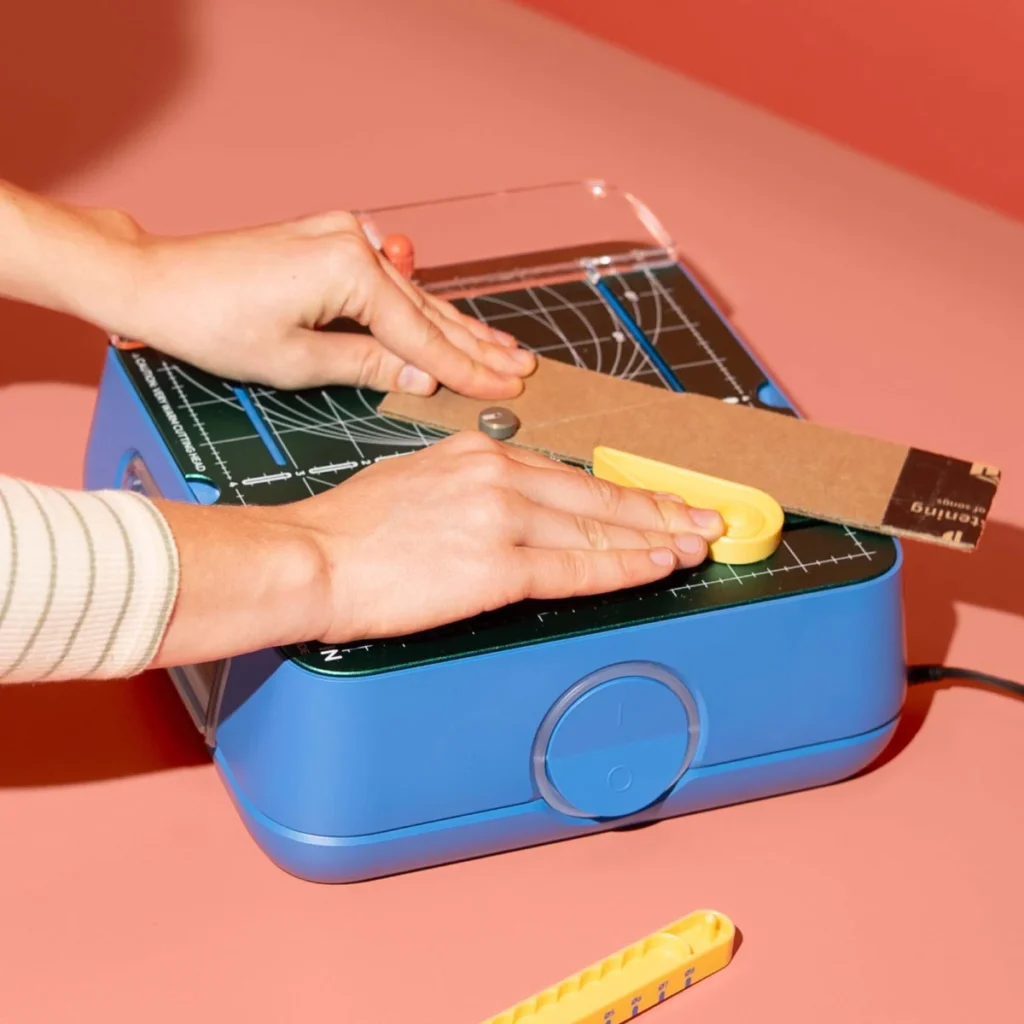
The ChompSaw is a robustly constructed desktop unit that prioritizes stability and ease of use. The device features a solid plastic base that houses the internal motor and a slide-out dust collection drawer designed to capture the "chomps"—the small rectangular bits of cardboard removed during the cutting process. The power cord is integrated with a storage solution within the base to maintain a tidy workspace.
The cutting interface consists of a heavy metal lid that serves as a guide for the material being fed into the machine. This lid is reversible, featuring both imperial (inch) and metric (centimeter) markings to assist in precision measurements. A prominent, chunky toggle switch serves as the primary on/off control, selected specifically for its tactile feedback and accessibility for children with varying levels of grip strength.
Mechanically, the ChompSaw operates like a high-speed precision hole puncher. As cardboard is fed into the narrow aperture, the internal mechanism takes rapid "bites" out of the material. This method offers several advantages over traditional sawing:

- Reduced Friction: Unlike a rotating blade, the nibbling action does not create significant heat or kickback.
- Multidirectional Cutting: The tool allows for the creation of intricate curves and internal cutouts that would be difficult to achieve with a straight blade.
- Controlled Speed: The rate of the cut is determined by how fast the user pushes the material, allowing for a meditative, steady workflow.
Real-World Performance and User Demographics
Field testing of the ChompSaw reveals a surprising level of versatility across age groups. In a controlled trial at a local public library, children as young as four years old were able to master the basic straight cut within minutes of introduction. While parental supervision remains recommended for the youngest users, the safety-certified design (ages 3+) provides a level of psychological comfort that traditional tools do not.
The tool’s utility extends into the teenage years as well. During testing, a ninth-grade student utilized the ChompSaw to modify a plastic folder, demonstrating that the tool’s capabilities are not strictly limited to corrugated cardboard. It effectively handles cardstock, thin plastics, and various grades of paper products. The "meditative state" reported by observers—where users of all ages become engrossed in the steady, rhythmic feeding of material into the cutter—suggests a high level of user engagement and satisfaction.
The Maker Bundle and Educational Ecosystem
While the standalone ChompSaw is a capable cutting tool, the $299 Maker Bundle expands the device into a full-scale design laboratory. This bundle includes specialized hand tools for punching holes and scoring folds, which are essential for creating 3D structures. It also features an alternate metal lid designed to assist in cutting perfect circles and maintaining specific angles, a feature that significantly lowers the barrier for complex engineering projects.
Chompshop has placed a heavy emphasis on the "software" of making—the instructional materials that guide a child from a novice to an inventor. The Inventor’s Workbook included with the bundle is a standout pedagogical resource. It avoids the dry tone of a technical manual, instead utilizing clear illustrations and real-world examples to explain the design process. Vocabulary terms are introduced and defined in context, making it a valuable literacy tool as well.
Furthermore, the company maintains a robust digital presence at learn.chompshop.com. This platform offers:
- K-8 Lesson Plans: Structured curricula for educators to integrate the tool into classrooms.
- Printable Templates: Projects that can be printed and traced onto cardboard.
- Badge Goals: A gamified system to encourage students to master specific fabrication skills.
- Monthly Subscription Kits: Add-on sets that include paper templates and supplementary supplies like marbles and rubber bands for kinetic projects.
Market Context and Economic Value
At a price point of $249 to $299, the ChompSaw is a significant investment compared to a $5 manual cardboard saw. To understand its value proposition, one must look at the broader STEM market. Comparable desktop fabrication tools, such as entry-level 3D printers or vinyl cutters (like the Cricut), occupy similar price brackets. However, those tools often require a steep learning curve involving CAD (Computer-Aided Design) software.
The ChompSaw offers an "analog-first" entry into engineering. It empowers children to build large-scale structures—playhouses, armor, robot chassis, and dioramas—without the frustrations of manual cutting. For schools and libraries, the ChompSaw represents a one-time capital expense that utilizes free or low-cost raw materials (recycled shipping boxes), making the long-term cost of operation lower than 3D printers which require constant filament purchases.

Maintenance and Operational Considerations
Despite its high-quality construction, the ChompSaw is not without minor operational quirks. The primary maintenance task involves the accumulation of cardboard dust. Because the tool functions by punching out small pieces of material, a fine dusting of fibers can collect around the cutting head and the internal drawer. Regular cleaning—either by shaking the unit out or using a small vacuum—is necessary to prevent the mechanism from slowing down.
Additionally, when cutting particularly thick or multi-layered corrugated cardboard, the unit can occasionally vibrate or slide on smooth surfaces. The manufacturer suggests using a non-slip mat or securing the base for heavy-duty projects. Users should also be aware that while the tool is exceptionally safe, it is also loud, producing a mechanical hum and "clacking" sound consistent with high-speed punching, which might be overstimulating for some sensitive users.
Broader Implications for Early Engineering
The introduction of the ChompSaw into the educational market signals a shift toward "low-floor, high-ceiling" tools. A "low floor" means the tool is easy for a beginner to start using immediately, while a "high ceiling" means the tool is capable of sophisticated, complex work as the user’s skills grow.
By removing the "danger" element from power tools, the ChompSaw allows the focus to shift from "how do I cut this without getting hurt?" to "what can I design with this material?" This shift is critical for fostering a design-thinking mindset. It encourages iteration—the process of building, testing, failing, and rebuilding—because the physical act of fabrication is no longer a laborious or frightening chore.
Conclusion
The ChompSaw stands as a unique entry in the world of educational technology. It successfully navigates the difficult balance between being a "toy" and a "tool," providing a professional-grade experience for a very young audience. While the price may be a deterrent for some individual households, its durability, safety certifications, and the depth of its supporting educational ecosystem make it a compelling choice for schools, libraries, and serious young makers. As the maker movement continues to emphasize sustainability and hands-on creativity, tools like the ChompSaw will likely become staples of the modern classroom, serving as the gateway through which the next generation of engineers and designers enters the field.