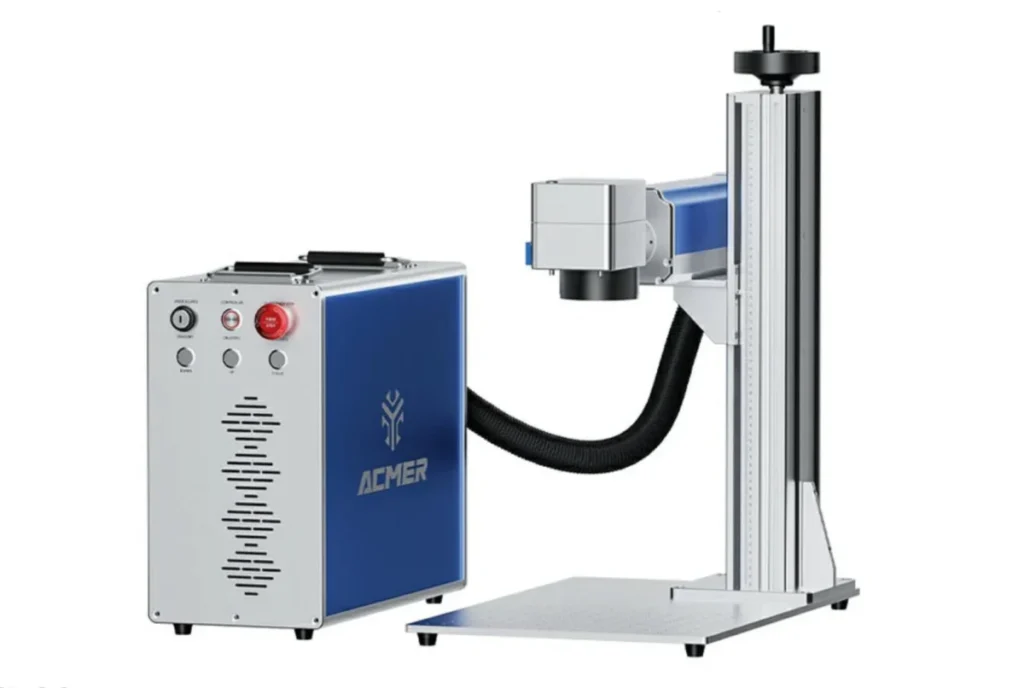
The Acmer SM 60W MOPA Split Laser represents a significant entry into the industrial-grade marking market, offering a high-power solution for professionals requiring rapid, precise engraving on metals and hard plastics. Priced at approximately $6,299 as tested, this machine sits at a crossroads between accessible desktop units and high-end factory floor equipment. While the "maker" community has traditionally favored gantry-style diode or CO2 lasers, the emergence of affordable fiber and MOPA (Master Oscillator Power Amplifier) technology has shifted the landscape, allowing small-scale manufacturers and specialized workshops to access speeds and material capabilities previously reserved for large-scale industrial operations.
Understanding the MOPA Technology and Machine Variations
The Acmer SM series is marketed in four distinct configurations to meet varying professional needs: 30W and 50W fiber models, and 60W and 100W MOPA models. While standard fiber lasers are highly effective for high-contrast marking on metals, MOPA technology offers a distinct advantage through its ability to control pulse duration. This flexibility allows for a wider range of effects, including the ability to engrave colors on stainless steel and achieve high-contrast blacks on anodized aluminum without damaging the underlying substrate.
The unit tested—the 60W MOPA variant—boasts a maximum marking speed of 10,000mm/s. This velocity is made possible by a galvanometer (galvo) system, which utilizes high-speed vibrating mirrors to direct the laser beam rather than moving a heavy laser head along a physical X-Y gantry. Out of the box, the machine provides a 150mm x 150mm marking area, though this can be expanded to 300mm x 300mm with the purchase of optional lenses.
Hardware Design and Industrial Build Quality
The physical presence of the Acmer SM 60W immediately signals its industrial intentions. Shipping in a heavy-duty crate that requires a two-person lift, the machine is constructed from substantial aluminum components. The "split" design is a critical feature for versatility; the laser head is mounted on a column separate from the main power and control box, allowing it to be positioned over larger or more awkwardly shaped workpieces that would not fit inside a standard enclosed cabinet.

Key hardware features include:
- Integrated Autofocus: A significant time-saver in production environments, the autofocus system ensures the laser is perfectly positioned for the material’s height.
- Sino-Galvo Scanner: A reputable component in the laser industry, the scanner ensures precision at the machine’s high operating speeds.
- Foot Pedal Operation: Included to facilitate high-volume throughput, allowing operators to trigger the marking process while keeping their hands free to position parts.
- Extended Duty Cycle: The manufacturer specifies that the cooling system is designed for continuous operation for up to 24 hours, catering to commercial shift work.
One notable design choice is the permanent tethering of the fiber cable between the power unit and the laser head. This requires careful planning during the setup process to avoid strain on the optical fiber, which is sensitive to tight bends or rough handling.
The Marking Experience: Speed and Precision
In performance testing, the Acmer SM 60W demonstrates the raw efficiency of galvo-based systems. Tasks that would take several minutes on a traditional gantry-style laser are completed in seconds. The 60W power source provides ample overhead for deep engraving (etching into the metal) rather than merely surface marking.
The MOPA source’s primary "party trick"—color marking on stainless steel—is functional but requires a steep learning curve. By modulating five distinct parameters (power, frequency, speed, pulse width, and hatch spacing), users can induce thin-film interference on the metal surface to create various hues. While the review noted the production of muted pastels, achieving a full, vibrant spectrum requires significant experimentation and a stable environment, as atmospheric conditions and material purity can affect the outcome.
Software Compatibility and User Interface Challenges
The Acmer SM 60W is primarily designed for the Windows operating system, reflecting its industrial roots. The machine comes bundled with BsIAppSimple, a proprietary software package that serves the basic needs of marking but lacks the polish found in consumer-facing applications.

Technical observations regarding the software include:
- File Compatibility: Some users may encounter issues with imported SVG files appearing scrambled or incorrectly rendered within the native app.
- Learning Curve: The interface uses non-standard terminology; for instance, the "fill" function—critical for creating solid engraved areas—is labeled simply as "H."
- Third-Party Support: The machine is compatible with LightBurn (specifically the galvo version) and EZCAD2. For most professional users, migrating to LightBurn is recommended for a more intuitive workflow and better file management.
Furthermore, the physical labeling on the machine itself can be counterintuitive. The power sequence is dictated by switches labeled "ON1," "ON2," and "ON3," which must be activated in a specific order to safely engage the laser source and control board.
Critical Safety Considerations in Open-Frame Designs
Perhaps the most significant aspect of the Acmer SM 60W is its status as a Class 4 laser product. Unlike "plug-and-play" consumer lasers that often come with protective enclosures and interlocks, the Acmer SM is an open-frame system. This design choice offers maximum flexibility for marking large parts but introduces substantial risks that must be managed by the end-user.
Eye Safety: The laser operates at a wavelength (typically 1064nm) that is invisible to the human eye but can cause permanent retinal damage instantly, even via reflections off metallic surfaces. While Acmer includes safety glasses, the lack of clear certification markings on the provided PPE is a point of concern. Professionals are strongly advised to invest in certified OD7+ safety eyewear from reputable manufacturers.
Fume Management: Marking metals and plastics generates hazardous particulate matter and gasses. The Acmer SM lacks an integrated extraction system. In an industrial setting, this necessitates the installation of a high-volume fume extractor and a dedicated ventilation solution to protect the operator’s respiratory health.

Enclosure Requirements: For any environment outside of a controlled industrial zone, the addition of a DIY or third-party enclosure is highly recommended. This not only contains stray reflections but also provides a mounting point for interlocks and fume extraction ports.
Market Context and Implications for Small-Scale Manufacturing
The introduction of the Acmer SM 60W at the $6,000 price point reflects a broader trend in the democratization of industrial tools. Ten years ago, a 60W MOPA laser with these specifications would have cost tens of thousands of dollars and required a specialized technician for setup. Today, these machines are available to small businesses, allowing for the in-house production of serialized parts, branded merchandise, and high-precision tools.
However, the "budget" nature of this machine comes with trade-offs in documentation and user support. The manual is reportedly sparse, and the user is expected to have a baseline understanding of fiber laser physics. This makes the Acmer SM less suitable for a hobbyist’s first laser and more appropriate for an experienced operator or a shop that already utilizes similar technology.
Chronology of Setup and Operation
- Unboxing: Removal from the wooden crate and inspection of the aluminum base and column.
- Mechanical Assembly: Bolting the column to the base and mounting the laser head.
- Electrical Connection: Connecting the foot pedal and USB interface to a Windows-based PC.
- Driver Installation: Loading the specific drivers for the Sino-Galvo controller.
- Calibration: Running test grids to ensure the software’s digital output matches the physical dimensions of the marking area.
- Focusing: Utilizing the autofocus or manual height adjustment to find the focal point (the "sweet spot" where the laser beam is most concentrated).
- Production: Marking materials ranging from anodized aluminum to stone and stainless steel.
Final Assessment
The Acmer SM 60W MOPA Split Laser is a formidable tool that offers high-speed, high-power marking capabilities for a fraction of the cost of traditional industrial brands. It excels in environments where speed is the primary metric and where the materials being processed—primarily metals—are unsuitable for CO2 or diode lasers.
Prospective buyers must weigh the machine’s impressive performance against its lack of built-in safety features and the unrefined nature of its included software. For the professional shop capable of providing a safe, well-ventilated workspace and willing to invest in a LightBurn license, the Acmer SM represents a high-value investment that can significantly increase production throughput. Conversely, for those looking for a user-friendly, "safe-for-the-home" experience, the inherent risks of an open-frame 60W fiber laser may outweigh the benefits of its speed.