For centuries, the depths off New England’s coast have stirred the human imagination with tales of the sea’s hidden denizens, none more captivating than the cephalopods. From ancient mariners’ legends of monstrous tentacled creatures to the widely publicized encounters with colossal giant squid along the North Atlantic in the 1800s, these intelligent invertebrates have held a special, often mysterious, place in maritime lore. Today, the focus of scientific inquiry and commercial interest turns to a more common yet equally fascinating inhabitant: the longfin inshore squid, Doryteuthis pealeii, affectionately known as the "Boston squid." This species has long been a cornerstone of the regional commercial fisheries, thriving in the emerald green, often turbid and nutrient-rich waters that characterize the coast of Massachusetts. Their presence, though vital, is often fleeting and profoundly influenced by the ever-changing dynamics of their ocean home.
The challenges of observing such a creature in its natural habitat are immense, a reality intimately understood by Keith Ellenbogen, an acclaimed underwater photographer and the resident artist for MIT Sea Grant. Ellenbogen has spent countless hours navigating these very waters, where visibility can be as limited as 20 feet on a truly exceptional day. Even under these optimal conditions, the longfin inshore squid, with its remarkable agility and mastery of camouflage, proved an elusive subject, evading his sophisticated lens for many months. His persistent quest to document their secret lives underscores the profound difficulty in truly comprehending the aquatic world, even for species that play a critical role in our ecosystems and economies.
Commercial Significance and Recent Volatility in Massachusetts
The economic footprint of the longfin squid in Massachusetts is substantial and deeply interwoven with the state’s vibrant seafood industry. In 2023, commercial landings of longfin squid in Massachusetts soared, exceeding 2.85 million pounds. This impressive haul, estimated to represent over 6 million individual squid, generated a value surpassing $2.82 million for the state’s fishing communities. The species consistently ranks among the top 10 commercially landed species in Massachusetts, sharing this prestigious list with other iconic marine resources such as the American lobster, Atlantic surf clam, and sea scallop. This consistent ranking highlights its enduring significance, not just as a commodity, but as a vital component of the local economy and cultural heritage, supporting livelihoods from fishermen to processors and distributors.
However, the narrative of consistent abundance took a dramatic turn in 2024. Preliminary data for the current year reveal a sharp decline, with landings plummeting to under 750,000 pounds – roughly a quarter of the previous year’s catch. This stark reduction was corroborated by scientific assessments. The spring 2024 trawl survey, meticulously documented in the Massachusetts Division of Marine Fisheries Annual Report, recorded a historic low in longfin squid biomass. This sharp downturn followed directly on the heels of a record-high biomass observed in 2023, presenting a perplexing picture of extreme year-to-year variability that demands careful scientific scrutiny.
Understanding the Unpredictable Nature of Squid Populations
While such a precipitous drop in landings might typically signal deep concern for a species’ health, for the longfin inshore squid, it does not necessarily portend long-term trouble. Biologically, Doryteuthis pealeii is renowned for exhibiting significant, often dramatic, fluctuations in abundance from one year to the next. This inherent unpredictability is largely attributable to several key biological and environmental factors. Longfin squid possess an exceptionally short lifespan, typically ranging from a mere six to nine months. This rapid life cycle means that population dynamics are highly susceptible to immediate environmental pressures and reproductive success in any given spawning season. A single unfavorable environmental event can profoundly impact an entire generation.
Furthermore, their sensitivity to shifting ocean conditions makes them particularly vulnerable to environmental changes. Factors such as sea surface temperature, ocean currents, and the availability of planktonic prey can profoundly influence their survival, growth, and reproductive output. For instance, warmer waters might accelerate growth and maturation but could also alter prey distribution or increase predation pressure from other species. Conversely, colder waters might slow growth, impacting their ability to reach reproductive size within their brief lifespan or making them more susceptible to disease. Intense competition for resources or increased predation from a boom in predator populations can also contribute to sudden declines. This intrinsic volatility necessitates a nuanced approach to their management and conservation, moving beyond simple year-on-year comparisons to understand the broader trends and underlying drivers of these dynamic population cycles. Such an approach often involves looking at multi-year averages and considering ecosystem-wide changes rather than isolated data points.
Deepening Scientific Understanding: Collaborative Research Initiatives
Recognizing the complex and dynamic nature of longfin squid populations, the scientific community has intensified its efforts to unravel the mysteries surrounding this crucial species. Kimberly Hyde, a distinguished biological oceanographer with the National Oceanic and Atmospheric Administration (NOAA)’s Northeast Fisheries Science Center (NEFSC), highlights the expanded scope of squid research over recent years. NEFSC research scientists have embarked on a comprehensive two-year study specifically focused on longfin squid. This ambitious project aims to meticulously document various aspects of their life history, including tracking their maturity stages, assessing their readiness to spawn, and understanding the environmental cues that trigger these critical life events. Such detailed biological data are indispensable for building more accurate population models, predicting future trends, and informing sustainable management strategies that can adapt to the species’ natural variability.
Beyond governmental research, a robust spirit of collaboration has emerged across the Northeast, uniting scientists with the very fishing industry that depends on these cephalopods. These cooperative research initiatives are critical, bridging the gap between theoretical science and practical, real-world observations. Notable programs include the Longfin Squid Biological Sampling Program (SQUIBS), which collects vital biological data directly from commercial catches, providing real-time insights into the health and structure of the population. Collaborative SQUid Size Monitoring (SQUISM) focuses on tracking changes in squid size distributions, which can indicate shifts in growth rates or age structure. Perhaps most innovative is the Squid-Squad, a highly interdisciplinary consortium comprising scientists, industry members, and fisheries managers, all united by the common goal of advancing squid science. These collaborative efforts acknowledge that fishermen, with their intimate daily knowledge of the marine environment, are invaluable partners in gathering data and understanding the subtle shifts in squid behavior and distribution that might otherwise go unnoticed. Despite these significant strides, Hyde notes that much of this fascinating cephalopod’s story, particularly its most intimate moments of reproduction and early life, remains largely hidden from human sight, underscoring the ongoing need for continued exploration and research.
The Artist’s Breakthrough: A Glimpse into the Hidden World
It was precisely this hidden world that Keith Ellenbogen sought to illuminate. For years, he had endeavored to locate and photograph a squid spawning aggregation, a quest made exponentially difficult by the very nature of their habitat. New England’s coastal waters, while rich in nutrients and teeming with life, are often characterized by their emerald-green hue and limited visibility – a stark contrast to the crystal-clear waters often associated with underwater photography. This challenge, however, fueled Ellenbogen’s determination to reveal the unseen beauty of these vital ecosystems. After extensive planning and preparation, Ellenbogen chartered a specialized vessel and leveraged his network of local fishermen, whose generational knowledge of the sea provided crucial insights into potential squid concentrations beneath the surface, gleaned from years of observing fishing patterns and environmental indicators.
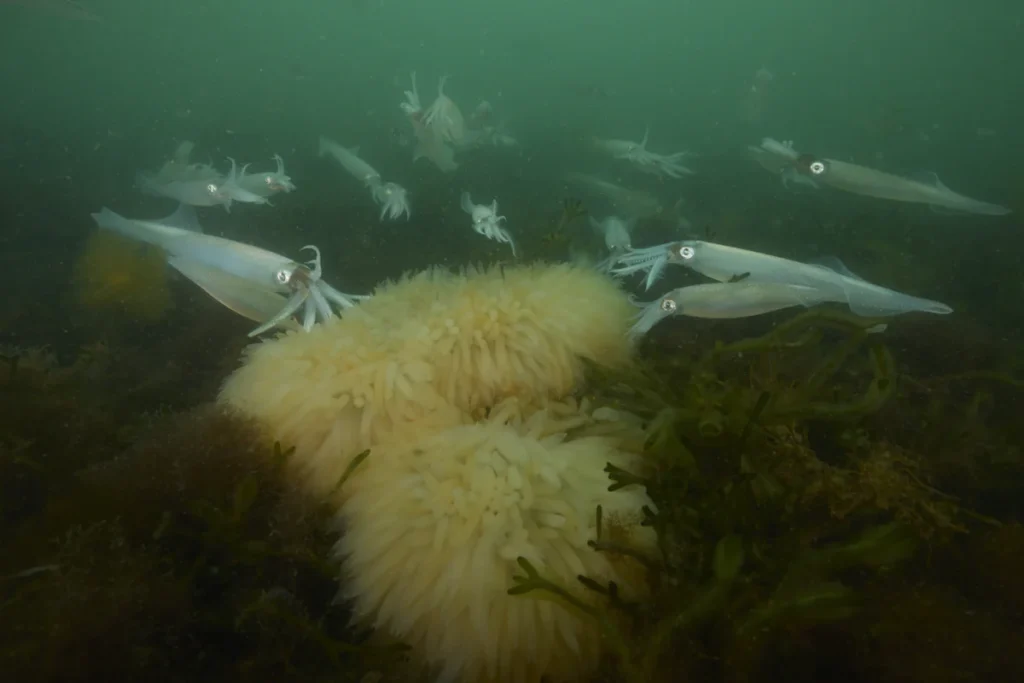
The moment of truth arrived off the coast of Cape Cod. Ellenbogen knew he was directly above the spawning grounds, yet the immense challenge of locating a cluster of eggs and the actively spawning squid 30 to 40 feet below the surface in such murky conditions was formidable. The water’s opacity meant relying heavily on intuition and the subtle shifts in light and shadow. "As I descended through the emerald-green waters of Cape Cod, I couldn’t see anything at first," Ellenbogen vividly recounts, recalling the initial sense of being enveloped by a featureless void. "I knew I was in the right area, but the seafloor seemed empty. Then I noticed a few faint shadows moving in the distance." This initial obscurity gradually gave way to revelation as he pressed onward, meticulously scanning the depths. Swimming closer, the scene slowly, almost magically, revealed itself, transforming from indistinct blurs into a vibrant, living tableau, a hidden world suddenly brought into focus.
Witnessing the Grand Spawning Spectacle
Ellenbogen’s perseverance was rewarded with an extraordinary spectacle, a rare glimpse into the private world of Doryteuthis pealeii. "First came the squid, then the egg masses, and then hundreds more animals appearing out of the green water," he describes, his voice conveying the profound awe of the moment. "Suddenly I found myself surrounded by squid flashing colors, courting, competing, and spawning. It felt like being in a theater, watching a carefully choreographed performance unfold all around me."
Dozens of longfin squid hovered with an intense focus, forming a mesmerizing circle. Their arms and tentacles stretched toward the central attraction: a large, pale cluster of eggs, commonly known as a "mop," securely fixed to a substrate of slipper shells and intricate, fingerlike seaweed. Thousands of individual gelatinous, translucent egg capsules swayed gently in the currents, each a promise of future life. With ceremonial precision, male and female pairs would break from the outer circle, darting inward to deposit and fertilize eggs. Their alien-like bodies pulsed and flickered with an astonishing array of colors—flares of rust-red, golden yellow, iridescent pink, and flashes of lightning white—a vibrant, transient tapestry of life. This critical moment of coordination represented the culmination of their brief lives, a singular, urgent drive to give rise to the next generation. The scene was a profound testament to the intricate and beautiful cycles of marine life, unfolding in a world largely unseen by human eyes, a hidden ballet of survival and renewal.
The Rapid Life Cycle and Unique Biology of Longfin Squid
The life history of the longfin squid is a testament to nature’s efficiency, characterized by a "live fast, die young" strategy. These cephalopods exhibit incredible exponential growth throughout their lifespan, which, as noted, typically lasts less than a year. Their journey begins as planktonic hatchlings, or paralarvae, emerging from their egg capsules at a mere 1.5 millimeters in length. Remarkably, these tiny organisms already possess the fully formed, albeit simplified, morphology of their adult counterparts, complete with chromatophores and developing eyes, ready to navigate the open ocean and begin their predatory existence.
As juveniles, they inhabit coastal surface waters, voraciously feeding on planktonic prey, rapidly increasing in size and complexity. Their rapid growth propels them deeper into the water column, where they transition to a life closer to the seafloor. As natural-born ambush and pursuit predators, they employ jet propulsion and their ten grasping arms and tentacles to hunt small crustaceans, other invertebrates, and even smaller squid. This predatory lifestyle underscores their significant role in the marine food web, both as efficient consumers of lower trophic levels and as a crucial food source for larger fish, seabirds, and marine mammals.
One of the most captivating aspects of squid biology, shared with their octopus relatives, is their sophisticated control over chromatophore organs. These pigmented cells, regulated by an intricate network of nerves and muscles connected to their central nervous system, allow for instantaneous contraction or dilation. The result is a mesmerizing display of iridescence and rapid color shifts. This remarkable ability serves multiple crucial purposes: camouflage, enabling them to blend seamlessly with their surroundings and evade predators; courtship displays, used to attract mates and signal reproductive fitness; and complex communication through an ancient visual language that remains largely undeciphered by humans. Adding an extra layer of intrigue, squid themselves are effectively colorblind. While their eyes are exquisitely adapted to detect contrast, brightness, movement, and even polarization—a form of light perception invisible to humans—they do not perceive hues in the same way we do. This suggests a communication system far removed from our own visual experience, relying on patterns of light and dark, flicker rates, and polarized signals to convey intricate messages.
According to a comprehensive report from the NEFSC, longfin squid can reach sexual maturity at a remarkably small mantle length, sometimes as little as 8 centimeters. Nearing adulthood, they undertake significant migrations, moving offshore to overwinter in deeper, warmer waters along the continental shelf. During these periods, they exhibit schooling behavior, forming large groups often stratified by body size, a strategy that offers protection from predators and aids in foraging efficiency. At night, these schools ascend in the water column to feed, capitalizing on the diel vertical migration of their prey. Growth remains exceptionally rapid and is highly temperature-dependent, with males generally growing faster and attaining larger sizes than females, a common pattern in many species where size confers an advantage in reproductive competition.
Intricate Reproductive Strategies and Communication
Longfin squid demonstrate a year-round spawning capability, though distinct seasonal and geographic peaks are observed. In the nutrient-