Scientific progress is rarely a sudden flash of inspiration; it is more often the culmination of years of meticulous research, incremental advancements, and the persistent dedication of scientists and engineers. These gradual evolutions, building upon foundational theories and experimental findings, eventually lead to breakthroughs that can fundamentally alter our understanding and capabilities. Today, researchers at the University of Michigan (U-M) and the Air Force Research Laboratory (AFRL) stand at what appears to be such a pivotal moment, having successfully demonstrated a novel method for 3D printing intricate tubular structures capable of unprecedented vibration suppression. These engineered marvels, classified as mechanical metamaterials, derive their extraordinary properties not from their inherent chemical composition, but from their meticulously designed internal architecture.
This groundbreaking development, detailed in the latest issue of Physical Review Applied, represents a significant leap forward from theoretical modeling and computer simulations to tangible, functional components. The ability to effectively block or significantly reduce vibrations holds immense potential across a vast spectrum of industries, promising to enhance safety, efficiency, and performance in everything from aerospace and automotive engineering to seismic-resistant construction and sensitive scientific instrumentation.
A New Era of Material Design: Geometry Over Chemistry
For centuries, material science has largely focused on altering the chemical makeup of substances to achieve desired properties. However, the field of metamaterials, as championed by Professor Xiaoming Mao of the University of Michigan’s Department of Physics and his collaborators, shifts this paradigm entirely. "Our work builds on the field of metamaterials, where it is geometry—rather than chemistry—that gives rise to unusual and useful properties," explained Professor Mao. "These geometric principles can apply from the nanoscale to the macroscale, giving us extraordinary robustness." This focus on architectural design, rather than elemental composition, unlocks a new dimension of material engineering, allowing for the creation of substances with characteristics previously unattainable.
The team’s innovation lies in their ability to 3D print complex internal geometries within tubular structures. These intricate designs, inspired by principles rooted in classical structural engineering and modern physics, act as passive vibration disruptors. Unlike active damping systems that require external power and complex control mechanisms, these metamaterials work intrinsically to absorb and dissipate vibrational energy.
James McInerney, a research associate at AFRL and a former postdoctoral fellow at U-M who worked closely with Professor Mao on this project, highlighted the significance of this achievement. "That’s where the real novelty is. We have the realization: We can actually make these things," McInerney stated, underscoring the transition from theoretical possibility to practical realization. He further expressed optimism about the future applications of this technology, adding, "We’re optimistic these can be applied for good purposes. In this case, it’s vibration isolation."
Tracing the Evolutionary Path: From Theory to Tangible Structures
The journey to this breakthrough was a long and complex one, drawing upon decades of theoretical advancements and computational modeling. The foundational concepts for these vibration-suppressing structures can be traced back to the work of 19th-century physicist James Clerk Maxwell. While renowned for his contributions to electromagnetism and thermodynamics, Maxwell also delved into mechanics, developing principles for creating stable structures through repeating subunits known as Maxwell lattices. These lattices, characterized by their specific geometric arrangements, possess inherent stiffness and stability.
A crucial development in the latter half of the 20th century, the emergence of topology as a field of study, provided further theoretical underpinnings. Physicists began to understand that peculiar and significant behaviors could arise at the edges and boundaries of materials. This understanding, particularly the discovery about a decade ago that Maxwell lattices could exhibit a topological phase, proved to be a seminal moment. This topological phase implies a robustness and unique behavior that is protected by the underlying geometry, making it resilient to certain types of perturbations.
Over the past several years, McInerney and his colleagues have been meticulously exploring the implications of this topological phase in the context of vibration isolation. Their research involved building a comprehensive model that explained this behavior and outlined how to design real-world objects exhibiting it. The successful 3D printing of these objects from nylon marks the most advanced stage of this research, validating their theoretical framework.
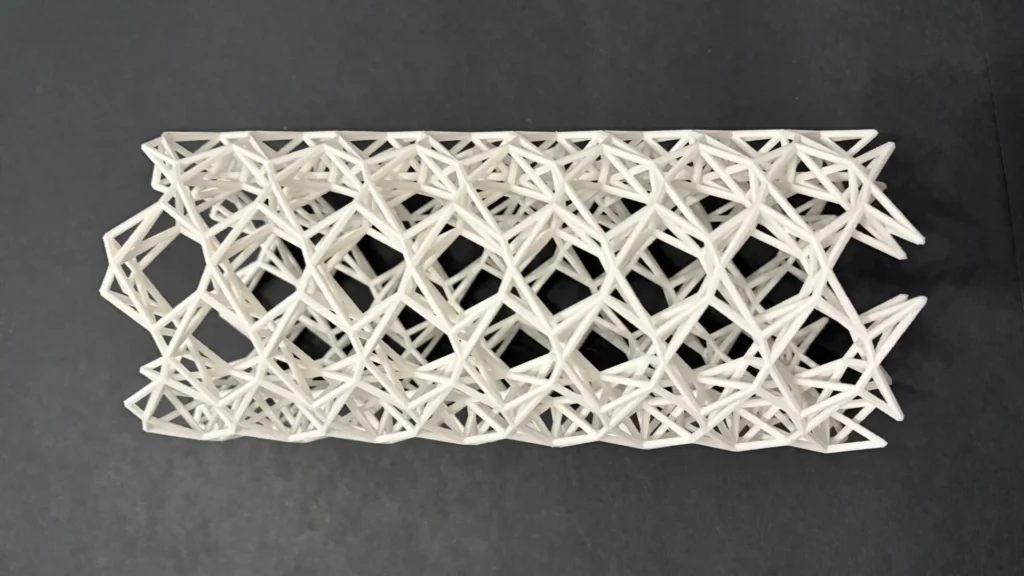
The resulting structures, when examined, bear a striking resemblance to a tightly woven chain-link fence that has been meticulously folded and rolled into a tube, featuring interconnected inner and outer layers. Physicists refer to these as "kagome tubes," a nod to the traditional Japanese basket weaving techniques that employ similar intricate patterns. This intricate geometry is precisely what allows the material to dissipate vibrational energy effectively.
Enriching the Narrative: Supporting Data and Broader Context
The implications of this research extend far beyond academic curiosity. The ability to engineer materials with specific vibration-damping properties could have profound impacts on a multitude of sectors.
- Aerospace: Reducing vibrations in aircraft and spacecraft can lead to increased passenger comfort, improved component longevity, and enhanced sensor accuracy. In spacecraft, minimizing micro-vibrations is critical for the precise operation of sensitive scientific instruments.
- Automotive: Smoother rides, reduced engine noise, and improved structural integrity of vehicles are all potential benefits. The technology could lead to lighter vehicles by enabling the use of less material to achieve the same level of vibration control.
- Civil Engineering and Architecture: The development of vibration-isolating building materials could revolutionize earthquake-resistant construction. Structures designed with these metamaterials could potentially withstand seismic events with greater resilience, minimizing damage and protecting occupants. This could be particularly impactful in regions prone to high seismic activity.
- Manufacturing and Precision Engineering: In industries requiring high precision, such as semiconductor manufacturing or intricate machining, minimizing external vibrations is paramount. These metamaterials could be integrated into machinery and infrastructure to create ultra-stable operating environments.
- Consumer Electronics: From reducing the hum of home appliances to enhancing the audio quality of high-fidelity sound systems, the potential applications are widespread.
The project received crucial financial backing from prominent government agencies, including partial funding from the Defense Advanced Research Projects Agency (DARPA) and the Office of Naval Research. Additional support was provided by the U.S. National Research Council Research Associateship Program, administered by the National Academies of Sciences, Engineering and Medicine. This broad base of support underscores the perceived strategic importance and potential impact of this research.
Key contributors to this landmark study include Serife Tol, an associate professor of mechanical engineering at U-M; Othman Oudghiri-Idrissi from the University of Texas; and Carson Willey and Abigail Juhl from AFRL. Their collective expertise across various disciplines was instrumental in bringing this complex project to fruition.
Challenges and Future Directions: Navigating the Frontier
Despite the remarkable achievement, the researchers acknowledge that this is merely the first step in unlocking the full potential of these novel structures. A significant challenge identified is the inherent trade-off between vibration suppression and load-bearing capacity. McInerney noted, "The study also showed that the better a structure is at suppressing vibrations, the less weight it can support." This presents a critical hurdle for many practical applications where structural integrity is paramount.
"That is a costly, potentially even unacceptable, tradeoff in terms of applications, but it highlights interesting opportunities and questions that remain at a fundamental level," he explained. Addressing this tradeoff will require further innovation in material design and potentially hybrid approaches that combine the vibration-damping metamaterials with traditional structural materials.
Furthermore, the advent of such novel structures necessitates the development of new methodologies for their testing, characterization, and assessment. "Because we have such new behaviors, we’re still uncovering not just the models, but the way that we would test them, the conclusions we would draw from the tests and how we would implement those conclusions into a design process," McInerney elaborated. This represents an exciting frontier for material scientists and engineers, requiring the creation of entirely new testing protocols and analytical frameworks. Answering these fundamental questions about how to reliably assess and integrate these materials is considered a prerequisite to fully exploring their myriad applications.
The vision articulated by McInerney is one of "being able to manufacture materials from the ground up with crazy precision." This implies a future where engineers can design and fabricate materials with specific, tailored properties for virtually any application, moving beyond the limitations of naturally occurring substances and conventional alloys. The question then becomes not just if we can create these materials, but what can we achieve with them, and how can we harness their unique capabilities to solve some of the world’s most pressing engineering challenges.
While the immediate focus is on vibration isolation, the principles underlying this research have far-reaching implications. The ability to precisely control the geometry of materials at a fine scale opens doors to designing for a wide array of mechanical properties, including enhanced stiffness, flexibility, energy absorption, and even acoustic insulation. The successful 3D printing of these complex kagome tubes represents a tangible realization of decades of theoretical work, bridging the gap between abstract concepts and practical engineering solutions, and heralding a new era of intelligently designed materials.