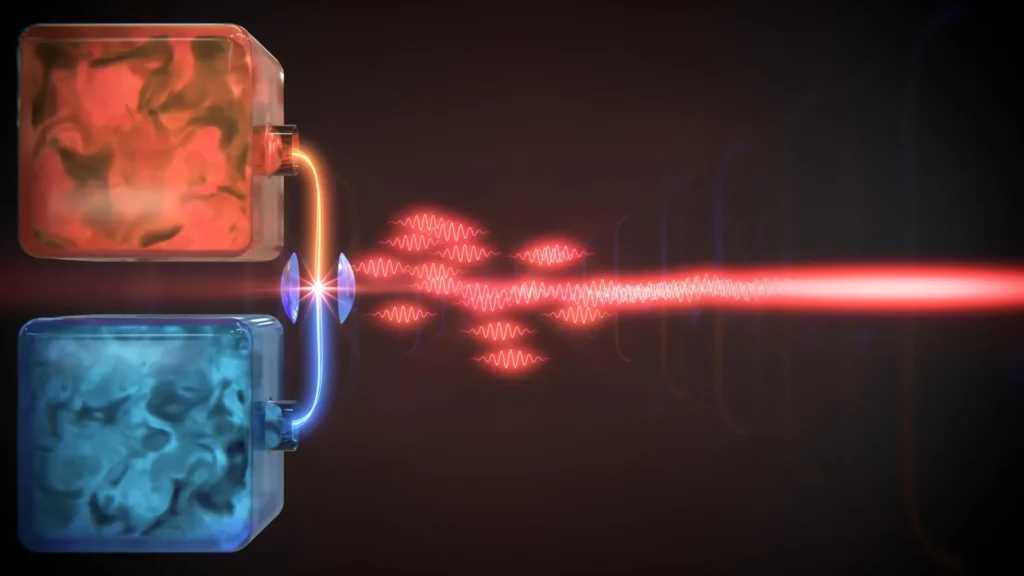
The boundaries between the macroscopic world of heat engines and the microscopic world of quantum particles have long been a source of theoretical friction, but a new breakthrough from the University of Basel has provided a mathematical bridge between these two disparate realms. Researchers led by Professor Patrick Potts at the University of Basel have introduced a theoretical framework designed to make thermodynamics and quantum physics work consistently in the same setting, specifically addressing the long-standing question of what qualifies as "work" versus "heat" at the atomic scale. Published in the prestigious journal Physical Review Letters, the study offers a robust description of how energy is converted and transferred in systems composed of single atoms and particles of light, potentially unlocking new efficiencies in quantum technologies and metrology.
The Convergence of Two Scientific Eras
To understand the significance of the Basel research, one must look at the historical trajectory of physics. Thermodynamics emerged in the 19th century as a practical response to the Industrial Revolution. Scientists such as Sadi Carnot and Rudolf Clausius sought to understand the fundamental limits of steam engines—massive machines that converted the thermal energy of coal into mechanical work. These classical laws, including the famous Second Law of Thermodynamics, were built on the assumption of large-scale systems where individual molecular movements are averaged out into macroscopic properties like temperature, pressure, and volume.
In contrast, quantum physics was born in the early 20th century to explain the behavior of the very small: atoms, electrons, and photons. In this realm, the "averaging" of classical thermodynamics does not apply. Instead, systems are governed by probability, wave-particle duality, and the uncertainty principle. For decades, these two fields operated in parallel, with thermodynamics handling the large and quantum mechanics handling the small.
However, as modern technology approaches the "quantum limit," the two fields have begun to overlap. Engineers are now building devices so small that they consist of only a few atoms, yet these devices are expected to perform tasks—such as sensing, computing, or energy conversion—that were traditionally described by thermodynamics. This has created a theoretical crisis: the definitions of "heat" and "work" that apply to a steam engine do not translate easily to a single photon escaping a cavity.
The Model: A Tiny Quantum Light Engine
The University of Basel team, specifically postdoc Marcelo Janovitch and Professor Patrick Potts, focused their research on a concrete physical model known as a "light engine." This setup involves a single atom placed inside an optical cavity—a small space between two highly reflective mirrors.
In this configuration, a laser continuously pumps energy into the cavity in the form of photons. The atom interacts with these photons, absorbing and re-emitting them. Because the mirrors are not perfectly reflective, some of these photons eventually escape the cavity into the surrounding environment. This is what physicists call a "driven-dissipative system." It is "driven" because it receives a constant stream of energy from the laser, and it is "dissipative" because it loses energy to its surroundings.
"This is a textbook example of a system that continuously receives energy and simultaneously loses it to the environment," explains Janovitch. Under traditional thermodynamic definitions, any energy escaping such a system into the environment would be classified as "waste heat." However, the Basel researchers have challenged this assumption, proving that the escaping light contains more than just disordered thermal energy.
Redefining the Boundary Between Work and Heat
The core of the research involves the distinction between "useful work" and "disordered heat." In a classical steam engine, work is the energy used to move a piston, while heat is the energy lost to the atmosphere. In a quantum light engine, the distinction is much more subtle.
In previous research, Potts and his colleagues demonstrated that the photons leaving the cavity should not be automatically discarded as waste. Instead, some of the energy carried by that escaping light retains a degree of "coherence" or order that allows it to perform useful work on another quantum system. The challenge was creating a mathematical framework that remained valid across different "limits" of physics.
Specifically, the researchers looked at the "semi-classical limit." This is a transitional state where one part of a system (the atom) is treated using the rules of quantum mechanics, while another part (the light) is treated as a classical electromagnetic wave. For a theory to be truly universal, it must produce the same results whether you use the complex "full quantum" equations or the simplified "semi-classical" equations.
The Basel team discovered that conventional thermodynamic approaches failed this consistency test. If one assumes that all escaping energy is heat, the transition to the semi-classical limit becomes mathematically inconsistent. However, by using their new framework—which correctly identifies a portion of the escaping light as useful work—the researchers proved that the theory moves smoothly between the quantum and classical worlds.
Chronology and Development of the Framework
The development of this framework is the result of several years of theoretical refinement within the Department of Physics at the University of Basel. The timeline of this research reflects a broader movement in the physics community toward "Quantum Thermodynamics."
- Initial Discovery (2021-2022): Professor Patrick Potts and his collaborators published early findings suggesting that energy dissipation in quantum systems was more complex than previously thought. They identified that "noise" in quantum systems could, under certain conditions, be harnessed.
- Model Refinement (2023): The team focused on the "atom-in-cavity" model, a staple of quantum optics, to serve as the testing ground for a unified theory.
- Mathematical Validation (2024): Marcelo Janovitch led the mathematical derivation that linked the full quantum description of the light engine to the semi-classical limit. This involved complex calculations regarding "quantum fluctuations"—the tiny, unpredictable changes in energy levels inherent in quantum systems.
- Publication (Present): The findings were peer-reviewed and published in Physical Review Letters, signaling acceptance by the broader scientific community as a significant advancement in theoretical physics.
Supporting Data and Technical Analysis
The researchers’ findings are rooted in the way quantum fluctuations are handled. In a standard classical system, fluctuations (or noise) are usually a sign of heat. However, in the quantum light engine, the researchers found that their calculations correctly described how quantum effects could actually reduce fluctuations in the emitted light particles.
This phenomenon, often related to "squeezing" in quantum optics, means that the light leaving the cavity is more "ordered" than typical thermal radiation. By quantifying this order, the Basel framework provides a specific value for how much "work" can be extracted from the emission.
According to the study’s data, when the system is treated with the new framework:
- The entropy production (a measure of wasted energy) is lower than predicted by traditional models.
- The "work extraction" potential remains consistent as the number of photons in the cavity increases, allowing the theory to scale from a single photon to a classical beam of light.
- The fluctuations in the output light follow a specific mathematical pattern that aligns with the "Fluctuation-Dissipation Theorem," a cornerstone of statistical mechanics, but adapted for the quantum regime.
Implications for Quantum Technology and Metrology
The practical implications of this research extend far beyond the laboratory. As the world moves toward a "Second Quantum Revolution," the ability to manage heat and work at the atomic scale is becoming a critical engineering requirement.
1. Quantum Metrology:
Quantum metrology is the science of making ultra-precise measurements using quantum effects. One of the biggest obstacles in this field is "noise" or fluctuations. The Basel team’s findings show that by understanding the boundary between heat and work, researchers can take advantage of energy that was previously thought to be lost. This could lead to the creation of "squeezed" states of light that allow for measurements of time, gravity, or distance with unprecedented accuracy.
2. Quantum Computing:
Quantum computers are notoriously sensitive to heat. Even a tiny amount of thermal energy can cause "decoherence," destroying the quantum states (qubits) necessary for calculation. By applying the Basel framework, engineers might design better cooling systems or "quantum batteries" that manage energy transfer more efficiently, reducing the heat footprint of quantum processors.
3. Nanoscale Heat Engines:
The research paves the way for the development of microscopic heat engines that could power nanorobots or molecular machines. If we can accurately define how a single atom converts light into work, we can begin to build machines that operate at efficiencies that were previously thought to be theoretically impossible.
Broader Impact and Future Outlook
The work of Janovitch and Potts represents a shift in how physicists view "waste." In the 19th century, smoke and heat rising from a steam engine were simply lost. In the 21st century, the "smoke" of a quantum engine—emitted photons—is a resource.
"Heat often creates disturbances that make quantum systems harder to control, but under the right conditions, it could instead become a useful resource," the researchers noted. This philosophy of turning "noise" into "signal" is likely to define the next decade of quantum research.
While the current framework is theoretical, it provides the mathematical "blueprints" for experimentalists to follow. The next step will likely involve laboratory tests using trapped ions or superconducting circuits to verify that the predicted "useful work" from escaping photons can indeed be captured and utilized in a real-world setting.
As thermodynamics and quantum physics continue to merge, the University of Basel has provided a vital roadmap. By reconciling the laws of the very large with the laws of the very small, science is one step closer to mastering the energy of the quantum world, turning the "disordered heat" of the past into the "precise work" of the future.