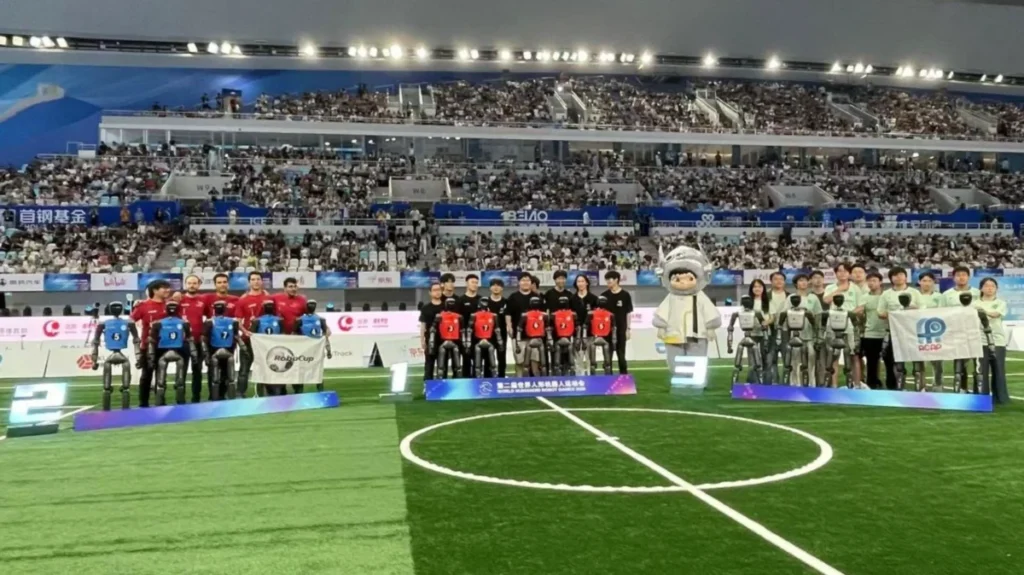
A Historic Milestone in Incheon
The 11-a-side match in South Korea represented the culmination of nearly three decades of incremental progress. When RoboCup was founded in 1997, the idea of a humanoid robot walking, let alone playing a team sport, was largely theoretical. By the time the humanoid league was officially introduced in Fukuoka in 2002, robots were still struggling with basic tasks like standing up after a fall or identifying a stationary ball. The 2026 match in Incheon proved that the field has moved beyond "proof of concept" into the realm of functional, high-performance autonomy.
In the exhibition match, B-Human and HTWK Robots utilized a larger pitch than is standard for robot soccer, providing the necessary space for complex tactical maneuvers. The match lasted one half, during which the robots demonstrated an unprecedented level of situational awareness. B-Human’s victory was secured through superior motion systems and coordination, but the real triumph was the lack of catastrophic failures. The robots managed to track the ball, navigate around teammates and opponents, and execute kicks while maintaining balance on a surface that—unlike the controlled environments of a laboratory—presented real-world friction and inconsistencies.
The Long Road to 2050: A Chronological Perspective
The overarching goal of the RoboCup Federation is as ambitious as it is specific: by the year 2050, a team of fully autonomous humanoid robots must be able to defeat the reigning FIFA World Cup champions in a match played under standard human rules. This target serves as a "moonshot" for the robotics industry, providing a clear benchmark for success.
The chronology of this journey highlights the accelerating pace of development:
- 1997: The inaugural RoboCup is held in Nagoya, Japan, focusing primarily on wheeled robots and simulation.
- 2002: The Humanoid League is introduced, featuring small, medium, and large-scale bipeds.
- 2010s: Development of the Standard Platform League (SPL) allows teams to compete using identical hardware (the SoftBank Robotics Nao), shifting the focus entirely to software and AI.
- 2024–2025: Significant breakthroughs in Deep Reinforcement Learning (DRL) allow robots to learn dynamic movements, such as running and jumping, in simulation before transferring them to physical hardware.
- 2026: The merger of the Standard Platform and Humanoid Leagues into a unified Humanoid Soccer League, and the first 11-a-side humanoid match.
This timeline demonstrates that the challenge is no longer just about making a robot walk; it is about making a robot think and collaborate in a high-speed, unpredictable environment.

Technical Foundations: The Science of Robot Soccer
A robot playing soccer is essentially a mobile computer solving a series of complex mathematical problems in real-time. To function on the pitch, the machine must map out kinematic vectors, calculate wheel or joint velocities, and manage directional forces. This requires a seamless integration of several core robotic disciplines.
Localization and Computer Vision
For a robot to be effective, it must know where it is, where its teammates are, and where the ball is located. Modern humanoid robots use a combination of wide-angle cameras and LiDAR to perceive their surroundings. Computer vision algorithms must process dozens of frames per second to identify the white lines of the pitch, the goalposts, and the moving ball. This data is then fed into a localization model that allows the robot to "see" its position on a mental map of the field.
Bipedal Locomotion and Balance
Walking on two legs is an inherently unstable process. Engineers use Inertial Measurement Units (IMUs) and pressure sensors in the feet to maintain a "Zero Moment Point" (ZMP), ensuring the robot’s center of mass stays within its support base. In the 2026 season, teams like B-Human moved away from traditional "hand-coded" gait patterns. Instead, they utilized deep reinforcement learning to train their robots. This allowed the machines to develop more fluid, human-like movements and the ability to recover from stumbles that would have previously resulted in a fall.

The Standard Platform Advantage
One of the most significant shifts in recent years is the adoption of the Booster Robotics K1 humanoid platform. By using off-the-shelf hardware, research teams can bypass the years of mechanical engineering required to build a biped from scratch. This democratization of hardware allows teams to focus their resources on the "brain" of the robot—the software, strategy, and coordination logic that ultimately wins matches.
Maker Faire Rome: Bringing the Lab to the Public
The upcoming Italian Open RoboCup Humanoid Soccer Tournament at Maker Faire Rome represents a critical bridge between academic research and public engagement. From October 23 to 25, the Gazometro Ostiense will host 3-v-3 and 5-v-5 matches across the Middle and Large Divisions. Unlike the polished, edited videos often seen in corporate tech demonstrations, the Maker Faire event offers a raw look at the state of robotics.
The event will feature:

- Live Competitive Matches: Teams will compete in a tournament format, showcasing tactical autonomy.
- Technical Testing: Public sessions where engineers debug code and calibrate sensors in real-time.
- Workshops: Interactive sessions designed to explain the mechanics of humanoid motion and AI to students and makers.
- Demonstrations of Resilience: Showing how robots handle hardware failures, battery depletion, and environmental interference.
For the "Maker" community, the appeal of RoboCup lies in its iterative nature. The philosophy of "Build, Test, Fail, Fix" is on full display. Visitors to Rome will see not just the successes, but the frequent falls and the subsequent "get-up" routines that are a vital part of autonomous recovery.
Broader Implications and Industry Impact
While the immediate goal of RoboCup is sporting excellence, the technological spin-offs have profound implications for society. The challenges solved on the football pitch are directly applicable to other fields:
- Disaster Recovery: The balance and navigation systems developed for soccer allow robots to traverse uneven terrain in search-and-rescue scenarios where human access is limited.
- Healthcare and Elder Care: Humanoid robots capable of stable movement and object manipulation can assist in domestic environments, providing support for an aging global population.
- Human-Robot Collaboration: The coordination logic used by a team of robots to pass a ball is the same logic required for multiple autonomous machines to work together in a factory or warehouse.
Analysis suggests that the transition to 11-a-side matches marks the beginning of the "Tactical Era" of robotics. We are moving away from individual robot performance and toward collective intelligence. The ability of eleven machines to share data and execute a unified strategy without a central server is a breakthrough in decentralized computing.

Conclusion: The Horizon of 2050
As Maker Faire Rome approaches, the robotics world is reflecting on the distance covered since 1997. The 4–0 victory in Incheon was a signal that the hardware and software are finally converging into a viable platform for complex, human-scale activity. The 2050 goal of beating human World Cup champions remains a daunting prospect, but it no longer feels like science fiction.
The Gazometro Ostiense in Rome, once a symbol of the industrial revolution, now serves as the backdrop for the digital and robotic revolution. By observing these machines in person, the public gains an appreciation for the sheer difficulty of replicating human movement and decision-making. The "European Edition" of Maker Faire will not only showcase the current state of the art but will also inspire the next generation of engineers who will likely be the ones to lead a robot team onto the pitch against humans in 2050. For now, every goal scored, every successful pass, and even every recovered fall is a step toward that historic encounter.