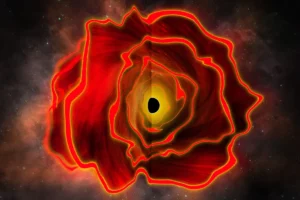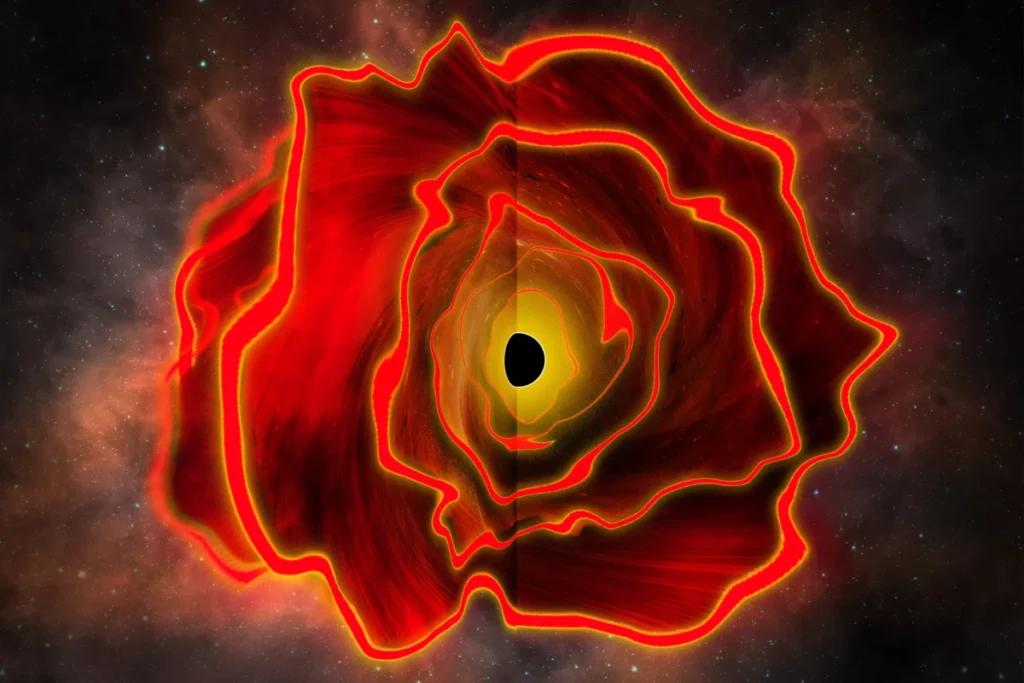
The James Webb Space Telescope (JWST) has once again upended established astrophysical paradigms with the discovery of a singular object that appears to bridge the gap between the first stars and the first supermassive black holes. Lead author Rohan Naidu, a NASA Hubble Fellow and Pappalardo Fellow at MIT’s Kavli Institute for Astrophysics and Space Research (MKI), describes the finding as a rapidly evolving picture of an object that defies traditional classification. The object, designated MoM-BH*-1, is believed to be a "black hole star"—a colossus featuring a central black hole roughly 100,000 times as massive as the sun, encased within a gargantuan envelope of hydrogen gas the size of our entire solar system. This discovery provides a potential solution to one of the most persistent mysteries of the JWST era: the nature of the "little red dots" that have populated the telescope’s deep-field images since its first transmissions.
The Mystery of the Little Red Dots
Since the James Webb Space Telescope began its science operations in 2022, astronomers have been puzzled by the presence of small, intensely red points of light in the distant, early universe. These objects, found in nearly every deep-space image, existed when the universe was less than a billion years old. However, they seem to vanish by the present day, leaving a gap in the chronological record of cosmic evolution.
According to Naidu, these little red dots have been the subject of intense debate within the astronomical community. Some researchers hypothesized they were extremely dense, dust-enshrouded star-forming galaxies, while others suggested they were early quasars—active black holes consuming vast amounts of matter. The identification of MoM-BH*-1 as a black hole star suggests a third, more exotic possibility that could redefine how we understand the growth of black holes and the formation of the first galaxies.
The research team, which includes MKI Director Robert Simcoe and MIT researcher Wendy Sun, alongside a global network of collaborators, initially set out to find the most distant and earliest galaxies. This endeavor was part of a survey titled "Mirage or Miracle" (MoM), a name reflecting the team’s skepticism and wonder. The survey aimed to determine if the surprisingly bright objects appearing in the early universe were true "miracles" of rapid galactic growth or "mirages" caused by other phenomena.
The Spectroscopic Fingerprint of an Anomaly
The discovery of MoM-BH*-1 occurred as the team scanned JWST images for sources to target with detailed spectroscopic analysis. They located a dot that was both exceptionally red and unusually bright. In astronomy, redness is often an indicator of distance or the presence of interstellar dust. Robert Simcoe explains that much like how smoke from terrestrial wildfires can turn the sun a deep crimson, astronomical dust—composed of carbon and silicates—scatters shorter blue wavelengths of light, leaving only the longer red wavelengths to reach the observer.
However, as the team analyzed the light from this specific red dot, the data failed to align with the "dusty galaxy" model. The most striking feature was a "Balmer break," a sharp drop-off in light intensity at specific wavelengths. This signature is typically found in the atmospheres of stars like Vega, where dense hydrogen gas absorbs photons. In the case of MoM-BH*-1, the Balmer break was the deepest ever recorded in the history of astronomy.
"The break we observed in this object is the deepest break we have ever observed in any object, ruling out ‘ordinary’ stars as the source," Naidu noted. The absence of "metals"—astronomical shorthand for any element heavier than hydrogen and helium—further deepened the mystery. The object appeared to be composed of primordial gas, untouched by the cycles of stellar death and rebirth that enrich the universe with heavier elements.
Simulating a Cosmic Hybrid
To understand what could produce such a deep Balmer break and intense red color without the presence of dust or heavy elements, the MIT-led team turned to advanced computational simulations. They tested various astrophysical scenarios, eventually asking if a sufficiently dense screen of pure hydrogen could mimic the observed light profile.
The simulations revealed that an extremely dense cocoon of hydrogen could indeed block the specific wavelengths of light, creating the observed spectral break. However, this posed a new problem: the object was roughly 100 billion times brighter than a standard star. Nuclear fusion, the engine that powers stars like our sun, is physically incapable of generating that level of luminosity in an object of that size.
The only known mechanism capable of producing such immense energy in a compact space is black hole accretion. When matter falls into a black hole, it is heated to millions of degrees, releasing vast amounts of radiation. By incorporating an active, accreting black hole into their hydrogen-cocoon model, the researchers found a match. The black hole provides the "engine," while the solar-system-sized hydrogen envelope acts as a "stellar atmosphere," absorbing and re-emitting the light in the specific patterns observed by the JWST.
MoM-BH*-1 and the Birth of Supermassive Black Holes
The implications of MoM-BH*-1 extend far beyond the classification of a single object. It offers a potential "missing link" in the evolution of supermassive black holes. For decades, cosmologists have struggled to explain how black holes at the centers of galaxies grew to billions of solar masses so quickly after the Big Bang.
The "black hole star" model suggests a pathway known as Direct Collapse Black Holes (DCBHs). In this scenario, massive clouds of primordial gas collapse under their own gravity without fragmenting into individual stars. This process can create a "seed" black hole of 10,000 to 100,000 solar masses almost instantly. MoM-BH*-1, with its 100,000-solar-mass core, fits the profile of a DCBH seed caught in the act of growing.
What makes MoM-BH-1 unique among the "little red dots" is its purity. While other red dots may be black hole stars embedded within developing galaxies, MoM-BH-1 is so luminous that it completely outshines its host galaxy. This allows astronomers to see "pure black hole star light," providing an unobstructed view of the physics at play in the early universe.
Chronology of the Discovery and Research Context
The discovery of MoM-BH*-1 is the culmination of years of theoretical preparation and the recent technological leap provided by the JWST.
- Pre-2022: Theoretical models of "quasi-stars" or black hole stars were proposed as a way to explain early black hole growth, but no observational evidence existed.
- December 2021: The JWST launches, equipped with the Near-Infrared Camera (NIRCam) and Near-Infrared Spectrograph (NIRSpec) capable of seeing the "reddened" light of the early universe.
- Early 2023: The "Mirage or Miracle" survey begins, targeting high-redshift candidates that appeared too bright for standard galactic evolution models.
- Late 2023: The team identifies the unique spectral signature of MoM-BH*-1, noting the unprecedented Balmer break.
- 2024: Simulation results confirm the black hole star hypothesis, and the findings are prepared for the scientific community.
Broader Impact and Future Observations
The identification of MoM-BH*-1 is expected to trigger a wave of follow-up studies. If "little red dots" are indeed black hole stars, it means the early universe was far more active and populated with intermediate-mass black holes than previously thought. This would require a significant revision of the timeline for galactic formation and the role of black holes in the "Cosmic Dawn."
The research, supported by NASA, the MIT Department of Physics, and the Space Telescope Science Institute, underscores the importance of the JWST’s infrared capabilities. Without the ability to peer through the cosmic distance and detect the specific hydrogen signatures of the Balmer break, MoM-BH*-1 would have remained just another anonymous red speck in the dark.
As the JWST continues its mission, astronomers will look for more objects like MoM-BH-1. Finding a population of these black hole stars would confirm that the "mirage" of early bright galaxies is actually the "miracle" of a previously unknown stage of stellar and black hole evolution. For Rohan Naidu and his colleagues, MoM-BH-1 is only the beginning—the "one" in its name serving as a placeholder for the many more they expect to find as our picture of the early universe continues to evolve.