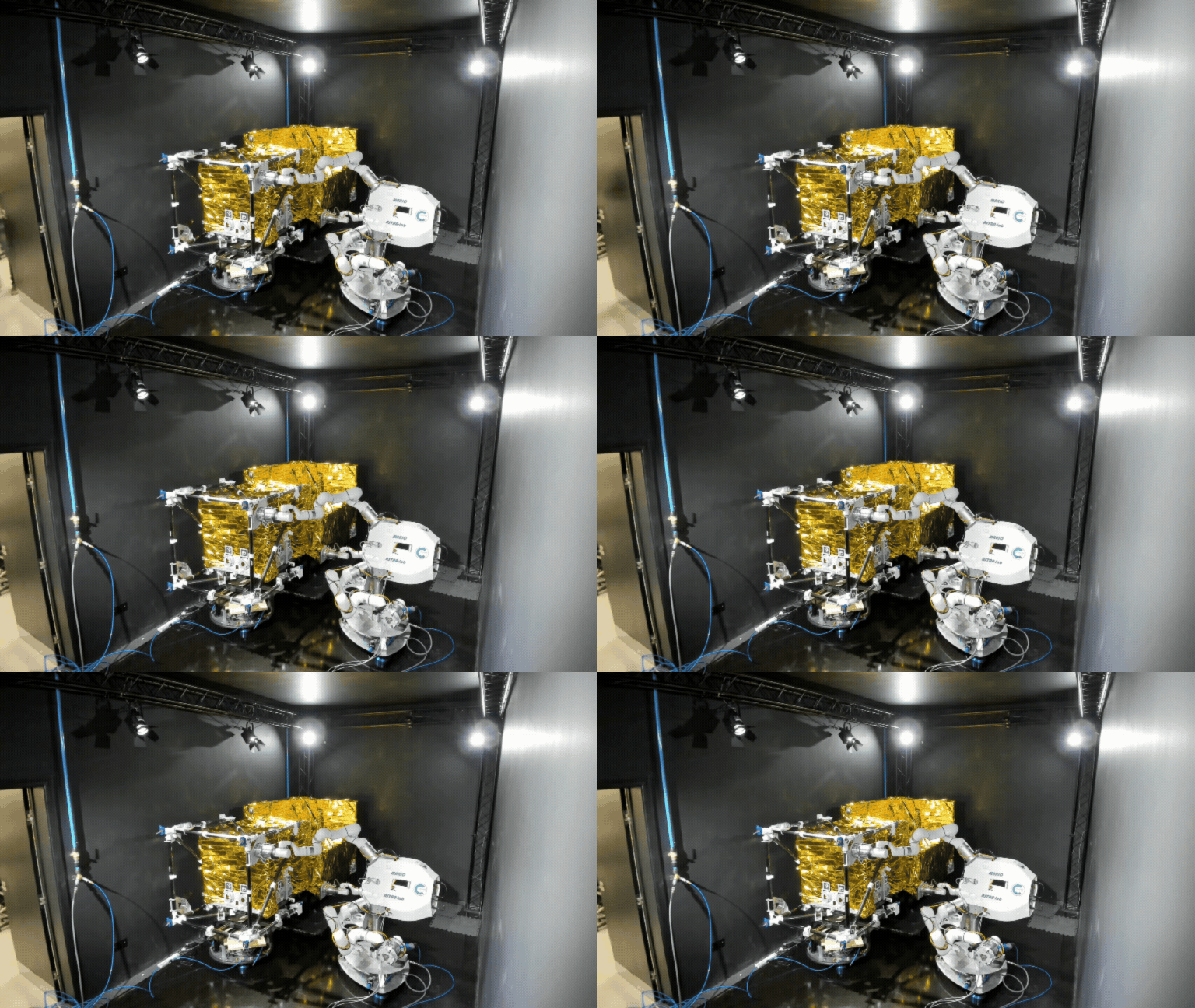
Cranfield University’s sophisticated robotic system, MARIO, has recently undergone a series of groundbreaking laboratory trials, offering a compelling glimpse into the future of in-orbit assembly and construction of large-scale space structures. The demonstration, conducted within Cranfield University’s specialized free-floating environment, showcased MARIO’s ability to autonomously manipulate structural components and build a truss-like framework, mimicking the intricate processes required for assembling vast orbital infrastructure. This pioneering work is a critical step towards enabling more ambitious and complex space missions, from advanced communication arrays to expansive solar power generation systems, that are currently beyond the reach of conventional launch capabilities.
The MARIO robot, a fully owned asset of Cranfield University, is specifically engineered to support the servicing and construction of significant structures in the space environment. Its design incorporates multiple articulated arms, allowing for complex manipulation and assembly tasks. During the recent trials, MARIO was observed meticulously grasping and positioning beams, a process likened to a climber carefully selecting and adjusting its grip on a rock face. This deliberate and steady movement across the laboratory’s simulated environment underscores the precision and control necessary for such delicate operations.
One of MARIO’s key functionalities demonstrated was the utilization of its three arms. Two arms were actively engaged in holding and maneuvering structural beams, while a third, unencumbered arm, was employed to manipulate and connect these components. This tri-arm configuration is crucial for tasks requiring both stable holding and dynamic manipulation, especially in the microgravity conditions of space. When not actively walking or gripping, one of MARIO’s secondary arms is equipped with a camera, providing enhanced visual feedback for precise manipulation and better perspective during assembly. This integrated vision system is vital for ensuring accurate placement and secure connections of structural elements.
The demonstration specifically focused on testing the structural parts developed under the ISAAC (In-Space Assembly and Construction) activity. ISAAC aims to develop the fundamental principles and technologies for building large space structures from modular components, such as beams and connectors, that are launched as loose parts. Cranfield University’s unique laboratory facility allows for systems to be tested in a simulated free-floating environment, a crucial step in validating the effectiveness of Multi-Arm Robots like MARIO in connecting ISAAC components under the simulated weightlessness of space. This validation process is essential for ensuring the robustness and reliability of these systems before they are deployed in actual orbital missions.
The Vision for Large-Scale Space Structures
The imperative for developing the capability to construct large structures in space stems from the inherent limitations of launching fully assembled components. Many of the ambitious projects envisioned for the future – including significantly larger antennas for enhanced communication and data transmission, more powerful reflectors for scientific observation, expansive solar power systems to provide clean energy in orbit, and modular platforms for research and development – are simply too large, too heavy, or too expensive to be sent into space in one piece. By enabling in-orbit assembly, these limitations can be overcome, paving the way for missions of unprecedented scale and capability.
ESA’s Coordinated Efforts in Orbital Construction
The European Space Agency (ESA) is at the forefront of developing the necessary technologies for this new era of space construction. Through a series of coordinated activities, ESA is bringing together expertise in robotics, structural design, and assembly tools. These initiatives include MIRROR, ISAAC, and RISE (Robotic Interfaces and Tooling for Space-Based Solar Power Engineering). These programs collectively aim to demonstrate how future spacecraft and orbital infrastructure can be constructed piece by piece in space. The goal is to enable larger, more adaptable, and more cost-effective missions, pushing the boundaries of what is achievable in space exploration and utilization.
While the MARIO robot showcased at Cranfield University is not the original robot developed under the MIRROR activity, it represents a crucial recreation and adaptation of the system. Cranfield University’s initiative to rebuild and demonstrate the system serves as a powerful validation of the ISAAC structural concept. This independent verification and demonstration by a leading academic institution significantly bolsters confidence in the feasibility and effectiveness of the proposed assembly methodologies.
Chronology of Development and Demonstration
The journey towards autonomous in-orbit assembly has been a gradual but determined one, built upon decades of research and development in robotics and space engineering.
Early Conceptualization and Research: The idea of assembling structures in space has been a recurring theme in space exploration planning since the dawn of the space age. Initial concepts focused on human-led assembly, but the inherent risks and costs associated with crewed missions quickly spurred interest in robotic solutions.
Robotics Advancements: Significant progress in robotics, particularly in areas like artificial intelligence, advanced manipulation, and sensor technology, began to lay the groundwork for complex autonomous operations in challenging environments.
ESA’s MIRROR Program: The MIRROR program, initiated by ESA, played a foundational role in exploring the potential of robotic systems for in-orbit assembly. While the specific robot used in MIRROR might differ, the program established key principles and demonstrated early prototypes of robotic arms capable of manipulating space structures. The development of specialized tooling and interfaces for robotic interaction was a key outcome of this initiative.
Development of ISAAC: Building upon the lessons learned from MIRROR and other related research, the ISAAC activity was launched with a specific focus on the modular structural components themselves. The goal was to design and test standardized beams, connectors, and assembly interfaces that could be efficiently handled and connected by robotic systems. This included addressing challenges related to structural integrity, thermal expansion, and the ease of robotic grasping and mating.
Cranfield University’s MARIO Project: Cranfield University, with its renowned expertise in aerospace engineering and robotics, took on the challenge of demonstrating the practical application of these concepts. The development of the MARIO robot was driven by the need for a versatile platform capable of simulating the complex maneuvers required for in-orbit assembly. This involved designing a robot with multiple degrees of freedom, advanced grasping mechanisms, and integrated sensor systems.
Laboratory Trials and Demonstrations: The recent laboratory trials at Cranfield University represent a significant milestone in this ongoing development. By simulating a free-floating environment, researchers could accurately assess MARIO’s performance in handling ISAAC structural parts. The successful demonstration of MARIO’s ability to autonomously build a truss structure provides tangible evidence of the viability of in-space assembly.
Future Integration with RISE: The RISE program, focusing on robotic interfaces and tooling for space-based solar power engineering, represents a forward-looking step. It aims to develop the specific robotic capabilities and interfaces needed to construct large solar power arrays in orbit. The successful demonstrations with MARIO and ISAAC will undoubtedly inform and accelerate the development of RISE technologies, paving the way for the actual construction of such ambitious projects.
Supporting Data and Technical Considerations
The successful demonstration of MARIO is underpinned by several critical technical considerations and advancements:
- Dexterity and Degrees of Freedom: The MARIO robot is equipped with highly dexterous robotic arms, featuring multiple degrees of freedom. This allows for precise movements in all three dimensions, essential for manipulating components in a confined and dynamic environment. Each arm’s articulation allows it to reach, grasp, and connect beams from various angles.
- Advanced Gripping Mechanisms: The "clutching" action of the robot highlights the importance of specialized end-effectors or grippers. These mechanisms are designed to securely hold the structural beams without causing damage and to facilitate precise alignment for connection. The ability to adjust grip strength and orientation is crucial for handling different component geometries.
- Vision and Sensor Integration: The camera integrated into one of MARIO’s arms is a vital component. It provides real-time visual feedback to the robot’s control system, enabling it to identify components, assess clearances, and ensure accurate mating. Other sensors, such as force/torque sensors, may also be incorporated to provide tactile feedback, allowing the robot to detect contact and adjust its forces accordingly.
- Autonomous Navigation and Path Planning: For a robot to operate autonomously, it requires sophisticated algorithms for navigation and path planning. MARIO must be able to navigate its environment, avoid obstacles, and plan the most efficient and safe sequence of movements to assemble the structure. This involves complex computational processes that consider the robot’s kinematics and the geometry of the workspace.
- Structural Integrity of ISAAC Components: The ISAAC activity focuses on the design of lightweight yet robust structural elements. These beams and connectors must withstand the stresses of launch, deployment, and operation in space, while also being easy for robotic systems to handle and connect. The modular design of ISAAC components ensures that they can be efficiently packed for launch and then readily assembled into larger, more complex structures. The materials used for these components are carefully selected for their strength-to-weight ratio and their resilience to the harsh space environment, including radiation and extreme temperature variations.
- Simulated Microgravity Environment: Cranfield University’s laboratory facility that simulates a free-floating environment is crucial for testing. Real-world microgravity conditions present unique challenges, such as the absence of gravity-induced friction and the need for precise control to prevent uncontrolled tumbling. Simulating these conditions allows engineers to identify and address potential issues before actual space deployment. This can involve using air-bearing tables, suspension systems, or neutral buoyancy tanks, depending on the specific aspects being tested.
Official Responses and Expert Commentary
While direct quotes from ESA or Cranfield University officials regarding this specific demonstration were not included in the provided text, the nature of the work strongly suggests positive reactions and continued investment.
Inferred Statement from Cranfield University (Hypothetical): "This demonstration of MARIO’s capabilities represents a significant leap forward in our efforts to prove the feasibility of autonomous in-space assembly," stated a spokesperson for Cranfield University’s Advanced Robotics Centre. "The successful construction of a truss structure highlights the maturity of the ISAAC concept and the advanced robotics technologies we are developing. We are proud to be contributing to ESA’s vision for a more capable and sustainable presence in orbit."
Inferred Statement from ESA (Hypothetical): "ESA is actively investing in groundbreaking technologies that will redefine our ability to operate in space," commented a senior program manager at ESA. "The work being done at Cranfield University with the MARIO robot and the ISAAC structural components is vital. It directly addresses the challenges of building large-scale infrastructure in orbit, which is essential for future scientific missions, communication networks, and even space-based solar power. These demonstrations are critical milestones on the path to realizing these ambitious goals."
Expert Analysis (Hypothetical): Dr. Anya Sharma, a leading astrophysicist specializing in space infrastructure, remarked, "The ability to assemble large structures in orbit is not just an incremental improvement; it’s a paradigm shift. It opens up possibilities for telescopes with unprecedented resolution, solar arrays that could power entire stations, and orbital manufacturing facilities. The precise, autonomous actions demonstrated by robots like MARIO are the building blocks for this future."
Broader Impact and Implications
The advancements showcased by MARIO and the ISAAC activity have far-reaching implications for the future of space exploration and utilization:
- Enabling Larger and More Complex Missions: The primary implication is the unlocking of missions that are currently impossible due to launch mass and volume constraints. This includes next-generation space telescopes with much larger primary mirrors, significantly more powerful communication satellites, and expansive orbital solar power stations.
- Cost Reduction and Increased Affordability: While initial development costs are high, the ability to launch modular components and assemble them in orbit can ultimately lead to cost savings. It avoids the prohibitive expense of launching massive, fully assembled structures. Furthermore, it could enable more frequent and less resource-intensive missions.
- Enhanced In-Orbit Servicing and Repair: The technologies developed for assembly are directly transferable to in-orbit servicing, maintenance, and repair of existing satellites. This could extend the operational life of valuable space assets, reducing the need for costly replacements.
- Facilitating Space-Based Solar Power: The development of large solar arrays in orbit, a key objective of the RISE program, holds the potential to provide a clean and sustainable energy source for Earth and for powering future space infrastructure. Autonomous assembly is a prerequisite for building these massive structures.
- Stimulating the Space Economy: The development of these advanced capabilities will foster innovation and create new markets within the burgeoning space sector. This includes companies specializing in robotic systems, modular space components, and orbital assembly services.
- Advancing Scientific Discovery: Larger and more sophisticated scientific instruments, such as advanced telescopes and observatories, will enable deeper insights into the universe, from studying exoplanets to observing distant galaxies with unprecedented clarity.
- Establishing a Sustainable Space Presence: The ability to build infrastructure in space, such as habitats and refueling depots, is a crucial step towards a more permanent and sustainable human presence beyond Earth. This could pave the way for lunar bases and eventual missions to Mars.
The work of Cranfield University with the MARIO robot, in conjunction with ESA’s broader initiatives like ISAAC and RISE, represents a pivotal moment in space engineering. It signals a transition from simply launching objects into space to actively constructing and shaping our presence there, piece by piece, with increasing autonomy and sophistication. This ongoing progress is not merely about building structures; it’s about building the future of space exploration, scientific discovery, and potentially, a new era of space-based industry.