Researchers at the University of Copenhagen’s Niels Bohr Institute, in collaboration with the international ALICE (A Large Ion Collider Experiment) team at CERN, have successfully recreated the primordial state of matter that dominated the universe in the immediate aftermath of the Big Bang. By utilizing collisions between atomic nuclei significantly smaller than those previously thought capable of producing such phenomena, the team has opened a new window into the first millionth of a second of cosmic history. This breakthrough, recently published in the journal Physical Review Letters, not only sheds light on the evolution of the early universe but also introduces a revolutionary method for mapping the internal structure of atomic nuclei, a quest that has occupied physicists for more than seven decades.
The Quest for Quark-Gluon Plasma
For decades, the primary objective of high-energy nuclear physics has been to understand the nature of matter under extreme conditions. Shortly after the Big Bang, the universe was far too hot and dense for the existence of atoms, or even the protons and neutrons that form their cores. Instead, the universe was filled with a "primordial soup" known as quark-gluon plasma (QGP). In this state, quarks—the fundamental building blocks of matter—and gluons—the particles that carry the strong nuclear force—moved freely, unbound by the constraints of hadronic matter.
As the universe expanded and cooled, this plasma underwent a phase transition, where the strong force "confined" quarks and gluons into the protons and neutrons we recognize today. To study this transition, scientists at the European Organization for Nuclear Research (CERN) use the Large Hadron Collider (LHC) to accelerate atomic nuclei to nearly the speed of light. When these nuclei collide, the sheer kinetic energy is converted into heat and density so extreme that it melts the protons and neutrons back into their constituent quarks and gluons, creating a "Little Big Bang" in a controlled laboratory environment.
Until recently, the scientific consensus held that producing a droplet of QGP required the collision of massive nuclei, such as Lead (Pb), which contains 208 nucleons. It was believed that only these large-scale systems could provide the volume and energy density necessary for the plasma to reach thermal equilibrium and behave as a fluid. However, the new findings from the University of Copenhagen and the ALICE collaboration have challenged this paradigm by demonstrating that much smaller systems, specifically Oxygen-16 and Neon-20, can also generate this exotic state of matter.
A Paradigm Shift in Collision Scales
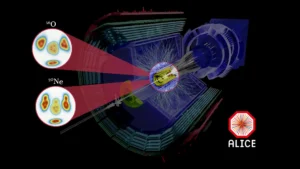
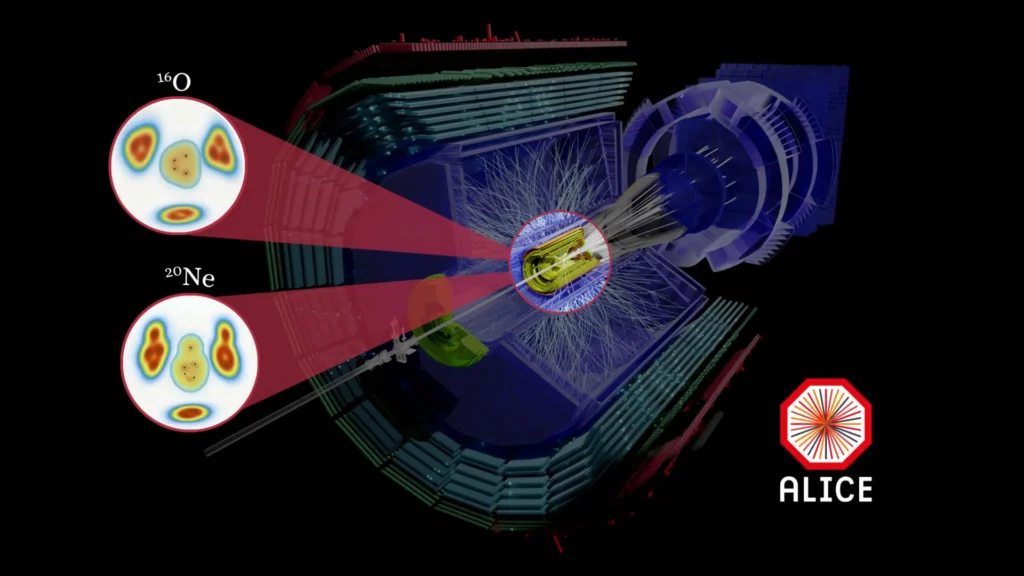
The experiment led by Associate Professor You Zhou and his team at the Niels Bohr Institute marks a significant milestone in high-energy physics. By colliding Oxygen-16 (8 protons and 8 neutrons) and Neon-20 (10 protons and 10 neutrons), the researchers pushed the boundaries of the "Small System" physics frontier. These nuclei are an order of magnitude smaller than the lead nuclei typically used in such studies.
The results confirm that even in these microscopic collisions, the resulting matter exhibits collective flow—a hallmark of quark-gluon plasma. This suggests that the transition to a plasma state is more universal and less dependent on total mass than previously hypothesized. "We have pushed the boundary for how small the atomic nuclei can be while still recreating this primordial matter," stated Associate Professor You Zhou. "We now know more about the fundamental conditions required for matter to transition into this extreme state."
This discovery has profound implications for our understanding of the early universe. If QGP can form in smaller, less dense environments, the dynamics of the early universe’s cooling process may have been more complex than current models suggest. It also provides a more precise set of parameters for the "Little Big Bangs" that occur in particle accelerators, allowing for more nuanced simulations of cosmic evolution.
Decoding Nuclear Geometry Through Particle Shadows
One of the most innovative aspects of this research is the use of collision dynamics to determine the geometric shape of atomic nuclei. Because the quark-gluon plasma droplet exists for only a tiny fraction of a second—approximately $10^-23$ seconds—it cannot be observed directly. Instead, physicists must act as detectives, analyzing the patterns of subatomic particles that fly out from the collision site as the plasma cools and "freezes" back into ordinary matter.
The research team discovered that the movement patterns of these secondary particles are directly dictated by the original shape of the colliding nuclei. When two spherical Oxygen-16 nuclei collide, the resulting particle flow is relatively uniform and rounded. However, Neon-20 nuclei are naturally shaped like bowling pins or pears. When these elongated nuclei collide, they produce a distinctive, anisotropic (non-uniform) flow pattern.
Postdoctoral Researcher Emil Gorm Dahlbæk Nielsen, a co-author of the study, compared the process to a shadow puppet theater. "It is a bit like shining light on an object and seeing its shadow. You cannot see the object directly, but its shadow reveals its shape," Nielsen explained. By measuring the "shadows" left by the particles, the team can reconstruct the three-dimensional geometry of the nucleus at the moment of impact. This "imaging" occurs at energies far higher than traditional nuclear structure experiments, providing a completely different perspective on how protons and neutrons are arranged within the nucleus.
The Legacy of the Niels Bohr Institute and the Strong Force
The study of nuclear structure is deeply rooted in the history of the Niels Bohr Institute. In 1975, Aage Bohr, the son of the institute’s founder, was awarded the Nobel Prize in Physics for his work on the non-spherical geometry of atomic nuclei. The current research represents a modern evolution of this legacy, moving from the low-energy studies of the 20th century to the high-energy "femtoscopy" of the 21st.
Understanding the shape of a nucleus is not merely a matter of geometry; it is essential for understanding the strong nuclear force. The strong force is what holds the nucleus together, overcoming the electromagnetic repulsion between positively charged protons. However, the strong force remains the least understood of the four fundamental forces of nature (the others being gravity, electromagnetism, and the weak force).
Traditionally, nuclear shapes were studied by observing how nuclei rotate or vibrate at low energies. The new technique developed at CERN allows researchers to "read" the shape of the nucleus through the imprint it leaves in the quark-gluon plasma. This provides a rigorous test for Quantum Chromodynamics (QCD), the theory that describes the strong interaction. If the predicted shapes from low-energy models match the observations from high-energy collisions, it confirms our understanding of nuclear stability. If they differ, it points toward new physics and a deeper complexity in how nucleons interact.
Chronology of Discovery: From Lead to Helium
The path to this discovery has been a multi-decade journey for the international physics community. The timeline of quark-gluon plasma research highlights the rapid acceleration of our understanding:
- 2000: CERN announces the first evidence of a new state of matter after experiments with lead ions at the Super Proton Synchrotron (SPS).
- 2005: The Relativistic Heavy Ion Collider (RHIC) in the United States confirms that QGP behaves like a "perfect liquid" with near-zero viscosity, rather than a gas.
- 2010: The Large Hadron Collider (LHC) begins its heavy-ion program, reaching unprecedented energy levels.
- 2017-2021: Hints of QGP-like behavior are observed in proton-proton and proton-lead collisions, surprising the scientific community and sparking a debate over the minimum size required for plasma formation.
- 2024: The Niels Bohr Institute and ALICE collaboration publish findings on Oxygen and Neon collisions, successfully bridging the gap between large-scale heavy ion physics and small-scale nuclear structure.
The team’s next objective is to push the limit even further. Plans are already in motion to conduct experiments with Helium-4, the second lightest element in the periodic table. By attempting to create a "Little Big Bang" with only four nucleons, researchers hope to find the absolute threshold of fluid-like behavior in the subatomic world.
Broader Implications and Future Frontiers
The implications of this research extend far beyond the walls of the laboratory. By perfecting the ability to recreate and measure the primordial state of matter, scientists are essentially building a "time machine" that allows them to observe the conditions of the universe as they were nearly 13.8 billion years ago. This helps cosmologists understand why the universe is composed of matter rather than antimatter and how the large-scale structures of the cosmos, such as galaxies and star clusters, were influenced by the fluctuations in the initial quark-gluon plasma.
Furthermore, the technique of using high-energy collisions to probe nuclear geometry could represent a paradigm shift in nuclear medicine and energy. A more precise understanding of the strong force and nuclear structure is fundamental to the development of next-generation fission and fusion reactors, as well as the refinement of isotope-based medical treatments.
The international ALICE collaboration, which involves thousands of scientists from over 100 institutes worldwide, continues to process the massive amounts of data generated by the LHC’s "Run 3" phase. As data analysis techniques improve—incorporating machine learning to identify particle patterns—the resolution of these nuclear "shadows" will only increase.
As You Zhou concluded, the most fascinating aspect of this work is the convergence of two seemingly disparate fields: "What is fascinating is that we can use the same experiment both to learn about the structure of atomic nuclei and to gain a better understanding of what happened during the birth of the Universe. These two things turn out to be much more closely connected than one might initially think." By smashing the smallest pieces of matter together at the highest possible speeds, humanity is finally beginning to see the shape of the beginning of time.