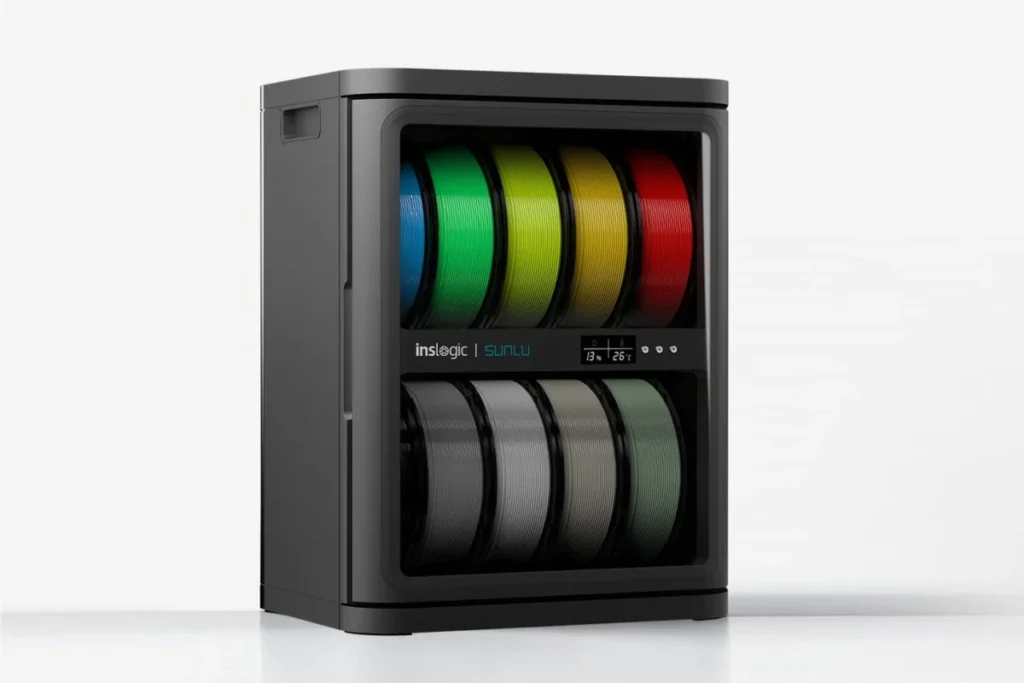
The 3D printing industry has long grappled with the challenge of material degradation due to environmental factors, specifically ambient humidity. In response to this persistent issue, Inslogic, in collaboration with the established 3D printing accessory manufacturer Sunlu, has introduced the FilaDC i10 filament dehumidifying cabinet. Priced at $199, the i10 represents a shift away from traditional high-heat active drying methods toward a more sophisticated, passive-maintenance approach designed for long-term material preservation. This cabinet is engineered to serve both as a high-capacity storage solution and a precision dehumidification system, capable of housing up to 10 spools of filament simultaneously.
The Evolution of Filament Moisture Management
To understand the significance of the FilaDC i10, one must first examine the hygroscopic nature of 3D printing filaments. Most thermoplastic polymers used in Fused Deposition Modeling (FDM), such as PLA, PETG, ABS, and particularly engineering-grade materials like Nylon (PA) and TPU, are inherently hygroscopic. This means they actively absorb moisture from the surrounding air.
When moisture-laden filament is fed into a 3D printer’s hot end, the water trapped within the plastic rapidly expands into steam. This process causes several documented print failures:
- Stringing and Oozing: Excess internal pressure causes material to leak from the nozzle during non-print moves.
- Surface Deficiencies: Bubbles or "zits" appear on the outer shell of the print as steam escapes.
- Structural Weakness: Hydrolysis can occur in some polymers, breaking the molecular chains and resulting in brittle parts with poor layer adhesion.
- Extrusion Inconsistency: The presence of water vapor disrupts the volumetric flow of plastic, leading to under-extrusion.
Historically, makers have relied on repurposed food dehydrators or dedicated "active" dryers that use heating elements and fans. While effective for rapid drying, these devices often consume significant power and can accidentally warp plastic spools or degrade filament through heat cycling. The FilaDC i10 addresses these concerns by utilizing a dual-effect dehumidification technology.
Technical Specifications and Engineering
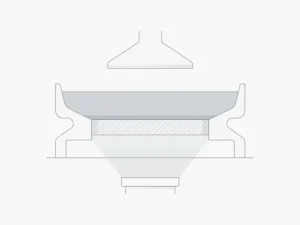
The FilaDC i10 distinguishes itself through its "PTC + molecular sieve" dual-effect system. Unlike standard heaters that rely solely on raising the air temperature to lower relative humidity, the i10 utilizes a molecular sieve—a material containing tiny pores of a precise and uniform size that is used as an adsorbent for gases and liquids.
The Role of the Molecular Sieve
The molecular sieve acts as a desiccant, trapping water molecules at the molecular level without the need for extreme heat. This allows for "room-temperature drying," which is significantly gentler on the chemical structure of the filament. This method is particularly beneficial for heat-sensitive materials that might soften or fuse at the temperatures required by traditional hot-air dryers.
Positive Temperature Coefficient (PTC) Technology
The inclusion of a PTC heating element serves a specific, regulated purpose. PTC heaters are self-regulating; as they heat up, their electrical resistance increases, which naturally limits the current and prevents overheating. In the context of the i10, this technology is used to "regenerate" the molecular sieve. Once the sieve becomes saturated with moisture, the system uses the PTC element to release the trapped water vapor and exhaust it outside the cabinet, effectively "resetting" the desiccant for continued use.
Operational Efficiency and User Experience
One of the primary advantages of the FilaDC i10 is its "set and forget" functionality. The unit features an intuitive digital interface that allows users to set a target humidity percentage. Once the internal sensors detect that the cabinet has reached the desired level, the unit enters a low-power maintenance mode. It only reactivates when the humidity drifts above the set threshold, ensuring a stable environment with minimal energy consumption.

In practical testing, the cabinet demonstrates a rapid drawdown of humidity. For users managing a medium-sized "farm" or a diverse collection of materials, the ability to stabilize five to ten spools simultaneously is a significant workflow improvement. Furthermore, the unit is noted for its near-silent operation. Traditional dryers often utilize loud centrifugal fans to circulate air; the i10’s passive-dominant system allows it to operate in the background of a home office or studio without causing auditory distraction.
Comparative Analysis: Active vs. Passive Dehumidification
The $199 price point places the FilaDC i10 in a mid-tier category—more expensive than a single-spool active dryer but significantly more affordable than industrial-grade dry cabinets used in laboratory settings.
| Feature | Traditional Active Dryers | FilaDC i10 Cabinet |
|---|---|---|
| Primary Mechanism | High-heat convection | Molecular sieve adsorption |
| Capacity | 1-2 spools | Up to 10 spools |
| Power Consumption | High (Continuous heating) | Low (Intermittent regeneration) |
| Material Safety | Risk of spool warping | High (Room temperature) |
| Noise Level | Moderate to High (Fans) | Very Low |
| Primary Use | Rapid pre-print drying | Long-term storage & maintenance |
For professional users and serious hobbyists, the i10 offers a better Return on Investment (ROI) by preventing the loss of expensive filaments. A single 1kg spool of high-quality Nylon or Carbon Fiber-reinforced filament can cost between $50 and $100. By preventing even two or three spools from becoming "waterlogged" and unusable, the cabinet effectively pays for itself.
Impact on Print Quality and Reliability
The transition from "wet" filament to filament stored in the i10 yields measurable improvements in print success rates. Data from user evaluations indicates that stringing issues—often blamed on retraction settings—are frequently resolved simply by lowering the moisture content of the material. In a controlled environment where humidity is maintained below 15-20%, filaments maintain their factory-spec properties for months, if not years.
The i10 also provides a solution for the "long-print" dilemma. On prints lasting 48 hours or more, hygroscopic filaments can absorb enough moisture from the air during the print process to cause the quality to degrade from the bottom of the model to the top. While the i10 is primarily a storage cabinet, its ability to keep a large volume of material ready for immediate use ensures that the filament starts the print in optimal condition.
Market Context and Industry Trends
The collaboration between Inslogic and Sunlu highlights a growing trend in the 3D printing market: the professionalization of the "prosumer" workspace. As 3D printers become faster (with the advent of high-speed platforms like the Bambu Lab X1 series or the Creality K1), the quality of the filament becomes the bottleneck. High-speed printing requires consistent melt zones and predictable extrusion, both of which are compromised by moisture.
Industry analysts suggest that the peripheral market—encompassing dryers, cabinets, and automated material handling systems—is expected to grow as users move away from occasional hobbyist printing toward functional prototyping and small-batch manufacturing. The FilaDC i10 positions itself as an essential infrastructure component for this transition.
Conclusion and Future Outlook
The FilaDC i10 filament dehumidifying cabinet is a robust response to one of the most common "silent" killers of 3D print quality. By combining the high-capacity storage of a cabinet with the scientific precision of molecular sieve dehumidification, Inslogic and Sunlu have provided a tool that addresses both the immediate need for dry filament and the long-term need for organized material management.
While the $199 investment may seem steep for a casual user, the combination of energy efficiency, quiet operation, and the prevention of failed prints offers a compelling case for anyone who utilizes hygroscopic materials. As the 3D printing community continues to demand higher reliability and better surface finishes, devices like the i10 are likely to transition from "luxury accessories" to standard equipment in the modern maker’s arsenal. The simplicity of its setup—requiring only a single power cord and a toggle switch—further lowers the barrier to entry for maintaining professional-grade material standards.