Physicists at the U.S. Department of Energy’s Thomas Jefferson National Accelerator Facility have announced the discovery of two previously unknown subatomic structures, marking a significant milestone in the ongoing effort to map the "exotic" landscape of matter. These findings, emerging from the GlueX Collaboration, provide new evidence for particles that do not fit the traditional quark model, potentially reshaping our understanding of the strong nuclear force—the fundamental interaction responsible for holding the nuclei of atoms together.
The discovery was made while researchers were searching for a specific, elusive particle known as Y(2175). Instead of finding their intended target, the high-sensitivity detectors at Jefferson Lab captured signals for two distinct, unexpected structures: Y(2240) and X(1830). These signals belong to a mysterious category of matter known as "XYZ states," which have puzzled the global physics community for two decades. The results, recently published in the journal Physical Review Letters, suggest that the "zoo" of subatomic particles is far more diverse and complex than the foundational theories of the 20th century originally predicted.
The Historical Context: From the Hadron Zoo to the Quark Model
To understand the significance of the Jefferson Lab discovery, one must look back to the mid-20th century. In the 1950s and 1960s, the advent of early particle accelerators led to a literal explosion of discovered subatomic particles. Researchers were finding so many new "hadrons"—particles made of quarks—that they began referring to the phenomenon as the "particle zoo."
In 1964, physicists Murray Gell-Mann and George Zweig independently proposed the quark model to bring order to this chaos. They suggested that all hadrons were composed of smaller, fundamental building blocks called quarks. In this original framework, hadrons were divided into two main categories: baryons (composed of three quarks, such as protons and neutrons) and mesons (composed of a quark and an antiquark pair).
For decades, this "Standard Model" of particle physics held firm. However, as technology advanced, physicists began to suspect that the strong nuclear force, mediated by particles called gluons, might allow for more exotic configurations. The theory of Quantum Chromodynamics (QCD), which describes how quarks and gluons interact, mathematically allows for "hybrons" (mesons with excited gluonic fields), tetraquarks (four quarks), and even "pentaquarks."
The Emergence of the XYZ States
The 21st century ushered in a new era of "exotic" spectroscopy. In 2003, the Belle experiment in Japan discovered the X(3872), a particle that defied classification. It was too heavy and decayed too strangely to be a simple meson. This discovery triggered a global hunt for similar anomalies, which became collectively known as XYZ states.
The "Y" states specifically refer to particles that have certain quantum properties (specifically $J^PC = 1^–$) and are typically produced in electron-positron collisions. One such state, the Y(2175), was first identified in 2006 by the BaBar experiment at the SLAC National Accelerator Laboratory. It was found in the "strangeonium" sector—a region of mass where particles are composed of a strange quark and an anti-strange quark.
For nearly 20 years, Y(2175) was observed only through electron-positron annihilation. The GlueX Collaboration at Jefferson Lab sought to confirm its existence using a completely different method: photoproduction.
The GlueX Experiment: A Unique Technological Feat
The GlueX experiment, located in Experimental Hall D at Jefferson Lab, was designed specifically to hunt for these exotic states by using high-energy light. The process begins at the Continuous Electron Beam Accelerator Facility (CEBAF), a massive underground ring that accelerates electrons to nearly the speed of light.
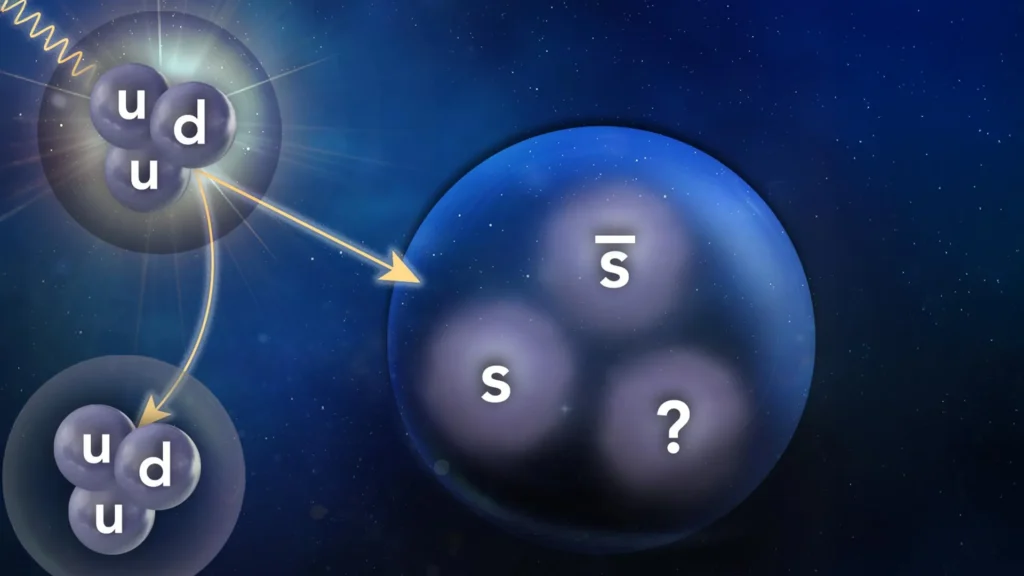
These electrons are then directed through an ultrathin diamond wafer. This interaction produces a beam of high-energy photons (light particles) that are linearly polarized. This specialized photon beam is then slammed into a fixed target of liquid hydrogen, which is essentially a collection of protons. When the photons strike the protons, the energy is converted into mass, creating a spray of new subatomic particles.
"No other experiment has a facility with a photon beam of this intensity at the energy we have available," noted Malte Albrecht, a staff scientist at Jefferson Lab. This unique setup allows GlueX to probe regions of the particle spectrum that are invisible to other types of accelerators.
Analyzing the Data: The Discovery of Y(2240) and X(1830)
During their analysis of the photoproduction data, the GlueX team looked for the signature of Y(2175). To their surprise, the expected signal did not appear. Instead, the data revealed two other distinct peaks in the mass spectrum.
The first structure, designated Y(2240), appeared at a mass of approximately 2.24 billion electron volts (GeV). The statistical significance of this signal is staggering. Physicists measure the certainty of a discovery using "sigma" ($sigma$). A $3sigma$ signal is considered "evidence," while a $5sigma$ signal is the "gold standard" for an official discovery. The Y(2240) signal reached a significance of over $5sigma$, meaning there is less than a one-in-a-million chance that the signal is a statistical fluke.
The second structure, X(1830), was detected at a lower mass of approximately 1.82 GeV. This signal reached $3sigma$ significance. While not as definitive as the Y(2240), it provides compelling evidence of a new state that theorists must now account for.
The absence of the Y(2175) in this process is just as scientifically important as the discovery of the new states. It suggests that the internal structure of Y(2175) may be such that it cannot be easily produced by a beam of light, whereas the new Y(2240) and X(1830) structures are more "transparent" to this production mechanism.
Theoretical Implications: Hybrids, Tetraquarks, or Molecules?
The discovery of Y(2240) and X(1830) opens a new chapter in theoretical physics. Researchers are now debating the nature of these structures. There are three primary leading theories:
- Hybrid Mesons: These are particles where the gluons—the "glue" that holds quarks together—are not just passive mediators but are actually excited and contribute to the particle’s quantum numbers. GlueX was specifically built to find these states.
- Tetraquarks: Instead of a simple quark-antiquark pair, these structures could be tightly bound clusters of four quarks (two quarks and two antiquarks).
- Hadronic Molecules: These are more loosely bound states, similar to a chemical molecule, where two separate mesons orbit each other via the residual strong force.
"We are in a new era here, similar to 70-odd years ago," said Frank Nerling, a collaborator from the GSI Helmholtz Centre for Heavy Ion Research. "First, a zoo of hadrons was discovered. Now, we’re facing a zoo of so-called exotic states."
Global Scientific Reaction and Next Steps
The announcement has resonated across the international physics community. Scientists from the Beijing Spectrometer (BES) in China and the Belle II experiment in Japan are expected to review their own datasets to see if these new structures can be identified in electron-positron collisions.
The fact that these states were found via photoproduction is a testament to the versatility of Jefferson Lab’s CEBAF accelerator. It provides a new "lens" through which to view the subatomic world. The GlueX Collaboration, which involves over 100 scientists from dozens of institutions worldwide, is already processing even larger datasets.
Justin Stevens, a physics professor at William & Mary and spokesperson for GlueX, emphasized that this is merely the beginning. "It really opens the door for a whole new set of hadron spectroscopy measurements we can make with GlueX," Stevens said. "We’ve got much more data to sort through, so this is just the beginning of the story."
Conclusion: Refining the Standard Model
The discovery of Y(2240) and X(1830) does not disprove the Standard Model, but it does highlight how much we have yet to learn about the strong force. While we understand the basic rules of how quarks interact, the complex "emergent behavior" of those interactions—how they form the vast variety of matter in the universe—remains one of the greatest mysteries in science.
By identifying these new exotic states, researchers at Jefferson Lab are providing the raw data that theorists need to refine Quantum Chromodynamics. As the GlueX experiment continues its run, and as other facilities around the world join the hunt, the "exotic zoo" will likely continue to grow, eventually leading to a more complete and unified understanding of the building blocks of reality. For now, Y(2240) and X(1830) stand as milestones on that journey, reminding us that even the most fundamental particles still hold surprises for those with the tools to look closely enough.