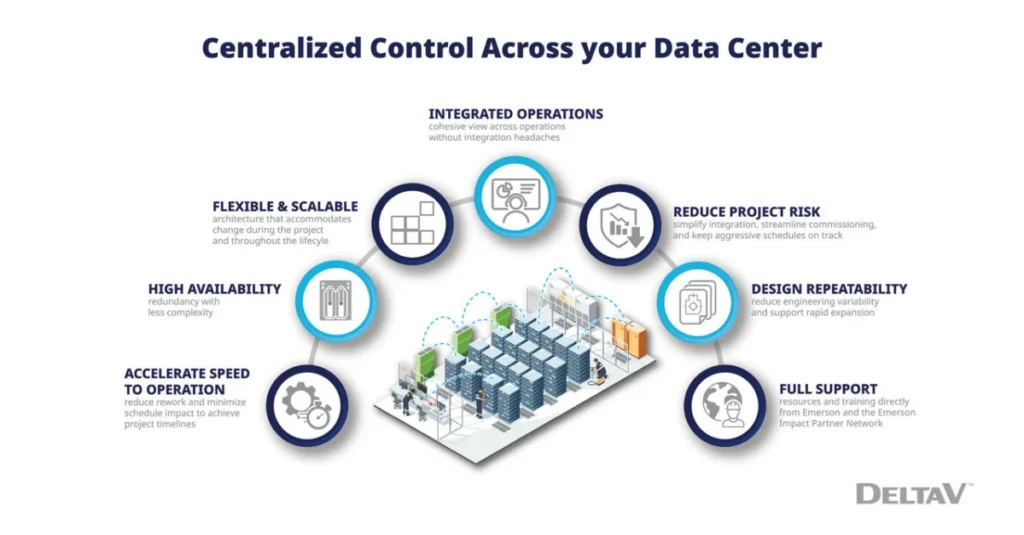
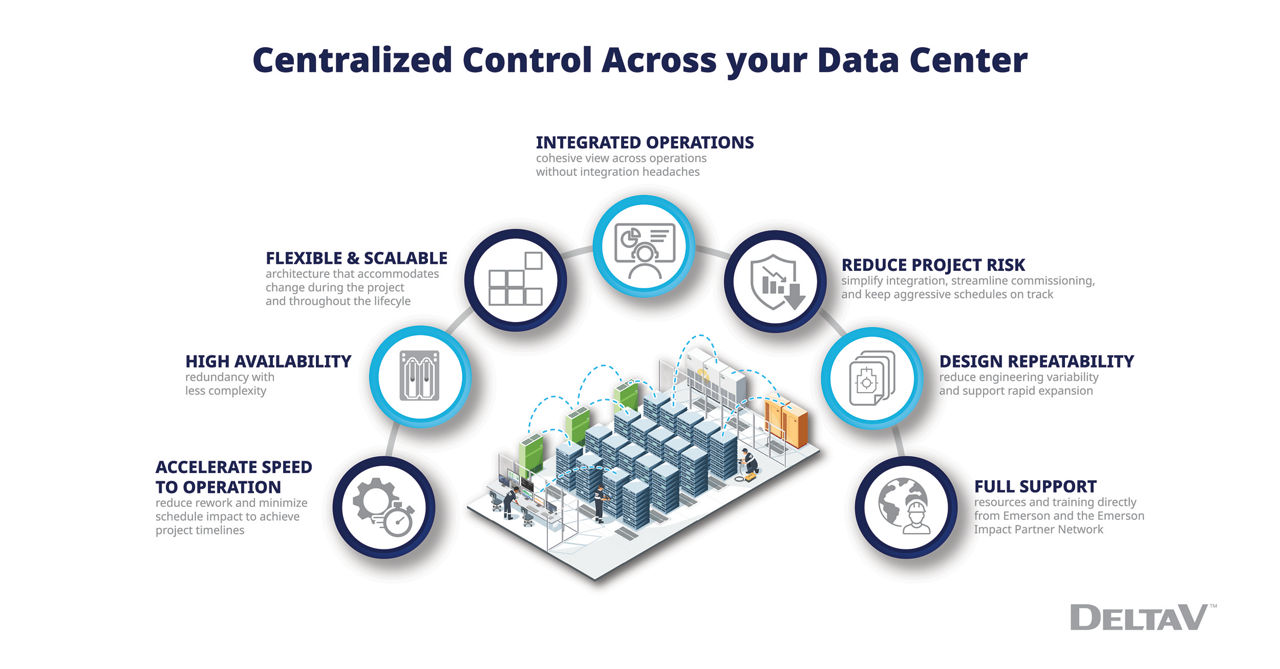
Emerson, a global technology and engineering company, has unveiled its DeltaV Automation Platform for Data Centers, a comprehensive automation portfolio specifically engineered to manage the intricate infrastructure demands of facilities supporting artificial intelligence (AI) workloads. This strategic introduction addresses the escalating complexity and shortened project timelines inherent in the rapid expansion of AI-driven computing, providing a unified solution for monitoring and control across critical thermal, mechanical, and electrical subsystems within a scalable architecture.
The proliferation of artificial intelligence, from large language models to complex machine learning algorithms, has catalyzed an unprecedented surge in demand for specialized data center infrastructure. These AI workloads, characterized by their immense computational intensity, require significantly more power and generate far greater heat than traditional enterprise or cloud computing operations. This necessitates advanced cooling solutions, robust power distribution, and highly efficient operational control, pushing the boundaries of conventional data center design and management.
The Intensifying Demands of AI Data Centers
The current landscape of AI-related data center growth is marked by several critical challenges. Project timelines, once measured in years, are now frequently compressed into months, creating immense pressure on every facet of development and deployment. This acceleration demands unparalleled coordination across a diverse ecosystem of stakeholders, including supply chain partners, engineering teams, design architects, electricians, and various project personnel. These disparate groups must collaborate seamlessly to bring large-scale facilities online rapidly, all while adhering to stringent requirements for reliability, flexibility, and operational efficiency—factors that are paramount in a high-stakes, always-on AI environment.
Traditional data center infrastructure, often managed through a patchwork of discrete, vendor-specific point solutions for cooling, power, and environmental control, struggles to meet these integrated demands. Such fragmented systems typically require extensive manual coordination, leading to increased engineering effort, longer integration cycles, higher potential for human error, and inconsistent operational performance. The absence of a unified control plane can impede rapid diagnostics, proactive maintenance, and optimized resource allocation, all of which are crucial for the high-performance, low-latency demands of AI.
Emerson’s Integrated Solution: The DeltaV Advantage
Emerson’s DeltaV Automation Platform for Data Centers aims to revolutionize this approach by providing an integrated automation architecture from the initial stages of project design. By replacing the traditional reliance on separate point solutions and manual subsystem coordination with a cohesive, unified control methodology, the platform promises substantial benefits. These include a significant reduction in engineering effort, simplification of integration processes, and marked improvements in consistency across commissioning, daily operations, and long-term maintenance cycles. This integrated strategy is designed to streamline the entire lifecycle of an AI data center, from conception to autonomous operation.
The core of the DeltaV Automation Platform for Data Centers lies in its robust components: the DeltaV Distributed Control System (DCS) and DeltaV Programmable Logic Controllers (PLCs). These established industrial automation technologies, renowned for their reliability and precision in process industries, are now being strategically applied to the complex environment of data centers. The DeltaV PLCs connect seamlessly to the DeltaV DCS, enabling system-wide process control that spans across all critical infrastructure elements. This integrated communication ensures that, for instance, a spike in server temperature detected by a thermal sensor can trigger an immediate, coordinated response from cooling units, power management systems, and even workload orchestrators, all managed from a single pane of glass.
Leveraging AI for Automation and Optimization
A standout feature of the DeltaV DCS and DeltaV PLCs within this new platform is the incorporation of context-specific AI tools. These embedded AI capabilities are designed to enhance engineering workflows, optimize advanced process control, and facilitate seamless integration with broader AI optimization models. For engineers, these tools can assist in design validation, anomaly detection, and predictive maintenance scheduling, significantly reducing manual oversight and accelerating troubleshooting. For operations, the AI tools can dynamically adjust parameters across the infrastructure—optimizing chiller performance, managing power distribution, and fine-tuning airflow—to maintain ideal environmental conditions while minimizing energy consumption.
Furthermore, the integration with external AI optimization models allows data center operators to feed real-time operational data into sophisticated algorithms that can predict future demands, optimize resource allocation, and even suggest proactive changes to infrastructure settings. This capability is pivotal for achieving the high levels of efficiency and resilience required by modern AI workloads. The synergistic design of the DCS and PLCs, combined with these AI enhancements, is explicitly aimed at improving project execution, controlling costs, boosting operating performance, and laying the groundwork for future autonomous operations within data centers. This vision of autonomy represents the pinnacle of data center efficiency, where systems intelligently manage themselves with minimal human intervention.
Historical Context: Emerson’s Legacy in Industrial Automation
Emerson’s foray into data center automation is a natural extension of its long-standing leadership in industrial control systems. For decades, the company has been at the forefront of providing automation solutions for some of the world’s most critical and complex industries, including oil and gas, chemical processing, power generation, and pharmaceuticals. The DeltaV system, in particular, has been a cornerstone of process control, known for its robustness, scalability, and ability to manage highly complex, continuous operations with precision and reliability.
This deep expertise in mission-critical process control provides Emerson with a unique advantage in the data center market. The principles of redundancy, fault tolerance, real-time data processing, and integrated control that are fundamental to industrial automation are directly transferable and highly relevant to the demands of modern data centers. As data centers evolve into highly sophisticated, interconnected "factories" for digital processing, the convergence of operational technology (OT) and information technology (IT) becomes increasingly vital. Emerson’s DeltaV platform represents a significant step in bridging this gap, leveraging decades of OT experience to address the complex IT infrastructure needs of the AI era.
The Economic and Operational Imperative for Automation
The economic implications of inefficient data center operations are staggering, particularly in the context of AI. A single hour of downtime can cost millions of dollars in lost revenue, service disruptions, and reputational damage. Moreover, the energy consumption of AI data centers is a growing concern, with estimates suggesting that AI could significantly increase global electricity demand in the coming years. Automation plays a critical role in mitigating these risks and optimizing resource utilization.
By automating the control of thermal management systems—which can account for 30-50% of a data center’s total energy consumption—Emerson’s platform can achieve significant energy savings. For example, intelligent control of chillers, computer room air conditioners (CRACs), and liquid cooling systems based on real-time workload demands and ambient conditions can reduce power usage effectiveness (PUE) scores, a key metric for data center efficiency. A PUE of 1.0 indicates perfect efficiency, and while practically unattainable, advanced automation can drive PUE closer to optimal levels, translating into substantial operational cost reductions and a smaller carbon footprint.
Furthermore, the platform’s ability to simplify integration and reduce engineering effort directly translates to faster time-to-market for new facilities or expansions. In a competitive landscape where speed of deployment is a critical differentiator, shortening commissioning times by even a few weeks can provide a significant competitive edge. This is particularly true for hyperscale cloud providers and enterprises building out private AI infrastructure, where the demand for capacity often outpaces the ability to construct and deploy new facilities.
Chronology of Data Center Evolution and AI Impact
The journey to AI-optimized data centers has been a rapid one:
- Early 2000s: Emergence of cloud computing and virtualization, driving demand for larger, more efficient data centers. Focus on power and cooling for general-purpose servers.
- 2010s: Hyperscale data centers become the norm. Introduction of advanced DCIM (Data Center Infrastructure Management) tools, but often still siloed. GPU acceleration begins for scientific computing.
- Mid-2010s: Deep learning revolution ignites, powered by specialized hardware (GPUs, TPUs). Early AI workloads begin to stress traditional data center designs. Liquid cooling starts gaining traction for high-density racks.
- Late 2010s – Early 2020s: AI adoption accelerates across industries. Demand for AI-specific infrastructure surges. Focus shifts to extreme power density, advanced thermal management, and rapid scalability. Project timelines shorten drastically.
- Present: The imperative for integrated automation becomes undeniable. Companies like Emerson, with their deep OT expertise, step in to offer unified control platforms to manage the unprecedented complexity and scale of AI data centers. The future points towards autonomous operations driven by embedded AI and advanced control systems.
Statements and Industry Reactions (Inferred)
While specific direct quotes from Emerson executives were not provided in the original announcement, it is highly probable that a spokesperson for Emerson would emphasize the company’s commitment to innovation and its strategic positioning at the intersection of industrial automation and digital transformation. An inferred statement might highlight: "The DeltaV Automation Platform for Data Centers represents a pivotal moment in how critical infrastructure for AI is designed, built, and operated. We are leveraging our decades of expertise in mission-critical process control to empower data center operators to meet the unprecedented demands of AI workloads with unmatched reliability, efficiency, and speed. This integrated approach is not just about control; it’s about enabling the future of autonomous computing."
Industry analysts and data center operators would likely welcome such an integrated solution. For instance, a hypothetical analyst might comment, "The fragmented nature of data center infrastructure management has long been a bottleneck for scaling high-performance workloads. Emerson’s move to offer a unified, industrial-grade automation platform for AI data centers is a significant development. It addresses a critical need for seamless integration, faster deployment, and enhanced operational reliability, which are non-negotiable for the next generation of computing." Data center operators, grappling with power density issues and compressed schedules, would see this as a potential game-changer for streamlining their complex operations and achieving greater uptime.
Broader Impact and Implications
The introduction of Emerson’s DeltaV Automation Platform for Data Centers carries several broader implications for the industry:
- Convergence of OT and IT: This move further accelerates the convergence of Operational Technology (OT) and Information Technology (IT) domains. As data centers become more akin to highly automated industrial plants, the expertise traditionally found in process control is becoming indispensable for IT infrastructure management.
- Standardization and Best Practices: By offering a unified platform, Emerson could contribute to the standardization of best practices in data center infrastructure automation, moving away from bespoke, project-specific solutions towards more scalable and repeatable models.
- Enhanced Reliability and Resilience: Industrial control systems are built for extreme reliability and continuous operation. Applying these principles to data centers can significantly improve their resilience against failures, a critical factor for AI workloads where even micro-downtimes can corrupt training models or disrupt services.
- Sustainability Drive: The intelligent optimization capabilities of the platform can lead to substantial reductions in energy consumption and carbon footprint, aligning with global sustainability goals and regulatory pressures on data centers.
- Competitive Landscape Shift: This entry by a major industrial automation player like Emerson could intensify competition in the data center infrastructure management (DCIM) market, pushing existing players to enhance their integration capabilities and embrace more sophisticated automation.
- Enabling Future Innovation: By providing a stable, highly optimized, and intelligently managed infrastructure, the platform frees up AI developers and researchers to focus on innovation, knowing that the underlying hardware environment is being handled with utmost precision and efficiency. It paves the way for increasingly complex and resource-intensive AI models to be developed and deployed at scale.
In conclusion, Emerson’s DeltaV Automation Platform for Data Centers represents a timely and strategic response to the formidable challenges posed by the exponential growth of AI. By leveraging its deep industrial automation heritage and integrating cutting-edge AI tools, Emerson is positioning itself as a critical enabler for the next generation of data centers, promising to deliver the reliability, efficiency, and speed essential for powering the future of artificial intelligence. The platform’s emphasis on unified control, reduced engineering complexity, and future autonomous operations underscores a significant leap forward in managing the foundational infrastructure of the digital age.