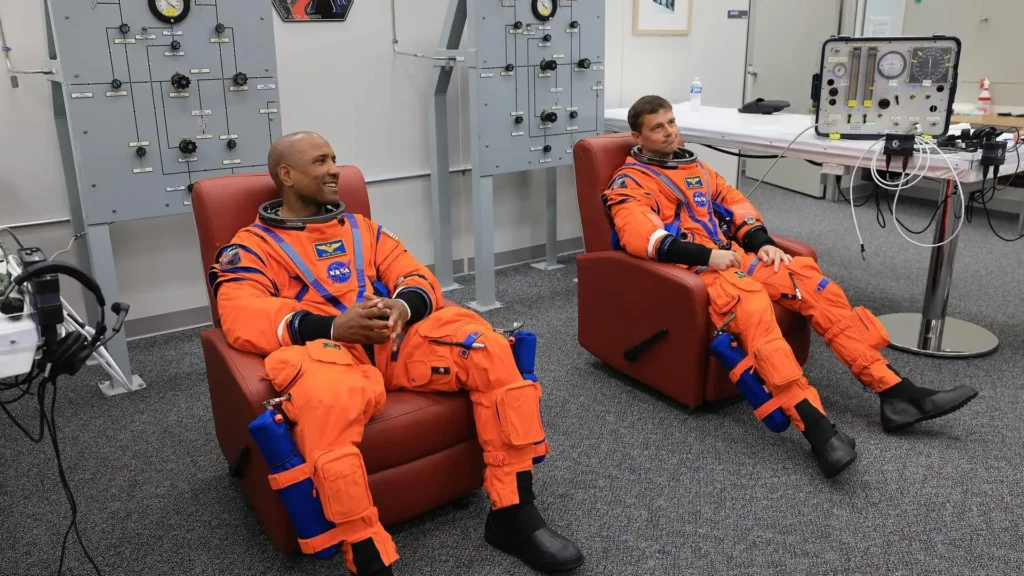
NASA astronauts Victor Glover and Reid Wiseman, who recently etched their names in history with the groundbreaking Artemis II mission around the Moon, are embarking on a new phase of their distinguished careers. In September, both seasoned spacefarers will transition to emeritus status at NASA’s Johnson Space Center in Houston, a program designed to retain the invaluable expertise of highly experienced personnel. This strategic move will allow Glover and Wiseman to volunteer their specialized knowledge, mentor current NASA employees, and simultaneously pursue external opportunities, ensuring their profound insights continue to fuel the agency’s ambitious future endeavors, particularly the upcoming Artemis III mission and subsequent lunar campaigns.
The Artemis II mission, a pivotal moment in humanity’s return to deep space, saw Glover and Wiseman, alongside NASA astronaut Christina Koch and Canadian Space Agency astronaut Jeremy Hansen, complete a daring 10-day circumnavigation of the Moon. Launched on NASA’s monumental Space Launch System (SLS) rocket and aboard the Orion spacecraft, this mission marked the first time a crew had journeyed to lunar orbit in over half a century. The crew achieved a record-breaking distance traveled farther into space than any humans before them, culminating in a safe splashdown on April 10. The experience gained from this historic flight is considered paramount as NASA gears up for Artemis III, slated for 2027, aiming to land American astronauts back on the lunar surface, and the broader Artemis campaign targeting a sustained presence on the Moon.
The Emeritus Program: A Strategic Investment in Expertise
The emeritus program at NASA represents a forward-thinking approach to human capital management, recognizing that the depth of knowledge held by veteran astronauts and personnel is an indispensable asset. By transitioning to emeritus status, individuals like Glover and Wiseman can continue to contribute to NASA’s mission on a consulting basis. This arrangement offers them the flexibility to share their extensive experience in training and mentoring current astronauts, flight controllers, and engineers, while also granting them the freedom to explore other professional avenues. This symbiotic relationship ensures that the hard-won lessons learned from complex missions are systematically transferred to the next generation of space explorers and mission planners, mitigating knowledge gaps and accelerating program development.
NASA Administrator Jared Isaacman lauded the transition, highlighting the profound impact Glover and Wiseman have had and will continue to have on the agency’s objectives. "I’ve had the privilege of knowing Reid and Victor for years, and both exemplify the leadership, character, and commitment that define NASA at its best," Isaacman stated. "Reid commanded Artemis II after previously spending 165 days aboard the International Space Station, while Victor brought his experience as a naval aviator, test pilot, and Crew-1 astronaut to his role as pilot. Together, they took on one of the most challenging missions in human spaceflight and helped return America to the lunar environment. As Reid and Victor transition to emeritus status, I’m grateful they will continue sharing what they learned with our astronauts, flight controllers, and engineers as we prepare for Artemis III in 2027 and the missions that follow."
Carrying the Artemis II Experience Forward
For Victor Glover, this new chapter signifies a continuation of his lifelong commitment to service and exploration. As he steps into his emeritus role, Glover intends to remain actively involved in the aerospace sector, focusing on leadership development and public service, both within and beyond NASA. A significant portion of his work will involve imparting his in-depth understanding of the Orion spacecraft and its intricate systems to the teams meticulously preparing for future Artemis missions. This direct transfer of knowledge is crucial for ensuring the smooth and successful operation of Orion on subsequent lunar voyages.
"As I grow into this new role, NASA and spaceflight remain a meaningful part of my journey of service," Glover expressed. "I’m excited to keep uplifting my friends and cheering them on as they reach for the Moon. Together, we’ll keep pushing boundaries and inspiring the next giant leap." His sentiment underscores the enduring passion and dedication that drive NASA’s personnel, even as their roles evolve.
Reid Wiseman, who commanded the Artemis II mission, will similarly dedicate his efforts to disseminating the valuable lessons learned from his extensive spaceflight career. His prior experience includes a significant 165-day tenure aboard the International Space Station, where he served as Flight Engineer and gained extensive experience in long-duration spaceflight operations and scientific research. This blend of deep-space transit and orbital operations experience makes his insights particularly valuable for Artemis III, which will test critical rendezvous and docking procedures between the Orion spacecraft and commercial human landing systems.
"There is no better place to work, and there are no better people to work with, than those in this agency," Wiseman remarked. "NASA gave me tremendous responsibility, supported me through two space missions, and my time as chief astronaut, and was always there for my family when we needed it most. I’m thrilled to continue serving future missions and programs through the emeritus program." His words reflect a profound sense of gratitude and commitment to the agency that has shaped his career and personal life.
Preparing NASA for Artemis III and Beyond
The transition of Glover and Wiseman to emeritus status is not perceived as an endpoint to their contributions but rather a strategic reallocation of their immense talent. Their continued availability to astronauts, engineers, flight controllers, and other key personnel ensures that the institutional knowledge gained from the Artemis II mission remains accessible and actively integrated into the planning and execution of future Artemis phases. This proactive approach to knowledge management is vital for maintaining momentum and mitigating risks as NASA ventures further into deep space exploration.
Vanessa Wyche, Director of NASA’s Johnson Space Center, emphasized the lasting impact of both astronauts. "Reid and Victor’s commitment to exploration, steady leadership, and service to our astronaut corps and our nation have made a lasting impact," Wyche stated. "Throughout their careers, they have each brought excellence, humility, and purpose to every role they have held at NASA. Their contributions have helped advance our mission and inspire those around them, leaving a legacy that will continue to shape the future of human spaceflight. We are immeasurably grateful for all they have given to NASA and are glad that this is not the end of their journey with the agency." Her statement highlights the deep respect and appreciation NASA holds for its seasoned professionals.
Scott Tingle, Chief of the Astronaut Office at Johnson Space Center, echoed Wyche’s sentiments, specifically addressing the influence Glover and Wiseman have had on the astronaut corps. "Reid and Victor are trusted teammates whose professionalism, calm leadership, and unwavering commitment to NASA have strengthened our office and inspired everyone around them," Tingle remarked. "As they transition into their emeritus roles, they leave a legacy of operational excellence that will continue shaping the astronaut corps for years to come. We’re grateful that they will still be part of our community, sharing their experience and insight as they begin this next chapter." Tingle’s words underscore the profound impact these astronauts have had on the morale, skill development, and overall ethos of the astronaut corps.
A Historic Journey and its Enduring Legacy
The Artemis II mission itself was a monumental undertaking. The 10-day flight, which commenced with the powerful roar of the SLS rocket from Kennedy Space Center, pushed the boundaries of human spaceflight. The astronauts aboard Orion experienced unparalleled views of Earth and the Moon, collecting crucial data on the performance of the spacecraft and the effects of deep space on the human body. This mission served as a critical testbed for the technologies and procedures that will be essential for landing humans on the Moon in the coming years. The successful completion of Artemis II not only reignited public interest in lunar exploration but also provided NASA with invaluable real-world data that directly informs the development of Artemis III.
The implications of Glover and Wiseman’s transition to emeritus status are far-reaching. It signifies a deliberate strategy by NASA to leverage the practical, hands-on experience of astronauts who have recently undertaken the most challenging missions. This is particularly critical for Artemis III, which will involve complex maneuvers such as rendezvous and docking with a commercial lunar lander. The nuanced understanding of spacecraft dynamics, emergency procedures, and human factors gained during Artemis II will be instrumental in refining training protocols and mission planning for Artemis III and subsequent missions, including Artemis IV, scheduled for 2028, which aims to establish a sustained presence on the lunar surface.
The continuity provided by the emeritus program ensures that the institutional memory and practical wisdom accumulated over decades of human spaceflight are not lost. As NASA continues to push the envelope of space exploration, from returning to the Moon to eventual missions to Mars, the insights of pioneers like Glover and Wiseman will be an invaluable resource. Their willingness to continue contributing, albeit in a new capacity, underscores a profound dedication to the advancement of space exploration and humanity’s enduring quest to understand and explore the cosmos. The Artemis II crew’s journey around the Moon was not just a singular event but a foundational step, and the ongoing contributions of its pioneering astronauts are essential to building upon that success for generations to come.