The intricate mechanics of high-performance automobiles and the precise engineering of analog timepieces share a profound, almost symbiotic relationship. This deep connection often results in a Venn diagram where watch enthusiasts and automotive aficionados overlap almost entirely, a testament to their shared appreciation for craftsmanship, heritage, and enduring design. While brands like TAG Heuer and Porsche have forged well-known alliances, the landscape of cross-promotional collaborations extends far beyond these prominent pairings. Some of the most intriguing and collectible partnerships emerge from unexpected corners, offering a glimpse into a world of mechanical fascination that runs deeper than the iconic images of racing legends. These six examples, including several from the Heuer archives, highlight unique collaborations that are not only collectible but also worthy of meticulous appreciation by those who understand the nuances of both horology and automotive history.
IWC Mark XII x Saab: A Fusion of Aviation Heritage and Scandinavian Design
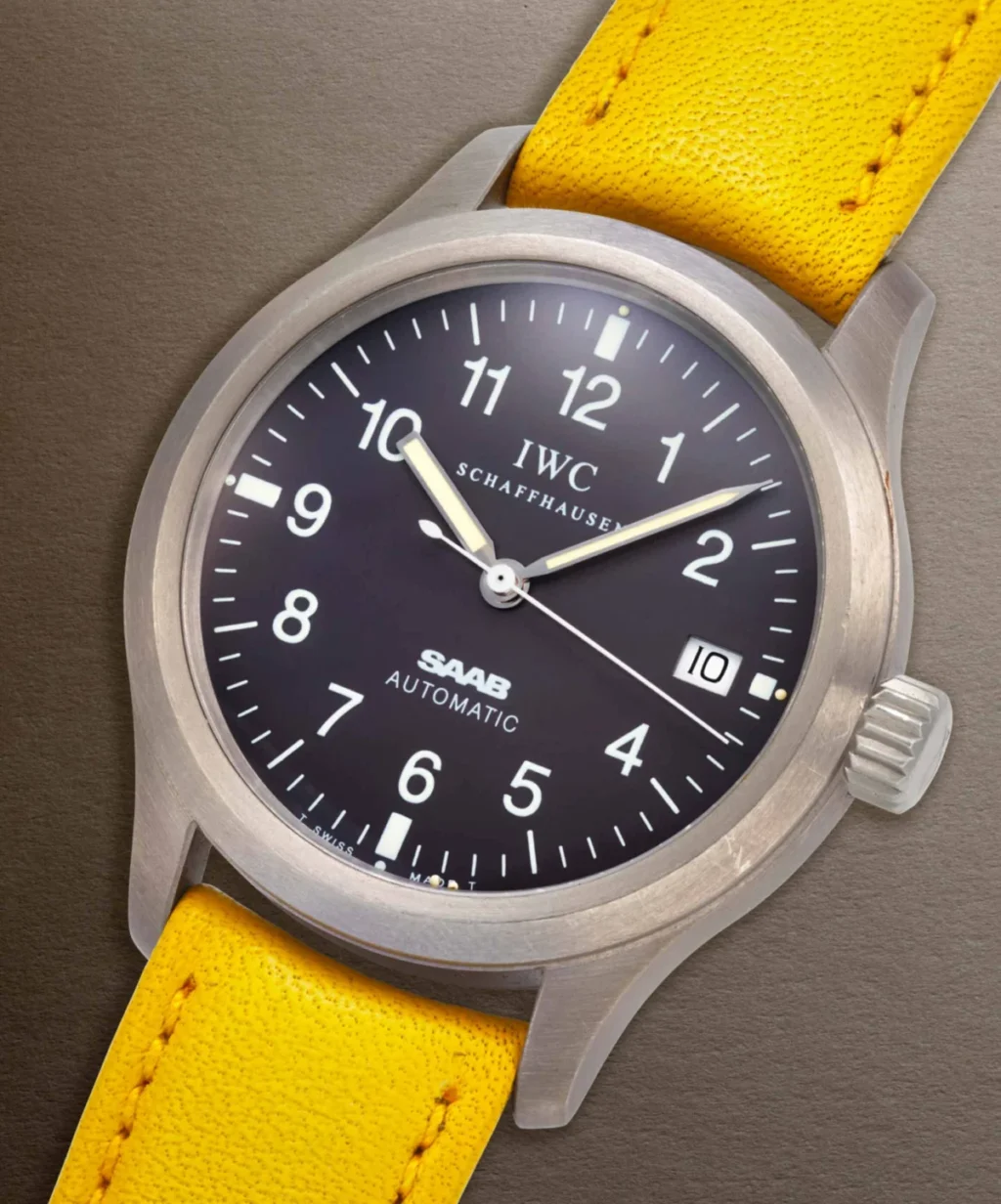
The defunct Swedish automaker Saab, particularly in its later years under General Motors, cultivated an advertising identity around the slogan "Born from Jets." While the distinction between the defense contractor Saab AB and the automotive division was clear, this heritage fueled exceptionally compelling television advertisements that resonated with a sense of innovation and daring. IWC Schaffhausen, a watchmaker renowned for its legacy in crafting pilot’s watches, lent its prestigious Mark Series to a distinctive collaboration with Saab in 1997.

This unique partnership offered a tangible reward for a specific purchase: individuals who placed a deposit on a limited-edition Saab 900 Mellow Yellow Cabrio were presented with one of these specially commissioned IWC Mark XII watches. These timepieces were subtly customized to reflect their automotive counterpart, featuring a vibrant yellow leather strap and the inscription "Saab Automatic" on the dial, replacing the standard "Mark XII Automatic." This initiative underscored a shared ethos of precision and performance, linking Saab’s reputation for innovative engineering, inspired by aviation, with IWC’s mastery of timekeeping for aviators. The 900 Mellow Yellow Cabrio itself was a special iteration of the popular convertible, distinguished by its cheerful hue and designed to appeal to a discerning clientele who appreciated both style and substance. The scarcity of these watches today, with only a limited number produced, contributes to their significant collector appeal. Current market valuations for these rare pieces range between $4,000 and $6,000, a sum equivalent to a considerable portion of the original vehicle’s cost, reflecting their desirability among collectors of both brands.
Seiko 7A28 Honda Racing Team: Capturing the Apex of an Eighties Dynasty
The 1980s marked a period of meteoric ascent for both Seiko and Honda, a decade that witnessed groundbreaking technological advancements and unparalleled sporting achievements. Seiko revolutionized the watch industry with the introduction of the world’s first analog quartz chronograph, the meticulously constructed 7A28. This sophisticated movement, known for its robust build and multiple variations, became a benchmark for precision timekeeping. Simultaneously, Honda forged a legendary partnership with the Brazilian Formula 1 driver Ayrton Senna. This collaboration would culminate in Senna’s first of three Driver’s Championships in 1988, a year that saw the McLaren-Honda team achieve an astonishing 15 victories out of 16 races, solidifying their dominance in Grand Prix racing.
In 1988, Seiko seized the opportunity to commemorate Honda’s burgeoning success on the global stage by releasing a specialized iteration of the 7A28. The Honda Racing Team version of this chronograph featured a striking gray and black color scheme, with its contrasting subdials designed to evoke the aesthetic of a car’s driver gauges. A minimalist tachymeter scale encircled the dial, further enhancing its sporty appeal. The "Honda" branding was prominently displayed at the top of the watch face, with "F-1 Grand Prix" elegantly engraved on the upper and lower lugs, signaling the watch’s direct connection to motorsport. Notably, the Seiko brand itself was conspicuously absent from the dial, a deliberate design choice that allowed Honda’s racing identity to take center stage. This approach underscored the brand’s understanding of allowing its partner to shine during a period of immense triumph.

The design of this 7A28 embraced the rounded, "jellybean" aesthetic that began to permeate the watch world in the late 1980s, a stylistic foreshadowing of trends to come in the following decade. While this design choice might be considered polarizing by some, its historical significance and inherent rarity have ensured its enduring appeal. The production of this specific 7A28 model continued until 1992, well after Senna had secured his subsequent championship titles, cementing its status as a time capsule of a golden era for both Honda and Seiko. The watch stands as a testament to a period of intense innovation and competitive fervor in both the automotive and horological spheres.
Citizen 8110A Walter Wolf Racing: A Flamboyant Chapter in Grand Prix History
While not achieving the same sustained success as some of its contemporaries, Walter Wolf Racing carved out a flamboyant and memorable niche in the annals of Formula 1. The eponymous Canadian businessman’s racing team competed in the Grand Prix seasons between 1977 and 1979, fielding a team that, despite its relatively short tenure, achieved notable victories. Under the skilled driving of Jody Scheckter, the team secured its inaugural win at the 1977 Argentinean Grand Prix, followed by prestigious triumphs at the Monaco and Canadian Grand Prixes. To honor this daring endeavor and its roster of celebrated drivers, including Bobby Rahal, James Hunt, and Keke Rosberg, Citizen released a series of watches in collaboration with the team.
These timepieces featured the bold red "W" logo of Walter Wolf Racing set against minimalist black dials, a design that perfectly encapsulated the team’s audacious spirit. Among the most compelling of these creations was the Walter Wolf 8110, a sophisticated chronograph that showcased one of Citizen’s most advanced movements of the era. The 8110 caliber was an automatic flyback movement, a highly desirable complication that allowed for the rapid resetting of the chronograph seconds hand without interrupting its continuous operation. This particular iteration was rendered in lightweight titanium and distinguished by an unusual compass bezel, adding a practical yet distinctive element to its design.

The Walter Wolf Racing team ultimately ceased operations after 1979, having been sold to Emerson Fittipaldi. However, the Walter Wolf brand continued to resonate, extending its influence through a line of period-appropriate accessories. Most notably, the brand became associated with a series of ultra-powerful, 500-horsepower Lamborghini Countaches. These exceptional supercars were meticulously hand-built and tuned by the renowned factory engineer Gian Paolo Dallara himself, further cementing the Walter Wolf name with a legacy of extreme performance and exclusive engineering. The Citizen collaboration serves as a tangible link to this exciting, albeit brief, chapter in motorsport history, offering collectors a piece of a bygone era characterized by daring ambition and distinctive style.
Buler Bertone Stratos LED: Echoes of Wedge Design and Digital Innovation
In 1970, Bertone unveiled the Lancia Stratos Zero at the Turin Motor Show, a car that irrevocably reshaped automotive design for the subsequent two decades. This dramatic, copper-colored wedge, with its sharp, angular lines, signaled a new direction for the future of car aesthetics. It was only fitting that a watch designed to complement such a revolutionary automotive concept would embrace cutting-edge technology and a similarly avant-garde design. Bertone selected Buler Watches, a Swiss brand established in 1945 in the shadow of the Jura Mountains, to develop a unique LED digital watch that would mirror the Stratos’s futuristic vision.
Buler engineered the module and encased it within a series of prototype watches that featured angular cases, some crafted from ABS plastic, and integrated bracelets. Exposed screws were a prominent design element, reflecting the prevailing aesthetic influenced by the mid-1970s design sensibilities, particularly the iconic work of Gerald Genta. These watches proudly bore the Stratos logo, a futuristic, angular typeface that has since been revived by contemporary graphic designers. The Bertone name and symbol were also present, a nod to the design house’s influential role in automotive history, evident in concepts from the 1968 Alfa Romeo Carabo to the Volvo 780.

Despite the innovative nature of the collaboration, Buler never achieved the same level of impact in the watchmaking world as Bertone did in its field. Even the embrace of the burgeoning LED technology, a revolution that Buler participated in alongside brands like Pulsar, Hamilton, and Omega, failed to propel the brand to lasting prominence. The rise of quartz dominance ultimately led to Buler’s gradual fade from the horological landscape. Nevertheless, the Buler Bertone Stratos LED remains a fascinating artifact, representing a unique intersection of radical automotive design and early digital watchmaking, a testament to a bold, albeit fleeting, vision.
Heuer Audi Sport Chronograph: A Limited Tribute to Rally Dominance
The early 1980s witnessed the undisputed dominance of Audi and its revolutionary Quattro Sport model, a vehicle that redefined rally racing with its pioneering four-wheel-drive system. To commemorate Audi’s early successes in Group B rallying, Heuer, a brand synonymous with motorsport timing, produced fewer than 300 examples of a highly specialized motorsports watch. This timepiece was not merely a branded accessory; it was a direct tribute to a dominant racing team, and it represents a less commonly known facet of Heuer’s rich history.
The Heuer Audi Sport Chronograph was built around the venerable Lemania 5100 movement, a robust and highly functional caliber that served as the foundation for a series of PVD-coated chronographs renowned for their durability and legibility. This movement powered iconic timepieces such as the Porsche Design Orfina, famously worn by Tom Cruise in "Top Gun," and early Sinn chronographs that helped establish the brand’s reputation. It was also the basis for Tutima’s Reference 798, a watch so widely adopted by European air forces that it became known as the "NATO watch."

A significant portion of these rare chronographs were supplied to Preston’s, a British retailer that held exclusive distribution rights for the homologation version of the Quattro Sport, a road-legal variant required for the car’s participation in Group B. These watches were also presented to key members of the Audi Sport team. Among the recipients was Hannu Mikkola, a Finnish rally legend who achieved seven victories at the grueling Rally of 1000 Lakes in his native country and secured the 1982 Driver’s Championship. The Heuer Audi Sport Chronograph, therefore, is more than just a rare watch; it is a direct link to a pivotal era in rally history, a tangible piece of the legend of Audi’s Quattro and the drivers who piloted it to victory. Its scarcity, coupled with its deep historical connection to motorsport excellence, makes it a highly coveted item for collectors.
Heuer Chronosplit Ferrari: A Digital Leap for the Prancing Horse
The association between Heuer and 1970s motorsport is indelibly etched in popular culture, largely thanks to iconic imagery like Steve McQueen’s presence in the racing circuit. However, the connection between Heuer and Ferrari extends beyond these familiar narratives, particularly with the fully digital Heuer Chronosplit bearing the iconic Prancing Horse logo. This timepiece represents an inspired choice, emerging from the post-quartz crisis era and embodying Heuer’s commitment to high-precision digital timing.
The Chronosplit was a groundbreaking split-seconds chronograph, powered by two separate quartz movements. This innovative configuration allowed wearers to simultaneously time two distinct events, a capability that was revolutionary for its time. Heuer’s newly established Mikrotechnic division was aggressively pursuing advancements in digital timing technology, and the Chronosplit, with its accuracy down to 1/100th of a second, stood as its flagship product.

The Ferrari-branded Chronosplit was awarded to a select group of VIPs, with estimates suggesting only around 200 examples were produced. One notable owner was Phil Hill, the first American driver to win a Formula 1 Grand Prix in 1961 while competing for Ferrari. A reference 102.703 Chronosplit Ferrari, previously owned by Hill, was presented at auction by Sotheby’s in 2024, highlighting its rarity and historical significance. The year of the Chronosplit’s introduction also saw Niki Lauda secure the Italian Grand Prix for Ferrari, a victory that would lead Heuer to introduce the Monza model the following year, further immortalizing the brand’s deep ties to the legendary Italian marque. This digital collaboration underscores Heuer’s forward-thinking approach, pushing the boundaries of timekeeping technology while forging an enduring legacy with one of the most iconic names in automotive history.