NASA and SpaceX are meticulously preparing for the highly anticipated launch of the Crew-13 mission, with the earliest opportunity set for 11:10 a.m. Eastern Daylight Time on Thursday, October 1. This critical mission will ferry four astronauts to the International Space Station (ISS), marking another significant milestone in the ongoing partnership between the U.S. space agency and the private aerospace giant. The launch is slated to originate from Space Launch Complex 40 at Cape Canaveral Space Force Station in Florida, a site with a storied history of facilitating space exploration.
In the days leading up to this pivotal liftoff, intensive final preparations and readiness reviews will be conducted. These comprehensive checks are designed to ensure that every element of the mission is primed for success. This includes rigorous evaluations of the astronauts’ health and readiness, the operational status of the International Space Station, the advanced capabilities of SpaceX’s Dragon spacecraft, and the reliability of the powerful Falcon 9 rocket. This collaborative approach underscores the commitment to safety and mission success that defines human spaceflight endeavors.
The Journey to the Stars: A Swift Rendezvous
The anticipated journey for the Crew-13 mission is remarkably swift. If the launch proceeds as scheduled on October 1, the SpaceX Dragon spacecraft is projected to reach the International Space Station in less than nine hours. This rapid transit is a testament to the technological advancements in propulsion and orbital mechanics that have been honed through years of development and previous crewed missions. The docking procedure is meticulously planned for approximately 8 p.m. EDT, targeting the forward-facing port of the Harmony module, a key connecting hub on the orbiting laboratory.
Following its ascent into orbit atop the Falcon 9 rocket, the Dragon spacecraft will undertake a series of precise maneuvers. These maneuvers are crucial for aligning its trajectory with that of the International Space Station, which orbits Earth at an average altitude of approximately 250 miles (400 kilometers) and at speeds exceeding 17,000 miles per hour (27,000 kilometers per hour). Docking is a complex and highly controlled process, requiring the spacecraft to carefully approach, align with, and securely attach to its designated port. The Harmony module, an integral component of the ISS, serves as a vital junction, providing essential docking locations for visiting vehicles and facilitating the movement of astronauts and cargo between modules.
Meet the Architects of Expedition 75
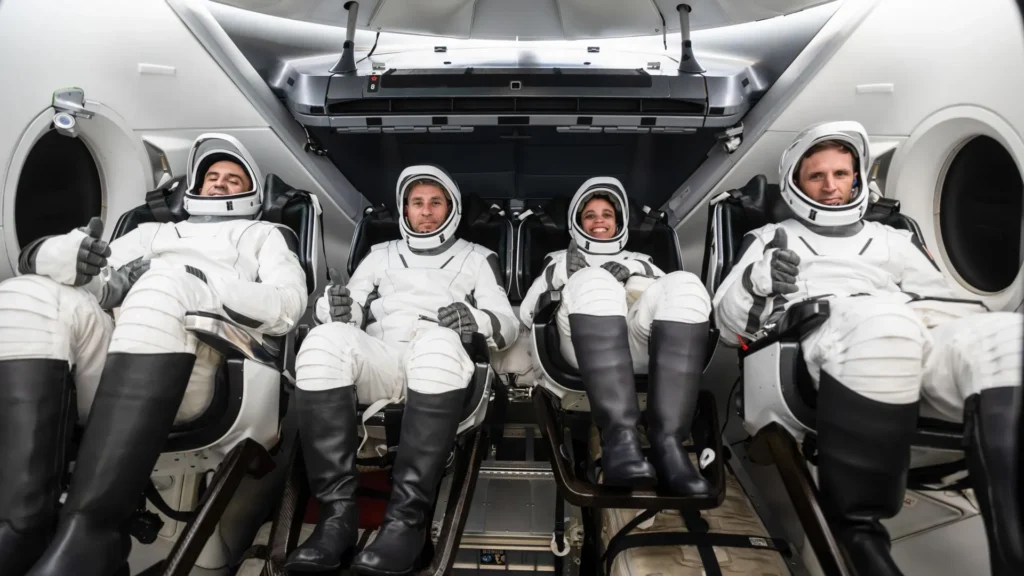
The Crew-13 mission will carry a diverse and highly skilled quartet of astronauts who will form the core of Expedition 75 aboard the International Space Station. Leading the mission as spacecraft commander will be NASA astronaut Jessica Watkins. Her extensive training and experience make her ideally suited to guide the crew through the complexities of the mission. Piloting the Dragon spacecraft will be NASA astronaut Luke Delaney, whose expertise in spacecraft operations is paramount for a safe and efficient journey.
Joining them as mission specialists will be Joshua Kutryk of the Canadian Space Agency (CSA) and Sergey Teteryatnikov from Roscosmos. The inclusion of international partners on crewed missions highlights the global nature of space exploration and the collaborative spirit that underpins scientific advancement in orbit. Upon their arrival at the ISS, these four individuals will integrate into the existing crew, embarking on a long-duration mission focused on a multitude of critical objectives.
Space station expeditions, such as Expedition 75, are the backbone of continuous human presence in space. During these extended stays, crews engage in a wide array of activities, including conducting cutting-edge scientific research across various disciplines, performing essential maintenance and upgrades to the orbiting laboratory, and supporting groundbreaking technology demonstrations. These operations not only advance our understanding of science and technology but also contribute to the development of capabilities necessary for future human exploration, including missions to the Moon and Mars.
Pre-Flight Preparations: A Tradition of Caution
In a testament to the rigorous safety protocols that govern human spaceflight, the Crew-13 astronauts are currently undergoing a period of quarantine at NASA’s Johnson Space Center in Houston, Texas. This preflight precaution is a standard measure designed to minimize the risk of illness among the crew members prior to their launch. By isolating the astronauts, health officials aim to ensure that they are in peak physical condition and free from any communicable diseases that could potentially jeopardize the mission or the health of the existing ISS crew.
The crew is scheduled to travel to NASA Kennedy Space Center in Florida on Saturday, September 26. This move signifies the final stages of their preparation, bringing them physically closer to the launch site as final checks and procedures are meticulously executed. This timeline allows for a seamless transition into the pre-launch environment, ensuring that all personnel and equipment are ready for the planned October 1 liftoff.
A Legacy of Partnership: The Evolution of Commercial Crew
The Crew-13 mission represents the continuation of a transformative era in human spaceflight, largely driven by NASA’s Commercial Crew Program. Launched in 2010, this program aimed to foster the development of American private sector capabilities to transport astronauts to and from the International Space Station. Prior to the program’s success, the United States relied on Russian Soyuz spacecraft for crewed access to orbit following the retirement of the Space Shuttle program in 2011.
SpaceX, under this program, developed its Falcon 9 rocket and Crew Dragon spacecraft. The inaugural crewed mission, Demo-2, successfully launched in May 2020, marking the return of human spaceflight launches from American soil after a nine-year hiatus. Subsequent missions, including Crew-1, Crew-2, and Crew-3, have further solidified the reliability and operational cadence of this partnership. Crew-13 builds upon this established foundation, representing the 13th crewed mission launched by SpaceX and the 10th operational mission to the ISS under the Commercial Crew Program.
The financial implications of this partnership are also significant. NASA’s investment in the Commercial Crew Program has spurred innovation and competition within the aerospace industry, leading to cost efficiencies compared to traditional government-led development programs. While specific contract details are proprietary, the program has demonstrably reduced the cost per seat for NASA astronauts traveling to orbit.
The Science of the Stars: Objectives of Expedition 75
The scientific agenda for Expedition 75 is expected to be multifaceted, encompassing a broad spectrum of research areas. Astronauts aboard the ISS routinely conduct experiments in microgravity that are impossible to replicate on Earth. These experiments span disciplines such as:
- Human Physiology: Understanding the long-term effects of space on the human body is crucial for enabling future deep-space missions. Research may focus on bone density loss, muscle atrophy, cardiovascular health, and the psychological impacts of prolonged isolation.
- Materials Science: The unique environment of space allows for the creation of novel materials and alloys with superior properties. Experiments might explore crystal growth, alloy solidification, and the behavior of fluids in microgravity.
- Biology and Biotechnology: Research in this area can lead to advancements in medicine, agriculture, and our understanding of fundamental biological processes. This could include studies on plant growth in space, cell cultures, and the development of new pharmaceuticals.
- Earth Observation: The ISS serves as a vital platform for monitoring Earth’s climate, environment, and natural disasters. Astronauts capture high-resolution imagery and collect data that aids scientists in understanding global changes.
- Fundamental Physics: Experiments in areas like quantum mechanics, fluid dynamics, and combustion can be conducted with greater precision in the absence of Earth’s gravitational influence.
The specific research objectives for Expedition 75 will be detailed in mission planning documents and are often influenced by proposals from scientific institutions worldwide. The successful execution of these experiments relies on the expertise and dedication of the astronauts, as well as the robust infrastructure of the International Space Station.
Looking Ahead: The Future of Space Exploration
The Crew-13 mission, and indeed all missions conducted under the Commercial Crew Program, are not merely about reaching the ISS. They are stepping stones towards a more ambitious future for human space exploration. The operational experience gained from these regular flights is invaluable for developing the technologies and protocols required for longer-duration missions beyond low Earth orbit.
NASA’s Artemis program, which aims to return humans to the Moon and establish a sustainable lunar presence, will undoubtedly benefit from the lessons learned through the Commercial Crew Program. The capabilities developed by SpaceX and other commercial partners are essential for supporting the logistical and operational demands of lunar missions and eventually, crewed missions to Mars.
The continued success of missions like Crew-13 reinforces the viability of public-private partnerships in achieving audacious space exploration goals. It demonstrates that collaboration between government agencies and private industry can accelerate innovation, reduce costs, and expand access to space. As the Crew-13 astronauts prepare for their journey, they carry with them not only the hopes of their nations but also the aspirations of humanity for continued exploration and discovery beyond our planet. The 11:10 a.m. EDT launch window on October 1 represents not just the start of a mission, but a pivotal moment in the ongoing narrative of human endeavor in the cosmos.