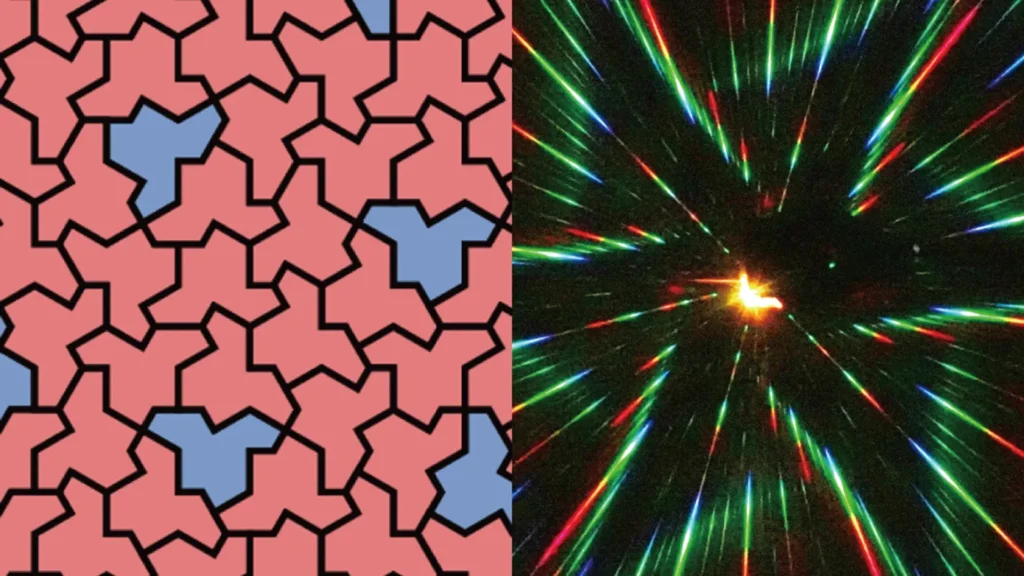
In a significant leap from theoretical mathematics to experimental physics, a team of researchers from the Institute of Industrial Science at the University of Tokyo, in collaboration with several international institutions, has successfully demonstrated that a recently discovered mathematical shape can fundamentally alter the behavior of light. The study, published in the prestigious journal Nature Communications, details how optical structures modeled after the "Smith hat"—the world’s first known aperiodic monotile—produce unique chiral diffraction patterns when struck by laser light. This discovery not only validates the physical properties of a long-sought mathematical concept but also opens new avenues for the development of advanced optical devices, including those used in telecommunications, computing, and high-security anti-counterfeiting measures.
The Convergence of Geometry and Nanophotonics
The research centers on the "Smith hat," a geometric shape that achieved global fame in early 2023 for solving a problem that had stumped mathematicians for over half a century. Known as the "Einstein problem"—derived from the German "ein stein," meaning "one stone"—the challenge was to find a single shape that could tile an infinite plane without ever repeating its pattern. While periodic tilings like squares, hexagons, and triangles are ubiquitous in nature and architecture, aperiodic tilings were previously thought to require at least two different shapes, such as the famous Penrose tiles discovered in the 1970s.
The University of Tokyo team, led by lead author Yuto Moritake and senior author Masaya Notomi, recognized that the unique geometric properties of the Smith hat could have profound implications for wave physics. By transitioning this abstract mathematical solution into a physical medium, the researchers sought to observe how the absence of translational symmetry combined with a specific type of order would influence electromagnetic waves. Their findings suggest that the Smith hat is more than a mathematical curiosity; it is a blueprint for a new class of photonic materials.
Solving a Decades-Old Mathematical Mystery
To appreciate the significance of the physical discovery, one must understand the historical context of the Einstein problem. For decades, the mathematical community debated whether a "monotile" capable of aperiodic tiling even existed. In the 1960s, mathematician Robert Berger discovered the first set of aperiodic tiles, but it required a staggering 20,426 distinct shapes. Over time, researchers whittled this number down. Roger Penrose famously reduced the requirement to just two shapes in 1974.
The breakthrough occurred in March 2023, when David Smith, an amateur mathematician from Yorkshire, England, identified a 13-sided polygon—resembling a stylized hat—that appeared to tile aperiodically. Working with academic collaborators Joseph Samuel Myers, Craig S. Kaplan, and Chaim Goodman-Strauss, Smith proved that this single shape could cover an infinite surface without a repeating unit cell.
"What is especially fascinating about the hat tile is that, although the resulting pattern appears irregular at first glance, it is actually constructed from the honeycomb lattice," noted Yuto Moritake. This underlying relationship to a regular hexagonal grid provided the researchers with a structured yet non-repeating framework, making it an ideal candidate for testing how light interacts with complex, non-standard geometries.
A Chronology of Discovery: From Yorkshire to Tokyo
The timeline of this discovery moved with remarkable speed, reflecting the high level of interest in both the mathematical and physical communities:
- March 2023: David Smith and his team publish their preprint announcing the discovery of the "Hat" tile, the first true aperiodic monotile.
- May 2023: The same team discovers the "Spectre" tile, a variation that is strictly aperiodic even without the need for reflected (mirrored) versions of the shape.
- Late 2023: Researchers at the University of Tokyo begin designing experiments to translate these mathematical patterns into physical nanostructures.
- 2024: The study is published in Nature Communications, marking the first time the optical properties of the Einstein monotile have been rigorously measured and analyzed at the nanoscale.
By moving from the theoretical proof to a physical experiment in roughly a year, the scientific community has demonstrated the rapid cross-pollination between pure mathematics and applied materials science.
Engineering the Monotile at the Nanoscale
To observe the optical response of the Smith hat, the University of Tokyo researchers employed advanced nanofabrication techniques. They utilized electron beam lithography to etch the monotile pattern onto silicon nitride (Si3N4) films. Silicon nitride was chosen for its high refractive index and low absorption in the visible spectrum, making it a standard material for high-performance photonic integrated circuits.
The researchers created a "metasurface"—a thin layer of material engineered with sub-wavelength structures that can manipulate light in ways that natural materials cannot. Each individual "hat" in the pattern was sized at the nanoscale, creating a dense, complex lattice that challenged traditional theories of light scattering.
In conventional crystals, atoms are arranged in a repeating, periodic lattice, which leads to discrete, predictable diffraction spots (Bragg peaks). In quasicrystals, which are ordered but not periodic (like Penrose tilings), the diffraction patterns show "forbidden" symmetries, such as five-fold or ten-fold rotations. The Smith hat, however, presented a different challenge: it is aperiodic but sits on a hexagonal lattice, creating a unique hybrid state of order.
Unveiling Chiral Pinwheels in Light Diffraction
The most striking result of the experiment occurred when the researchers directed laser light at the Smith hat structures. Instead of the standard dots or rings seen in other materials, the diffraction patterns formed distinctive, pinwheel-like shapes.
These pinwheels are a direct manifestation of chirality. Chirality, or "handedness," refers to a property where an object cannot be superimposed on its mirror image—much like a human left and right hand. While the individual Smith hat tile is chiral (it has a distinct left- and right-handed version), the researchers found that the entire aperiodic arrangement produced a global chiral response in the light itself.
"We found that the diffraction patterns themselves become chiral because the structure lacks mirror symmetry," explained senior author Masaya Notomi. "This kind of optical response is fundamentally different from that observed in conventional quasicrystalline materials."
The observation of "chiral diffraction" is significant because it suggests that the geometry of the tiling can "twist" the light as it passes through. This interaction between the aperiodicity of the tiling and the polarization of the light provides a new mechanism for controlling electromagnetic fields at the microscale.
Analyzing the Optical Response and Polarization
The team’s data revealed that the optical behavior of the structures was highly sensitive to two factors: the direction of the incoming light and its polarization. Polarization refers to the orientation of the light waves’ vibrations. When the researchers changed the polarization of the laser, the intensity and shape of the chiral pinwheels shifted accordingly.
Furthermore, the researchers performed a "mirror test." They fabricated a version of the structure that was a perfect mirror image of the original. When illuminated, this mirrored structure produced a diffraction pattern that was also perfectly mirrored. This confirmed that the chiral light response was not an artifact of the laser or the experimental setup, but was directly dictated by the mathematical symmetry—or lack thereof—of the Smith hat tiling.
This level of control is highly desirable in the field of photonics. Typically, inducing chirality in light requires complex 3D structures or specific magnetic fields. The ability to achieve it using a 2D surface patterned with a single, simple shape represents a major simplification in design and manufacturing.
Broader Implications for Photonic Technology
The transition of the Smith hat from a mathematical puzzle to a physical tool has several practical implications for the future of technology:
- Advanced Optical Modulation: By utilizing the sensitivity of these structures to polarization, engineers could develop new types of optical switches and modulators for high-speed fiber-optic networks.
- Chiral Sensing: The ability to generate and manipulate chiral light is essential in the pharmaceutical industry, where many drug molecules are chiral. Aperiodic monotile surfaces could lead to more sensitive sensors for detecting specific molecular "hands."
- Security and Authentication: Because the diffraction patterns of the Smith hat are unique and highly dependent on the exact geometry of the tile, they could be used to create nearly impossible-to-forge optical security tags for currency or sensitive documents.
- Holography and Displays: The unique way these structures scatter light could be harnessed to create new types of holographic displays that offer wider viewing angles or more complex image encoding.
The Future of Symmetry-Controlled Physics
The University of Tokyo’s research marks the beginning of a new chapter in the study of "topological photonics" and "non-periodic order." While the Smith hat has solved a 60-year-old math problem, it has raised a host of new questions for physicists.
"These results open a new direction of research on the fusion of quasiperiodic order and chirality," Moritake remarked. The team plans to continue exploring how other aperiodic monotiles, such as the "Spectre" tile (which tiles aperiodically without needing its mirror image), might interact with light. Because the Spectre is "purely" chiral in its tiling, it may produce even more pronounced optical effects.
The broader scientific community has reacted to the study with enthusiasm. Dr. Masaya Notomi noted that the interplay of symmetry, chirality, and aperiodicity creates a "rich playground" for discovering new physical phenomena. As researchers continue to bridge the gap between abstract geometry and tangible materials, the Smith hat serves as a reminder that the solutions to ancient puzzles often contain the keys to future technologies.
The findings demonstrate that in the realm of modern science, the boundary between "pure" and "applied" research is increasingly porous. A shape discovered by an amateur mathematician in a home workshop has, within months, provided a new lens through which the world’s leading physicists view the fundamental nature of light. As the study of aperiodic monotiles moves forward, the "hat" may well become a cornerstone of next-generation optical engineering.