Water, the ubiquitous solvent and lifeblood of Earth, occupies over 70% of the planet’s surface, yet its fundamental behavior distinguishes it profoundly from nearly every other known liquid. Among its most enigmatic traits is its unique property of expanding upon freezing, rather than contracting—a characteristic deviation that underpins everything from the buoyancy of icebergs to the very mechanics of cellular life. For centuries, scientists have recognized these peculiar behaviors, attributing them to intricate changes in water’s microscopic structure as temperature and pressure fluctuate. However, a persistent challenge has been the lack of a consistent and universally accepted framework to describe, quantify, and compare these elusive structural transformations.
Now, a significant breakthrough from researchers at the University of Osaka, Japan, promises to unravel this long-standing scientific enigma. Leveraging the power of artificial intelligence (AI), their newly developed system offers a unified methodology to systematically compare various theoretical models and descriptors used to characterize the structure of supercooled water. This innovative AI approach not only identifies which structural descriptions most accurately capture the critical features of water’s molecular arrangements but also provides a robust platform for future investigations. The seminal findings of this research, which mark a crucial step in understanding water’s fundamental properties, were recently published in the esteemed journal Communications Chemistry.
The Enduring Mystery of Water’s Anomalies
Water’s eccentricities extend far beyond its expansion upon freezing. It possesses an unusually high specific heat capacity, meaning it requires a significant amount of energy to change its temperature, a property vital for moderating Earth’s climate and stabilizing biological systems. Its high surface tension allows capillary action, enabling water to climb against gravity in plants, and its remarkably high boiling point, compared to other hydrides of similar molecular weight like hydrogen sulfide (H2S), is another indicator of its exceptional intermolecular forces. These anomalies, often termed "water’s strange properties," have captivated scientists for generations, suggesting a complex underlying molecular dance that defies simple explanation.
At the heart of many of these anomalies lies the unique nature of hydrogen bonding. Water molecules (H2O) are polar, with oxygen attracting electrons more strongly than hydrogen, creating partial positive charges on the hydrogen atoms and a partial negative charge on the oxygen. This polarity allows individual water molecules to form transient, yet strong, hydrogen bonds with up to four neighboring molecules, creating a dynamic, constantly forming and breaking network. It is the intricate geometry and energetic balance of these hydrogen bonds that dictates water’s macroscopic properties, and crucially, how they shift under varying conditions.
Supercooled Water: A Window into Molecular Complexity
The realm of supercooled water offers an even more pronounced display of these unusual properties, providing scientists with a unique experimental window into water’s fundamental structural transitions. For liquid water to solidify into ice, its molecules must meticulously arrange themselves into a highly ordered, hexagonal crystal lattice. This process typically initiates at a "nucleation site"—a microscopic impurity, dust particle, or even a minuscule scratch on a container surface—that provides the initial template for ice crystal formation.
However, in the absence of such nucleation sites, water can defy its conventional freezing point of 0°C (32°F) and remain in a liquid state, even when cooled to temperatures as low as approximately -48°C (-55°F). This metastable state is known as supercooled water. While thermodynamically unstable, it can persist for varying durations, offering a unique opportunity to study water’s properties in a state where the usual crystalline constraints are lifted. In this supercooled regime, water’s anomalous behaviors, such as its density maximum at 4°C, become even more pronounced, prompting intense scientific scrutiny.
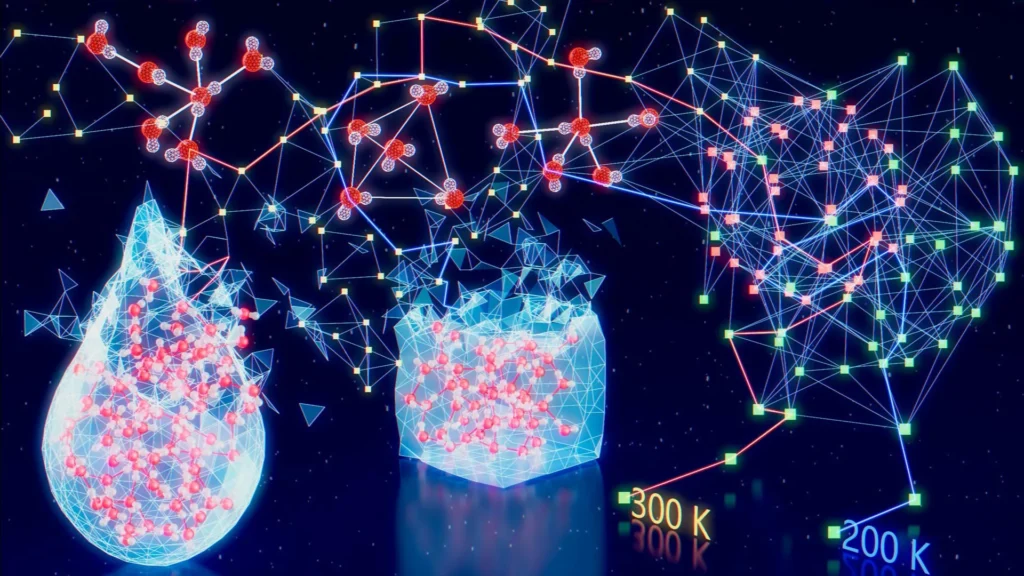
The prevailing scientific hypothesis linking these behaviors posits a delicate balance between two competing forms of liquid water at the molecular level: a high-density liquid (HDL) and a low-density liquid (LDL). The HDL state is characterized by more compact, disordered arrangements of water molecules, with hydrogen bonds often distorted or broken. Conversely, the LDL state features a more open, tetrahedral network of hydrogen bonds, resembling the structure of ice but without long-range crystalline order. As temperature rises, the kinetic energy of molecules increases, leading to more frequent breaking of hydrogen bonds and a greater prevalence of the more compact HDL structures over the open LDL arrangements. Understanding the precise interplay and transition between these two proposed liquid states is considered crucial for fully elucidating water’s anomalies.
The Historical Quest for Structural Understanding
The scientific journey to understand water’s structure is a long and winding one, punctuated by various theoretical models and experimental challenges. Early insights in the 1930s, particularly from Desmond Bernal and Ralph Fowler, laid the groundwork by proposing the existence of hydrogen bonds and a tetrahedral arrangement of water molecules in ice. However, describing the dynamic, disordered nature of liquid water proved far more complex. Over the decades, researchers developed numerous "structural descriptors"—mathematical or computational metrics designed to quantify the local arrangement of water molecules. These include measurements like "tetrahedral bond order," which assesses how closely a molecule’s immediate neighbors conform to an ideal tetrahedral geometry, and "local density," which measures the number of molecules within a specific radius.
The independent development of these descriptors, often tailored for specific computational models or experimental techniques, led to a fragmented landscape. Each descriptor might use different scales, dimensions, or types of information, making direct comparisons extraordinarily difficult. This fragmentation has been a significant barrier to establishing a consistent, unified understanding of water’s structural evolution across different conditions. Without a common language or metric, correlating microscopic structural changes with observed macroscopic thermodynamic behaviors—like density anomalies or heat capacity—remained an arduous task.
AI’s Transformative Role: Bridging the Descriptive Gap
This is precisely where the University of Osaka’s AI system makes its groundbreaking contribution. Recognizing the limitations of disparate descriptors, the research team sought a method to objectively evaluate their efficacy. "Past studies have shown that using machine learning to classify and understand structural data is effective," explains corresponding author Kang Kim. "We specifically wanted to incorporate a neural network model into this study to evaluate how accurate the descriptors were at capturing key structural information, in a way that is like human cognition."
The AI system, a sophisticated neural network, was trained using vast datasets generated from molecular dynamics simulations of supercooled water. These simulations, powerful computational tools, model the movements and interactions of thousands of water molecules over incredibly short timescales, providing atomic-level insights into their dynamic behavior. By repeatedly feeding the neural network this structural data, allowing it to learn through iterative trial and error, the system developed the capacity to recognize meaningful patterns and differentiate between the subtle structural nuances of HDL and LDL states. This unsupervised learning approach enabled the AI to identify intrinsic structural features without explicit human programming for each specific descriptor.
Quantifying Descriptors and Unveiling Efficiency
The core of the AI’s utility lies in its ability to objectively compare and rank the effectiveness of various structural descriptors. As senior author Nobuyuki Matubayasi reports, "The network used what it had learned to compare how 16 descriptors differentiated between LDL and HDL structures at different temperatures. In this way, we determined the most efficient descriptors." This process involved the AI evaluating each descriptor’s capacity to distinguish between the proposed HDL and LDL structures across a range of supercooled temperatures. The descriptors that most effectively and consistently captured the differences between these two states, as inferred by the AI’s pattern recognition capabilities, were deemed the most efficient and informative.
This AI-driven evaluation is a paradigm shift. Instead of researchers painstakingly comparing descriptors through indirect means, the neural network offers an unbiased, data-driven assessment. It allows for the identification of descriptors that are not only quantitatively precise but also qualitatively relevant to the underlying physical phenomena—the very essence of what makes water unique.
Broader Implications for Science and Technology
The implications of this research extend far beyond merely cataloging water’s oddities. The framework developed by the Osaka team could profoundly improve scientists’ understanding of how microscopic structural changes are intimately connected to the macroscopic thermodynamic behavior of water. By providing a unified and validated set of tools to describe water’s structure, the findings may help to definitively explain the origin of water’s unusual properties, a puzzle that has eluded full resolution for centuries.
Fundamental Physics and Chemistry: A clearer understanding of the HDL-LDL transition and the precise structural characteristics of these states could lead to a more complete phase diagram for water, particularly in the supercooled and high-pressure regimes, where experimental data is scarce and theoretical models diverge. This could resolve long-standing debates about the existence of a second critical point in water.
Materials Science and Engineering: Knowledge of water’s structural behavior is crucial for designing new materials with tailored properties. For instance, developing advanced anti-icing coatings for aircraft or infrastructure relies on understanding how water molecules interact with surfaces at low temperatures. Similarly, the ability to control ice formation has implications for cryopreservation techniques, aiming to preserve biological tissues and organs without damaging ice crystal formation. The insights from this research could guide the development of cryoprotectants that manipulate water’s molecular structure more effectively.
Biology and Medicine: Water is the primary component of all living organisms, and its properties are fundamental to biological processes. The precise way water molecules interact with proteins, DNA, and cell membranes dictates their structure and function. Understanding how water’s microscopic structure changes could shed light on phenomena like protein folding, enzyme activity, and cellular response to stress. This could have profound impacts on drug design, understanding disease mechanisms, and improving biotechnological processes.
Atmospheric and Climate Science: Water plays a critical role in Earth’s climate system, from cloud formation to precipitation and ice dynamics in polar regions. The behavior of supercooled water is central to understanding cloud microphysics, as water droplets can remain liquid at sub-zero temperatures high in the atmosphere. Improved models of water’s structural transitions could enhance climate models, leading to more accurate predictions of weather patterns and climate change impacts.
The Future of AI in Scientific Discovery: This research also serves as a compelling case study for the transformative potential of artificial intelligence in fundamental scientific discovery. By automating the complex task of evaluating and comparing scientific descriptors, AI frees human researchers to focus on hypothesis generation, experimental design, and deeper theoretical insights. It exemplifies how AI can augment human cognition, allowing scientists to tackle problems of unprecedented complexity and accelerate the pace of discovery across various disciplines. The Osaka team’s framework could be adapted to study other complex liquids, glasses, and soft matter systems, where understanding microscopic structure is paramount to predicting macroscopic behavior.
In conclusion, the University of Osaka’s pioneering use of AI to standardize the description of water’s microscopic structure represents a pivotal moment in chemistry and physics. By providing a consistent, data-driven methodology, this research not only offers new clues to water’s hidden complexities but also guides the development of even better tools for studying its intricate molecular dance. This unified approach promises to unlock long-standing scientific mysteries, paving the way for innovations that could impact fields from medicine and materials science to climate modeling, underscoring the profound and ongoing quest to understand the most common, yet most mysterious, liquid on Earth.