The burgeoning field of artificial intelligence is increasingly proving to be an indispensable ally in humanity’s quest to unravel the universe’s deepest mysteries. From analyzing vast astronomical datasets to accelerating complex simulations, AI algorithms are transforming the pace and scope of scientific discovery. A recent study, published in the Journal of Cosmology and Astroparticle Physics (JCAP), delves into one such transformative application: the use of transfer learning to expedite the search for physics beyond the established standard cosmological model, known as Lambda-CDM (ΛCDM). While offering a promising pathway to significantly reduce the computational burden, the research simultaneously flags a critical challenge: the potential for "negative transfer," where an AI’s prior knowledge inadvertently impedes its ability to detect genuinely novel phenomena.
The Standard Model of Cosmology: Successes and Unanswered Questions
To appreciate the significance of this research, it’s crucial to understand the current bedrock of cosmological understanding: the ΛCDM model. This model posits that the universe is composed of approximately 5% ordinary baryonic matter (the stuff we see and interact with), 27% mysterious dark matter (which exerts gravitational pull but doesn’t interact with light), and 68% equally enigmatic dark energy (responsible for the accelerating expansion of the universe). ΛCDM has been remarkably successful in explaining a wide array of cosmological observations, from the precise anisotropies in the Cosmic Microwave Background (CMB) – the faint afterglow of the Big Bang – to the large-scale distribution of galaxies and the cosmic expansion history.
However, despite its triumphs, the ΛCDM model is not without its limitations and unresolved puzzles, prompting scientists to actively search for "new physics" that might extend or even supersede it. Among the most pressing are several persistent anomalies and fundamental unknowns. The "Hubble tension," for instance, refers to the significant discrepancy between the expansion rate of the universe (the Hubble constant) measured from early universe data (like the CMB) and that measured from local universe observations (like supernovae). Another intriguing puzzle is the "S8 tension," which highlights a mismatch in the measured clustering of matter in the universe. Beyond these observational discrepancies, the very nature of dark matter and dark energy remains profoundly unknown, representing two of the biggest outstanding problems in fundamental physics. Furthermore, the standard model assumes neutrinos are massless, yet experiments have shown they possess a tiny but non-zero mass, which could have subtle but detectable cosmological effects. These challenges and unknowns fuel the urgent need for theoretical investigations into alternative models, such as modified theories of gravity, evolving dark energy, or the impact of massive neutrinos.
The Computational Bottleneck in Exploring New Physics
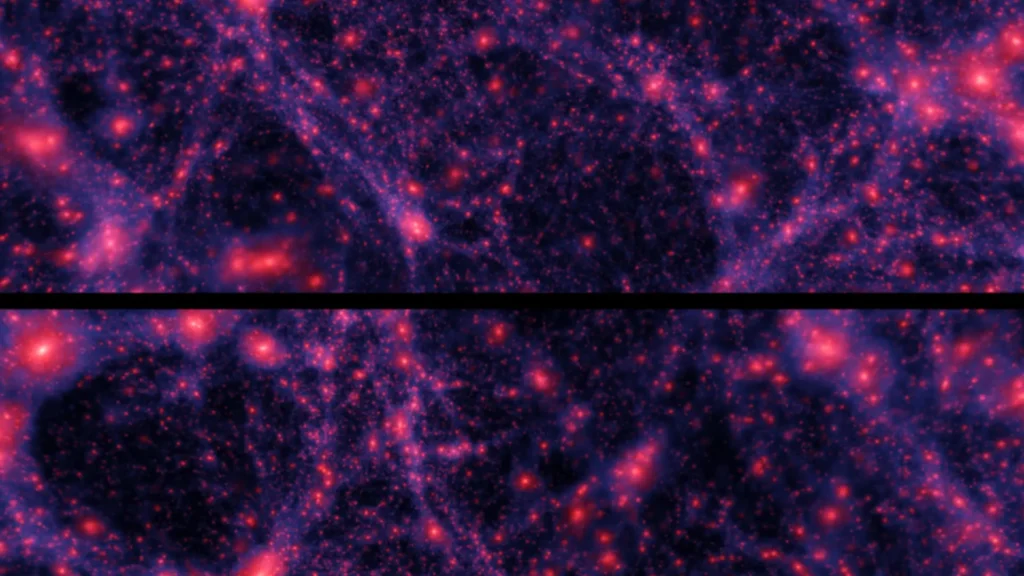
Exploring these "beyond-ΛCDM" theories is an incredibly resource-intensive endeavor. Researchers typically rely on sophisticated computer simulations that model the evolution of the universe under different physical assumptions. Each simulation represents a "virtual universe," meticulously tracking the gravitational interactions of billions of particles over cosmic timescales, from the Big Bang to the present day. To effectively constrain a new theory, cosmologists must generate and analyze an enormous ensemble of these simulations, each corresponding to a unique set of parameters or theoretical variations.
The sheer scale and complexity of these simulations demand immense computational power. A single high-resolution cosmological simulation can require thousands of CPU hours on supercomputers and generate terabytes of data. When multiplied by the hundreds or even thousands of simulations needed to thoroughly map out the parameter space of a new physics model, the computational cost quickly becomes astronomical, often consuming significant portions of national computing facilities and research budgets. This computational bottleneck significantly limits the speed at which new theories can be tested and evaluated against observational data, underscoring the critical need for more efficient methodologies.
Transfer Learning: A Strategic Shortcut to Efficiency
This is precisely where the innovative application of transfer learning, as explored by the research team led by Adrian Bayer of the Flatiron Institute and Princeton University, and first author Veena Krishnaraj, an undergraduate student at Princeton University, enters the picture. Transfer learning is a machine learning technique that allows an AI model to leverage knowledge gained from solving one task to improve its performance on a related but different task. Instead of training a neural network from scratch for every new problem, it benefits from pre-existing expertise.
The team’s strategy involved a two-stage training process. In the initial phase, known as pretraining, they trained a neural network on simpler, less computationally expensive simulations based on the well-understood ΛCDM model. These simulations, while not encompassing "new physics," provided the AI with a foundational understanding of cosmic structure formation, gravitational dynamics, and the general evolution of the universe under standard assumptions.
"It’s basically a shortcut," explains Adrian Bayer, co-author of the study. "Usually people train the AI directly on the most computationally expensive simulations. What we do instead is first use simpler and less expensive ΛCDM simulations to give the AI an idea of what’s happening, and only afterward move to the more complex models." Bayer draws an analogy to human learning: "You first read a basic book to get an idea of the knowledge, and then move to the really complicated book." This approach, according to Veena Krishnaraj, prevents the AI from having to "digest everything at once," allowing for a more gradual and efficient assimilation of complex information.
Following this pretraining phase, the AI system was then fine-tuned using a smaller, carefully selected set of more sophisticated simulations that incorporated the "new physics" theories researchers wished to investigate. The results were remarkably encouraging. In several test cases, the application of transfer learning reduced the number of expensive simulations required for the AI to achieve a desired level of accuracy by more than a factor of ten. This translates into substantial savings in computational time and resources, potentially accelerating the discovery timeline for new cosmological insights by months or even years. Such efficiency gains are not merely incremental; they represent a paradigm shift in how cosmologists can approach the vast parameter spaces of theoretical models.
The Paradox of Prior Knowledge: The Challenge of Negative Transfer
While the efficiency gains were substantial, the study also brought to light a less intuitive, yet critical, challenge: the phenomenon of "negative transfer." This occurs when the knowledge acquired during the initial pretraining phase, instead of aiding the learning of a new task, actually hinders it. Using Bayer’s textbook analogy, imagine a medical student who has mastered the diagnosis of common illnesses. When confronted with a rare disease that presents symptoms remarkably similar to a common cold, their ingrained knowledge might initially lead them down the wrong diagnostic path, making it harder to recognize the truly novel condition.
The same issue can arise in AI systems, especially when searching for subtle signatures of "new physics." In some instances, the observational imprints of a novel physical effect can closely mimic patterns that the AI has already learned to associate with parameters within the standard ΛCDM model. When this happens, the pretrained neural network may misinterpret the unfamiliar information, attempting to fit it into its existing framework rather than recognizing it as truly distinct.
The researchers observed this effect vividly when studying simulations that included massive neutrinos. While neutrinos are part of the Standard Model of particle physics, their precise mass is still unknown, and their collective mass could influence the large-scale structure of the universe by slightly suppressing the growth of cosmic structures. However, some of the cosmological signatures associated with the mass of neutrinos bear a striking resemblance to changes caused by a well-known ΛCDM parameter called σ8 (sigma-eight). The σ8 parameter is a measure of the amplitude of matter fluctuations in the universe, essentially quantifying how "clumpy" the universe is. An increase in neutrino mass can cause a similar smoothing effect on cosmic structures as a decrease in σ8.
Because of this inherent degeneracy – where different physical processes can produce very similar observable outcomes – the pretrained neural network initially struggled to differentiate between the effects of neutrino mass and changes in σ8. "The negative transfer is not random. It is driven by underlying physical degeneracies in the model," states Krishnaraj. This highlights a profound challenge: if AI is too heavily biased by what it already knows, it might overlook genuinely new physics simply because the new signature looks "too much like" something old. "So this is something we need to be aware of and try to mitigate," she concludes, emphasizing the need for robust strategies to counteract this effect.
Broader Implications for Scientific Discovery and AI Development
The findings of this study resonate far beyond the confines of cosmology, offering valuable insights into the broader application of foundation models and machine learning across scientific disciplines. The principles underlying transfer learning in this context are conceptually similar to those driving the rapid advancements in modern generative AI systems and large language models (LLMs), which leverage massive datasets for pretraining before fine-tuning for specific tasks.
This research underscores a fundamental tension in the deployment of AI for scientific discovery: the trade-off between efficiency and the potential for genuine novelty detection. While pretraining can dramatically speed up inference and analysis, it also introduces a risk of "bias towards the known," potentially hindering the recognition of truly unexpected phenomena. This is not merely an algorithmic glitch but a philosophical challenge for scientific methodology in the age of AI. The goal of science is not just to confirm existing models but to push beyond them, to uncover the entirely unforeseen. If AI tools are inherently predisposed to interpreting new data through the lens of old theories, they could inadvertently limit the scope of discovery.
This necessitates careful consideration of how AI models are designed, trained, and validated. Researchers must develop methods to ensure that AI maintains a degree of "open-mindedness," capable of flagging anomalous data or patterns that do not fit neatly into existing frameworks. This might involve more diverse and representative training datasets, novel architectural designs for neural networks, or sophisticated interpretability tools that allow human scientists to understand why an AI is making certain classifications. Ultimately, AI remains a powerful tool, but human oversight, critical thinking, and the scientific method’s inherent skepticism remain paramount to prevent these tools from becoming echo chambers of existing knowledge.
The Road Ahead: From Simulations to Real Cosmic Data
The current study represents a crucial proof-of-concept, demonstrating the potential and pitfalls of transfer learning within a simulated environment. The next, and arguably most critical, step will be to apply these sophisticated AI techniques to real astronomical observations. This transition is not trivial, as real data comes with its own set of complexities, including observational noise, instrumental biases, and incomplete sky coverage, all of which must be meticulously accounted for.
The timing for this transition is particularly opportune, as the coming years will witness an unprecedented deluge of high-precision cosmological data from a new generation of observational surveys. Missions such as the European Space Agency’s Euclid telescope, NASA’s Nancy Grace Roman Space Telescope, the ground-based Vera C. Rubin Observatory’s Legacy Survey of Space and Time (LSST), and the Dark Energy Spectroscopic Instrument (DESI) are poised to map billions of galaxies and quasars across vast swathes of the universe. These surveys will generate exabytes of data, far exceeding what human analysts or traditional statistical methods can process efficiently. In this era of "Big Data cosmology," AI, and specifically techniques like transfer learning, will not just be helpful; they will be absolutely essential.
These upcoming surveys are designed with the explicit goal of pushing the boundaries of the ΛCDM model and searching for evidence of new physics. By combining the efficiency of transfer learning with the sheer volume and quality of data from these observatories, cosmologists hope to unlock secrets about dark energy, dark matter, neutrino masses, and the very early universe with unprecedented precision. The ability to rapidly test theoretical predictions against real-world observations will fundamentally transform the pace of cosmological research, enabling quicker hypothesis testing and more robust parameter estimations.
In conclusion, the research by Krishnaraj, Bayer, Jespersen, and Melchior, titled "Transfer Learning Beyond the Standard Model" and published in JSTAT, offers a compelling vision for the future of cosmology. It highlights the immense promise of artificial intelligence in accelerating scientific discovery by significantly reducing computational costs. Yet, it also serves as a vital cautionary tale, reminding researchers that the very mechanisms that make AI efficient – its ability to learn from prior knowledge – can sometimes become a blind spot. Navigating this delicate balance between leveraging past insights and remaining open to truly novel discoveries will be the defining challenge for scientists as they increasingly integrate AI into their quest to understand the cosmos. The universe, in its boundless complexity, continues to demand not just powerful tools, but also profound intellectual humility and an unwavering commitment to questioning the known.