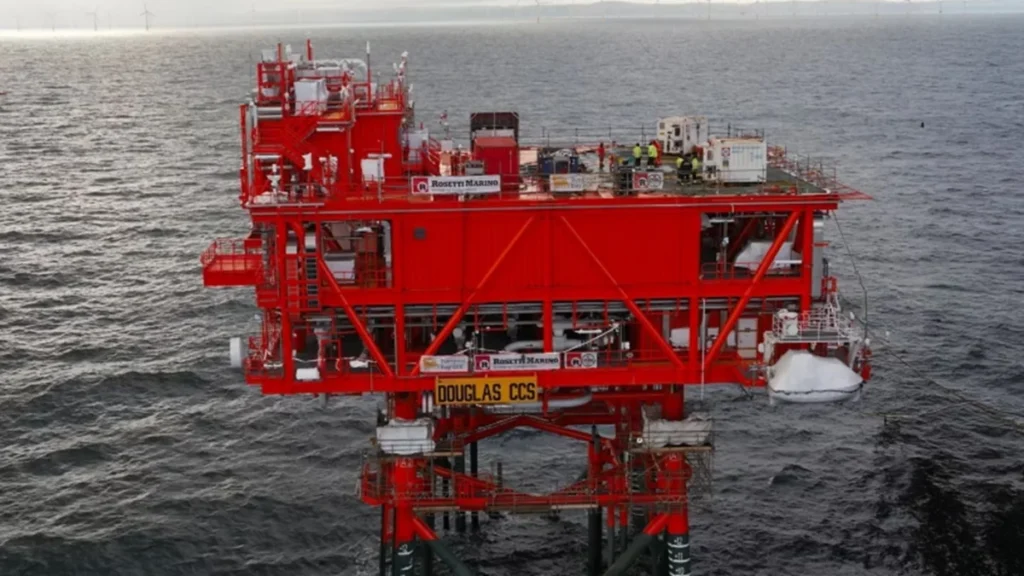
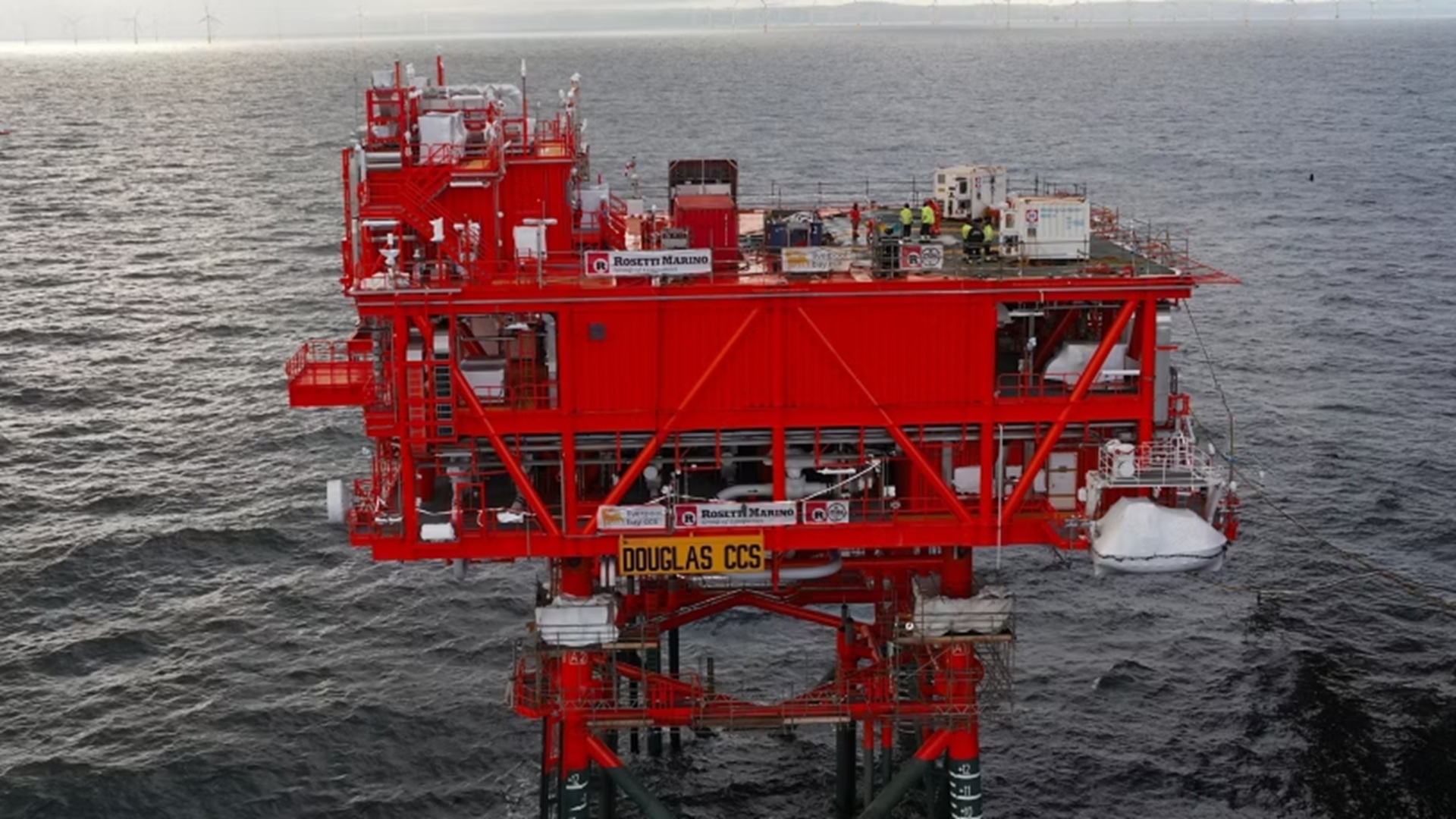
The United Kingdom has successfully installed the world’s inaugural purpose-built offshore hub designed for the comprehensive transport and long-term storage of carbon dioxide (CO2) from industrial facilities deep beneath the seabed. This monumental engineering achievement, known as the Douglas CCS platform, was strategically positioned in Liverpool Bay, an integral part of the Irish Sea situated between England and Wales, in early October. The installation signifies a critical advancement in the nation’s ambitious climate agenda and its commitment to developing robust infrastructure for industrial decarbonization.
Weighing an impressive 4,817 US tons (approximately 4,370 metric tons), the Douglas CCS platform is engineered to facilitate the safe and efficient movement of captured CO2 into subterranean reservoirs. These geological formations, once productive sites for natural gas extraction, are now repurposed to serve as secure, permanent storage locations for industrial emissions, preventing their release into the atmosphere. The project leverages existing subsea pipeline infrastructure, previously used for natural gas transport, a strategic decision that not only streamlines operations but also significantly reduces the environmental impact and cost associated with new construction.
The Vision Behind the Douglas CCS Platform
The completion and installation of the Douglas CCS platform were orchestrated by Liverpool Bay CCS Ltd., a dedicated project entity operated by Rome-based Eni CCUS Holding. This firm is a joint venture between the Italian energy giant Eni and Global Infrastructure Partners (GIP), a prominent infrastructure investor that operates as part of BlackRock, the world’s largest asset manager. This partnership underscores the increasing confluence of global energy companies and financial institutions in driving large-scale climate solutions.
The Douglas CCS platform is envisioned as a cornerstone supporting the HyNet industrial decarbonization cluster, a flagship low-carbon and hydrogen energy project. HyNet aims to unlock a new low-carbon economy across northwest England and north Wales by significantly slashing emissions from some of the UK’s most energy-intensive industrial sectors. By providing a crucial link for CO2 transport and storage, the Douglas CCS platform is indispensable to HyNet’s objective of creating a sustainable industrial future for the region.
Understanding Carbon Capture and Storage (CCS) Technology
Carbon Capture and Storage (CCS) is a suite of technologies designed to capture carbon dioxide emissions from large point sources, such as power plants and industrial facilities, before they are released into the atmosphere. Once captured, the CO2 is compressed and transported to a suitable storage site, typically deep underground geological formations, where it is permanently sequestered. This technology is considered vital for achieving global climate targets, particularly for "hard-to-abate" industries like cement, steel, chemicals, and refining, where transitioning entirely to renewable energy or electrification is currently technically or economically challenging.
The process typically involves:
- Capture: CO2 is separated from other gases produced during industrial processes using various chemical or physical methods.
- Transport: The captured CO2 is then compressed and transported, often via pipelines (as in the case of Douglas CCS), ships, or trucks, to the storage site.
- Storage: The CO2 is injected deep underground into suitable geological formations, such as depleted oil and gas fields, saline aquifers, or unmineable coal seams, where it is permanently trapped.
The environmental benefit of CCS lies in its ability to significantly reduce greenhouse gas emissions from industrial activities that are difficult to decarbonize through other means. Without CCS, many of these essential industries would struggle to meet stringent emission reduction targets, potentially impacting economic stability and industrial competitiveness.
A Chronology of Development and Strategic Alignment
The journey to the installation of the Douglas CCS platform reflects a concerted effort spanning several years, aligning with the UK government’s broader net-zero strategy. The UK has set a legally binding target to achieve net-zero greenhouse gas emissions by 2050, a goal that heavily relies on the deployment of CCS infrastructure.
- 2020-2021: The UK government outlined its ten-point plan for a green industrial revolution, identifying CCS as a key technology and announcing support for industrial clusters. HyNet was subsequently designated as one of the "Track 1" clusters, poised to receive government backing.
- Early 2022: The contract for the Douglas CCS platform was awarded, initiating an intensive design and construction phase. Company officials have noted the platform was delivered in less than 18 months following this contract award, a testament to efficient project management and engineering prowess.
- Early October: The Douglas CCS platform, a monumental piece of infrastructure, was successfully installed in Liverpool Bay, marking a significant physical manifestation of the project’s progress. This event propels the Liverpool Bay CCS project to approximately 50 percent completion, signaling that the operational phase is drawing closer.
The platform itself is a marvel of modern offshore engineering. It comprises topside facilities weighing approximately 2,078 US tons (1,885 metric tons) and a robust supporting jacket structure of another 1,935 US tons (1,755 metric tons). These components are securely anchored to the seabed by eight foundation piles, which collectively add another 805 US tons (730 metric tons) to the overall weight. The combined mass underscores the scale and durability required for a structure designed to operate in the challenging marine environment for decades. "The new Douglas CCS is the first purpose-built offshore platform dedicated to Carbon Capture and Storage (CCS) for industrial decarbonization in the world," affirmed company officials, highlighting its pioneering status.
Supporting Data and Economic Impact
The Liverpool Bay CCS project, with the Douglas CCS platform at its core, is projected to deliver substantial environmental and economic benefits. Over its operational lifetime, the first phase alone is expected to store a staggering 109 million tons of CO2. The initial annual capacity will reach 4.5 million tons, with ambitious plans for expansion to 10 million tons per year after 2030, significantly contributing to the UK’s emission reduction targets.
Beyond its environmental impact, the project is a major economic driver for the UK. Approximately 60 percent of its total investment expenditure is being channeled through UK-based supply chains, fostering local industries and expertise. During its construction phase, the project has already supported over 2,000 jobs, providing significant employment opportunities. Looking ahead, the operational period, anticipated to exceed 25 years, is set to create up to 300 long-term roles, ensuring sustained economic activity and specialized job creation in the region. This demonstrates how large-scale infrastructure projects can intertwine environmental sustainability with robust economic development.
Official Responses and Strategic Vision
The installation of the Douglas CCS platform has been met with considerable enthusiasm from project stakeholders and government bodies, who view it as a critical step in the energy transition.
Eni CCUS Holding, through its spokesperson, articulated the strategic importance of this development: “Liverpool Bay CCS forms part of Eni CCUS Holding’s portfolio of CCS initiatives and represents a key project in the company’s strategy to develop CO2 transportation and storage infrastructure to support industrial decarbonization at scale.” This statement underscores Eni’s commitment to evolving its business model to align with global decarbonization efforts, leveraging its extensive experience in offshore energy infrastructure. The involvement of GIP and BlackRock further highlights the growing financial sector interest in backing scalable climate solutions, recognizing the long-term investment potential in sustainable infrastructure.
While no direct government statement was provided in the source material, it is highly inferable that UK government officials from departments such as the Department for Energy Security and Net Zero would commend this milestone. They would likely emphasize the project’s contribution to the UK’s net-zero targets, its role in securing future industrial competitiveness, and the significant job creation and economic investment it brings to the regions of northwest England and north Wales. The government has consistently championed CCS as a vital technology for its industrial strategy, aiming to establish the UK as a global leader in this field.
Representatives from the HyNet cluster would undoubtedly express their satisfaction, as the Douglas CCS platform is a linchpin for their entire decarbonization ecosystem. They would likely highlight how this infrastructure enables industries within the cluster – including refineries, chemical plants, and cement manufacturers – to capture and safely store their emissions, thereby safeguarding jobs and industrial output while meeting environmental obligations.
Broader Impact and Implications for the Energy Transition
The commissioning of the Douglas CCS platform holds significant broader implications for the UK’s energy transition and global climate action:
- Pioneering Industrial Decarbonization: As the world’s first purpose-built offshore CCS hub, it establishes a precedent and a scalable model for other nations and regions grappling with emissions from heavy industries. It demonstrates tangible progress in moving beyond pilot projects to large-scale infrastructure deployment.
- Boosting UK Leadership in Green Technology: This project positions the UK at the forefront of CCS technology and implementation, potentially attracting further investment and fostering expertise that can be exported globally. It reinforces the UK’s ambition to be a leader in the green industrial revolution.
- Economic Resilience and Regional Development: By offering a viable pathway for decarbonization, CCS helps to safeguard existing industrial jobs and attract new investments in regions like northwest England and north Wales, which are traditionally industrial heartlands. It provides a long-term solution for industries that are critical to the national economy but are also significant emitters.
- Leveraging Existing Infrastructure: The strategic reuse of depleted gas fields and existing pipelines is a cost-effective and environmentally sound approach. It minimizes the need for new, extensive infrastructure development and demonstrates a circular economy approach within the energy sector.
- Challenges and Future Outlook: While highly promising, CCS technology also faces challenges. These include the high upfront capital costs, the need for robust regulatory frameworks for long-term storage, and ongoing public perception management. Critics often raise concerns about the potential for CCS to prolong reliance on fossil fuels or divert investment from renewable energy. However, proponents argue that CCS is a complementary technology, essential for sectors where renewables alone cannot provide a complete solution. The success of projects like Douglas CCS will be crucial in building confidence, driving down costs through economies of scale, and refining operational best practices.
The Douglas CCS platform represents a bold step in the global effort to combat climate change, offering a tangible solution for industrial decarbonization. Its successful operation will provide invaluable data and experience, shaping the future trajectory of carbon capture and storage technologies worldwide and reinforcing the UK’s commitment to a net-zero future.