The European Organization for Nuclear Research, known globally as CERN, has officially commenced one of the most technically demanding phases of its Long Shutdown 3 (LS3) program, marking a pivotal transition in the history of particle physics. At the heart of this operation is the removal and replacement of the "inner triplet" magnets, the sophisticated hardware responsible for the final focus of proton beams before they collide within the Large Hadron Collider’s (LHC) massive detectors. This replacement is the cornerstone of the High-Luminosity LHC (HL-LHC) project, an ambitious upgrade designed to increase the collider’s "luminosity"—a measure of the number of potential collisions—by a factor of ten. By dismantling the aging infrastructure that has served the international scientific community for nearly two decades, CERN is laying the groundwork for a new era of discovery that could unlock mysteries surrounding dark matter, the Higgs boson, and the fundamental laws of the universe.
The Critical Role of Inner Triplets in Particle Acceleration
The Large Hadron Collider is a marvel of 21st-century engineering, stretching 27 kilometers in circumference beneath the Franco-Swiss border. To maintain the trajectory of particles traveling at nearly the speed of light, the machine utilizes an intricate network of thousands of superconducting magnets. While dipole magnets are used to bend the beams around the circular ring, and various other magnets like sextupoles and decapoles correct minor orbital deviations, the quadrupole magnets—specifically the inner triplets—perform the essential task of beam "squeezing."
Located on either side of the LHC’s four primary interaction points—ATLAS, CMS, ALICE, and LHCb—the inner triplets act as the final optical lens for the particle beams. As protons approach the center of the detectors, these magnets focus the beams into incredibly tight clusters. In the world of subatomic physics, density is paramount; the more compressed the beam, the higher the probability that protons will collide rather than passing through one another. This "instantaneous luminosity" is the lifeblood of experimental physics. Without the extreme focusing provided by the inner triplets, the rate of data acquisition would be insufficient to observe the rare physical phenomena that researchers are currently hunting.
A Generational Handover: From Niobium-Titanium to Niobium-Tin
The current inner triplets, which have been in operation since the LHC first saw beam in 2008, are constructed using niobium-titanium (NbTi) superconducting cables. While this technology was revolutionary at the time of the LHC’s construction in the mid-2000s, it has reached its physical limits. To meet the demanding requirements of the High-Luminosity era, CERN engineers have spent years developing a new generation of magnets utilizing niobium-tin (Nb3Sn).
This transition from niobium-titanium to niobium-tin represents a massive leap in material science. Niobium-tin is a much more difficult material to work with because it is brittle and requires complex heat treatments during the manufacturing process. However, the reward for this complexity is a significantly higher critical magnetic field. The new HL-LHC inner triplets are capable of generating magnetic fields of approximately 11.3 tesla, a 40% increase over the roughly 8 tesla produced by the current NbTi magnets.
This increased strength allows for a much narrower beam focus at the collision point. In practical terms, this means that while the current LHC produces roughly 1 billion collisions per second, the HL-LHC will be capable of producing far more, allowing for the accumulation of data at a rate ten times faster than the original design specifications.
Chronology of the LS3 Operation and the First Cut
The replacement operation is a multi-year endeavor integrated into the Third Long Shutdown (LS3), which began in late 2024. The timeline for this project is rigorous, involving hundreds of specialized technicians and engineers.
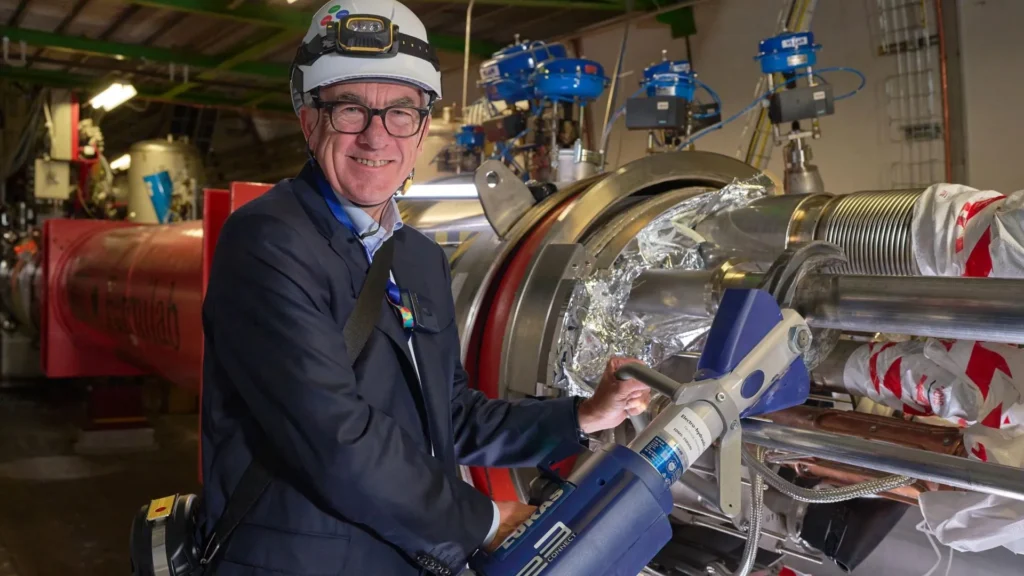
On September 7, 2024, CERN teams officially began the dismantling process on either side of the ATLAS (Point 1) and CMS (Point 5) experiments. The most symbolic moment of this phase occurred recently when crews performed the first "interconnection cut." This process involves physically severing the complex vacuum, cryogenic, and electrical links that have joined the magnets to the rest of the 27-kilometer ring for twenty years.
The current schedule for the HL-LHC upgrade is as follows:
- 2024–2025: Dismantling of the 28 existing superconducting magnets near ATLAS and CMS, including the legacy inner triplets.
- 2026–2027: Civil engineering and infrastructure preparation, including the installation of new cryogenic plants and power converters to handle the increased load of the new magnets.
- 2028: Testing and validation of the new niobium-tin cryo-assemblies.
- Early 2029: The first of the new quadrupole magnets is scheduled to be lowered into the tunnel and positioned.
- 2029–2030: Final integration, cooling to 1.9 Kelvin (-271.3°C), and commissioning of the beams.
CERN Director-General Mark Thomson emphasized the gravity of the moment during a visit to Point 1, noting that the replacement of these magnets is not merely a maintenance task but a fundamental reimagining of the machine’s capabilities.
Technical Scope and Engineering Challenges
The scale of the "handover" is immense. According to Jean-Philippe Tock, Head of the LS3 Coordination Team, the project involves the installation of 16 cryostats and 28 cryo-assemblies. These are not just magnets; they are self-contained, ultra-cold environments designed to keep the superconducting coils at temperatures colder than outer space.
The removal of the old magnets is a delicate operation due to the residual radioactivity inherent in components that have been exposed to high-energy particle beams for decades. Every piece of hardware removed must be carefully monitored, documented, and stored according to strict safety protocols. Furthermore, the space within the LHC tunnel is extremely confined. Moving a 20-ton magnet assembly requires specialized robotic transport vehicles and precision laser-tracking systems to ensure that the new components are aligned with sub-millimeter accuracy.
While the primary focus of the inner triplet replacement is on the ATLAS and CMS experiments—the two "general purpose" detectors that discovered the Higgs boson—the ALICE and LHCb experiments will also see significant changes. Although ALICE and LHCb do not require the same level of instantaneous luminosity because their detectors are optimized for different types of particle interactions (heavy ion collisions and B-meson studies, respectively), their existing inner triplets will still be upgraded to ensure compatibility with the overall increased luminosity of the machine.
Official Responses and Global Collaboration
The High-Luminosity LHC project is not just a CERN initiative; it is a global collaboration involving dozens of countries. The development of the niobium-tin magnets, for instance, involved a major partnership with the United States Department of Energy through the HL-LHC Accelerator Upgrade Project (AUP), which includes contributions from Fermilab, Brookhaven National Laboratory, and Lawrence Berkeley National Laboratory.
Markus Zerlauth, the HiLumi LHC Project Leader, reflected on the historical significance of the current phase. "The current inner triplets date back to the LHC construction phase and were installed in the machine between 2005 and 2007," Zerlauth stated. "After nearly twenty years of operation, they will give way to a new generation of even more powerful magnets. It’s truly remarkable to witness such a handover from one generation of innovation to the next."
This sentiment is echoed throughout the physics community. The "old" magnets were the workhorses that allowed for the 2012 discovery of the Higgs boson, a feat that earned a Nobel Prize and completed the Standard Model of particle physics. The "new" magnets are seen as the key to moving beyond the Standard Model.
Broader Implications: The Search for New Physics
The ultimate goal of the HL-LHC is to provide researchers with a massive dataset. In particle physics, data volume is directly proportional to the ability to see "rare events." If a specific particle interaction only happens once in every trillion collisions, the current LHC might only see it a handful of times over a decade. The HL-LHC, with its increased luminosity, could see that same event hundreds of times, providing the statistical significance needed to claim a new discovery.
Physicists are hopeful that the HL-LHC will provide insights into several key areas:
- Precision Higgs Studies: By producing more Higgs bosons, researchers can measure their properties with unprecedented accuracy, looking for tiny deviations that might hint at new physics.
- Dark Matter: The increased collision energy and rate might reveal the existence of WIMPs (Weakly Interacting Massive Particles) or other candidates for the dark matter that makes up 27% of the universe.
- Supersymmetry and Beyond: The HL-LHC will probe energy scales where "super-partners" of known particles might exist, potentially solving the hierarchy problem in physics.
- The Matter-Antimatter Asymmetry: More data will help explain why the universe is made almost entirely of matter, even though the Big Bang should have produced equal amounts of matter and antimatter.
Conclusion
The cutting of the first interconnection at Point 1 is more than a technical milestone; it is the definitive end of the LHC’s "discovery" phase and the beginning of its "precision" phase. As the 28 superconducting magnets are hauled out of the tunnel to make room for their 11.3-tesla successors, CERN is demonstrating its commitment to remaining at the forefront of human knowledge. The transition to the High-Luminosity LHC is a testament to two decades of engineering progress and a bold investment in the next twenty years of scientific inquiry. When the machine restarts in 2029, it will be, in many ways, a brand-new collider, ready to probe the deepest secrets of the cosmos with ten times the power of its predecessor.