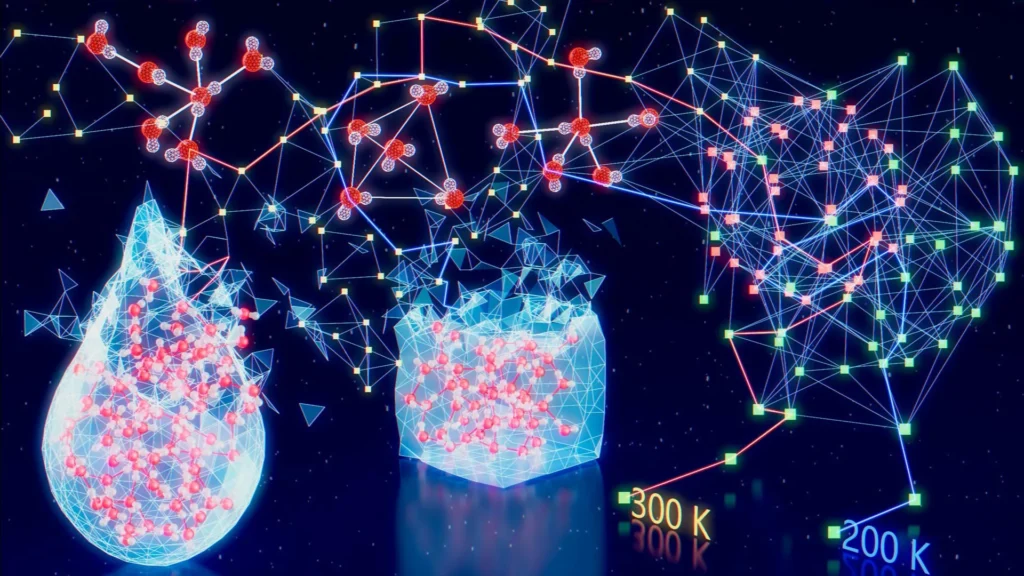
Water, the ubiquitous solvent and lifeblood of Earth, covers approximately 71% of the planet’s surface, yet its fundamental behavior remains a source of profound scientific intrigue. Unlike almost every other liquid, water exhibits a suite of paradoxical properties, chief among them its expansion upon freezing rather than contracting. This anomalous behavior, alongside its unusually high specific heat capacity, high surface tension, and a maximum density at 4°C, has puzzled scientists for centuries. These peculiar traits are widely understood to stem from intricate changes in water’s microscopic structure as temperature and pressure fluctuate, but a consistent, universally accepted method to describe and quantitatively compare these structural shifts has long eluded researchers.
Now, a significant breakthrough from the University of Osaka promises to shed new light on this enduring mystery. Researchers there have successfully leveraged the power of artificial intelligence (AI) to develop a system that provides a unified framework for comparing diverse methods of describing the structure of supercooled water. This innovative AI approach helps pinpoint which structural descriptors most effectively capture the critical features responsible for water’s unique characteristics. The groundbreaking findings were formally published in the esteemed journal Communications Chemistry, marking a pivotal moment in the ongoing quest to fully comprehend one of nature’s most essential and enigmatic substances.
The Enduring Enigma of Water’s Anomalies
Water’s exceptional properties are not merely academic curiosities; they are foundational to life as we know it. Its ability to expand upon freezing, making ice less dense than liquid water, ensures that lakes and oceans freeze from the top down, insulating aquatic life below. Its high specific heat capacity acts as a thermal buffer, moderating Earth’s climate. Its unparalleled solvent capabilities facilitate countless biochemical reactions essential for life. Despite its omnipresence and critical role, the molecular-level mechanisms underpinning these behaviors have remained partially obscured, often likened to an invisible dance of hydrogen bonds.
Historically, scientists have grappled with water’s structural complexity. Early models, like those proposed by Bernal and Fowler in the 1930s, conceptualized water as a dynamic network of hydrogen-bonded molecules. Over the decades, advanced spectroscopic techniques and computational simulations, particularly molecular dynamics, have provided unprecedented glimpses into this microscopic world. However, the transient nature of hydrogen bonds—constantly forming, breaking, and reforming—makes a static description impossible. Instead, scientists have focused on statistical descriptions of local molecular arrangements, leading to a proliferation of different "descriptors" or metrics designed to quantify specific aspects of water’s local structure. The independent development of these descriptors, each with its own scale, dimensionality, and underlying assumptions, created a fragmented understanding, hindering direct comparisons and the identification of truly fundamental structural motifs.
Supercooled Water: Exaggerating the Paradoxes
Water’s unusual properties become even more pronounced and complex when it enters the supercooled state. This occurs when liquid water is cooled below its normal freezing point (0°C) without solidifying. The formation of ice typically requires nucleation sites—microscopic impurities, dust particles, or even tiny imperfections on container surfaces—where water molecules can initiate the ordered arrangement of a crystal lattice. In the absence of such sites, water can persist as a liquid at temperatures well below freezing, sometimes down to approximately -48°C, a point known as the homogeneous nucleation temperature, beyond which it spontaneously freezes.
Studying supercooled water presents significant experimental challenges due to its inherent instability and rapid crystallization. This is precisely why computational methods, particularly molecular dynamics simulations, have become indispensable tools for probing this metastable state. Under these extreme conditions, scientists believe water exists as a dynamic equilibrium between two competing liquid forms: a high-density liquid (HDL) and a low-density liquid (LDL).
At the molecular level, water molecules engage in a continuous ballet of forming and breaking hydrogen bonds. The LDL state is characterized by more open, tetrahedral-like arrangements of molecules, often associated with a higher degree of hydrogen bonding and a more "ice-like" structure, albeit disordered. Conversely, the HDL state features more compact, disordered arrangements with a higher density, where hydrogen bonds are less perfectly organized. As temperature rises, the more compact HDL structures become increasingly dominant, reflecting a general trend of thermal agitation disrupting ordered arrangements. The delicate balance and dynamic interconversion between these two liquid forms are thought to be the root cause of many of water’s most perplexing properties, especially in the supercooled regime where the system is poised between liquid and solid states. Understanding this balance is critical to unlocking the full spectrum of water’s behaviors.
AI’s Intervention: A Unified Approach to Molecular Descriptions
The challenge for decades has been the lack of a consistent "language" to compare the various structural descriptors used to characterize these HDL and LDL states. Researchers have proposed many different ways to quantify the local arrangement of water molecules, including metrics like tetrahedral bond order parameters (which measure the deviation from an ideal tetrahedral arrangement), local density, and various angular and radial distribution functions. Each of these descriptors captures a different facet of the complex molecular architecture, but their independent development meant they used disparate scales, dimensions, and types of information. This fragmentation made it exceedingly difficult to directly compare their efficacy or determine which ones truly captured the most salient features of water’s structural evolution.
This is where the University of Osaka team, led by corresponding author Kang Kim and senior author Nobuyuki Matubayasi, introduced their innovative AI solution. Recognizing the power of machine learning in discerning complex patterns from data, they designed a neural network model to evaluate and unify these competing structural descriptions.
"Past studies have shown that using machine learning to classify and understand structural data is effective," explains Kang Kim. "We specifically wanted to incorporate a neural network model into this study to evaluate how accurate the descriptors were at capturing key structural information, in a way that is like human cognition." This analogy to human cognition highlights the network’s ability to learn and generalize from complex, high-dimensional data, much as a human expert might intuitively grasp the essence of a pattern after extensive observation.
To train their AI system, the researchers fed the neural network a vast dataset of structural information generated from sophisticated molecular dynamics simulations of supercooled water. These simulations, which model the classical motion of atoms and molecules over time, provide atomic-level trajectories and interactions. Through an iterative process of trial and error, the neural network was able to identify and recognize meaningful patterns within these molecular structures, learning to distinguish subtle differences between the HDL and LDL arrangements across various temperatures and pressures. The AI’s ability to process and interpret such large volumes of complex data far exceeds human capabilities, offering an unbiased and data-driven approach to a long-standing problem.
Identifying the Most Efficient Descriptors: New Clues to Hidden Structures
The culmination of the AI’s learning process was its application to evaluate the existing structural descriptors. "The network used what it had learned to compare how 16 descriptors differentiated between LDL and HDL structures at different temperatures," reports Nobuyuki Matubayasi. By systematically analyzing how well each descriptor could distinguish between the two hypothesized liquid forms, the AI system was able to quantitatively assess their individual strengths and weaknesses. "In this way, we determined the most efficient descriptors," Matubayasi concludes.
The identification of these "most efficient" descriptors represents a critical advancement. It provides scientists with a refined toolkit, enabling them to prioritize and utilize the metrics that are most sensitive and accurate in capturing the essential structural information related to water’s anomalous behavior. This not only streamlines future research efforts but also lays the groundwork for developing even more precise and insightful structural probes. Instead of relying on a multitude of potentially redundant or less informative descriptors, researchers can now focus on those validated by AI as being most effective, thereby accelerating the pace of discovery.
Broader Implications: Reshaping Scientific Understanding Across Disciplines
The framework developed by the Osaka researchers holds profound implications, extending far beyond the realm of physical chemistry. By improving scientists’ understanding of how microscopic structural changes are intricately connected to the macroscopic thermodynamic behavior of water, this research could fundamentally reshape our grasp of water’s most enigmatic properties.
- Fundamental Science: The findings offer a clearer pathway to explaining the very origin of water’s unusual properties. A unified description of its structural states could resolve long-standing debates and refine existing theoretical models, leading to a more complete and coherent understanding of this vital molecule.
- Biology and Biochemistry: Water is the universal solvent in biological systems, crucial for protein folding, enzyme activity, membrane structure, and cellular processes. A deeper understanding of water’s structural dynamics, especially near biomolecules, could unlock new insights into disease mechanisms, drug design, and the stability of biological macromolecules. For instance, understanding how water organizes around hydrophobic regions could inform the design of more effective therapeutic agents.
- Materials Science and Engineering: Knowledge of water’s precise structural behavior is vital for designing new materials, understanding ice formation and growth (critical for anti-icing technologies), and optimizing industrial processes involving aqueous solutions. This could impact everything from cryopreservation techniques to the development of advanced electrolytes and catalysts.
- Climate Science: Water in its various phases plays a central role in Earth’s climate system. A more accurate molecular-level understanding of phase transitions, such as the formation of ice crystals in clouds, could lead to more precise climate models and better predictions of weather patterns and global warming impacts.
- The Future of AI in Scientific Discovery: This study stands as a powerful testament to the transformative potential of artificial intelligence in fundamental scientific research. By tackling complex, data-rich problems that are intractable for traditional methods, AI is proving to be an invaluable partner in accelerating discovery across diverse scientific disciplines. The Osaka team’s work exemplifies how AI can move beyond mere data analysis to actively guide scientific inquiry, helping researchers ask better questions and design more effective experiments.
While this study represents a significant leap forward, the scientific journey continues. The next steps will likely involve experimental validation of the AI-identified descriptors, perhaps through advanced spectroscopic techniques that can probe local water structure. Furthermore, researchers may explore how these descriptors perform under even more extreme conditions or in the presence of various solutes, mimicking real-world biological and environmental contexts. The long-term vision is a comprehensive, predictive model of water’s behavior that leverages the power of AI to unlock its full range of secrets, ultimately benefiting humanity in countless ways.