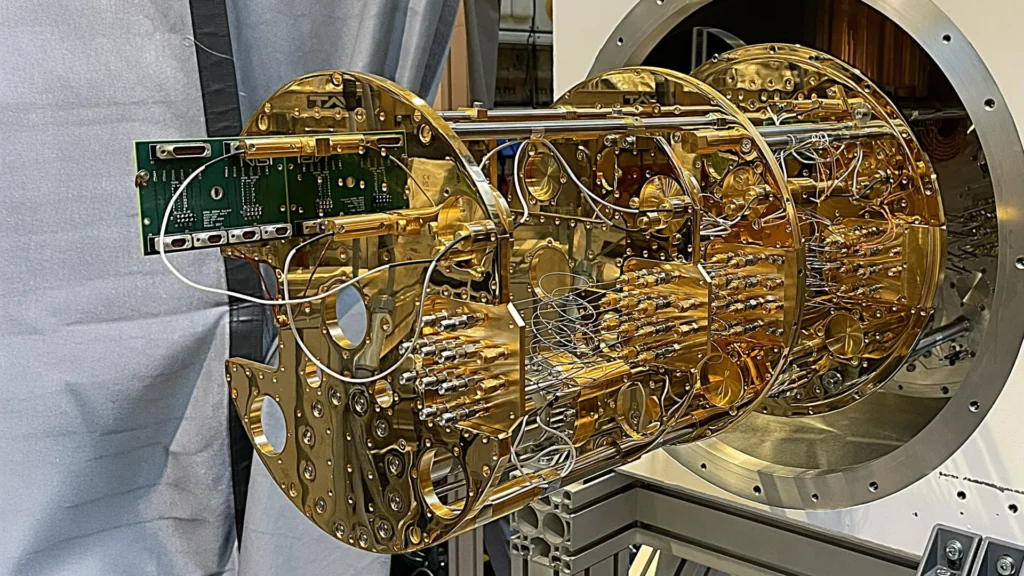
The scientific landscape of European X-ray research has reached a significant milestone with the official commissioning of a state-of-the-art Transition Edge Sensor (TES) spectrometer at the BESSY II synchrotron facility in Berlin. This advanced analytical instrument, the result of a multi-year international collaboration between the Helmholtz-Zentrum Berlin (HZB), the Max Planck Institute for Chemical Energy Conversion (MPI-CEC) in Mülheim an der Ruhr, and the National Institute of Standards and Technology (NIST) in Boulder, Colorado, represents a paradigm shift in how researchers observe the electronic properties of matter. As the first and only TES spectrometer operating at a synchrotron facility in Europe, the tool provides a level of sensitivity and efficiency that was previously unattainable on the continent, positioning BESSY II as a premier destination for the study of quantum materials, nanostructures, and dilute chemical systems.
A Quantum Leap in Detection Efficiency
The primary challenge in traditional X-ray emission spectroscopy (XES) and Resonant Inelastic X-ray Scattering (RIXS) lies in the "photon-hungry" nature of the techniques. Conventional spectrometers typically rely on wavelength-dispersive crystals to sort photons by energy. While these crystals offer high energy resolution, they possess a very small solid angle of collection, meaning the vast majority of photons emitted by a sample never reach the detector. This inherent inefficiency has historically restricted XES and RIXS experiments to highly concentrated samples or bulk materials, leaving researchers unable to probe the delicate electronic states of atomically thin layers or highly diluted molecular samples.
The newly installed TES array spectrometer at BESSY II overcomes this limitation by a staggering margin. According to Régis Decker, the HZB scientist responsible for the instrument, the system delivers a photon detection efficiency that is 100 to 1,000 times greater than that of conventional wavelength-dispersive spectrometers. This dramatic improvement is achieved through an energy-dispersive approach that captures a significantly larger portion of the emitted X-ray signal without sacrificing the energy resolution required for sophisticated electronic analysis.
For the scientific community, this efficiency gain translates into a massive reduction in data acquisition times. Experiments that previously required hours of continuous X-ray exposure—risking damage to sensitive biological or chemical samples—can now be completed in a matter of minutes. This speed not only increases the throughput of the facility but also enables the study of transient states and materials that are susceptible to radiation damage.
The Physics of Extreme Cold: 248 Superconducting Sensors
At the core of the spectrometer is a complex array of 248 individual superconducting sensors. The operating principle of a Transition Edge Sensor is rooted in the physics of superconductivity and extreme thermodynamics. To function, the sensors must be cooled to 25 milli-Kelvin (mK), a temperature just a fraction of a degree above absolute zero and significantly colder than the vacuum of deep space.
Achieving and maintaining this temperature in a high-vacuum synchrotron environment requires a He4-He3 dilution refrigerator, a technology more commonly associated with the cooling of quantum bits in quantum computing. The sensors are held at their "transition edge"—the precise temperature point where the material sits between a superconducting state (zero electrical resistance) and a normal conducting state.
When an X-ray photon emitted from a sample strikes a sensor in the TES array, its energy is converted into heat. Even the minuscule energy of a single X-ray photon is sufficient to cause a localized temperature spike that nudges the sensor out of its superconducting state. This results in a sudden, measurable increase in electrical resistance. The change in resistance is proportional to the energy of the incoming photon, allowing the system to record the energy of every detected photon with high precision. To process these rapid signals, the instrument utilizes an array of Superconducting Quantum Interference Devices (SQUIDs), which act as ultra-sensitive amplifiers for the electronic circuitry.
From Astrophysics to Synchrotron Science
The journey of TES technology from a specialized tool for stargazing to a powerhouse of materials science is a testament to the benefits of cross-disciplinary innovation. Originally, TES spectrometers were developed for astrophysics applications, where they were used on telescopes to detect the incredibly faint X-ray signals coming from distant galaxies, black holes, and supernovae. In the vacuum of space, where every photon is precious, the high efficiency of the TES was a necessity.
Recognizing the potential for this technology to transform terrestrial research, NIST and other institutions began adapting TES arrays for use at synchrotron light sources. Before the installation at BESSY II, the global footprint of such instruments was extremely limited. Only five other TES spectrometers were operational at X-ray facilities worldwide: four in the United States (including those at the Stanford Linear Accelerator Center and the National Synchrotron Light Source II) and one in Japan at the Photon Factory.
The introduction of this technology to BESSY II fills a critical gap in the European research infrastructure. By bringing the TES spectrometer to Berlin, HZB and its partners have ensured that European researchers no longer need to travel across oceans to access this specific level of analytical sensitivity.
Strategic Applications: Quantum Materials and Molecular Biology
The enhanced sensitivity of the TES spectrometer opens a new frontier for "low-count" experiments. Researchers are particularly focused on three primary areas of study:
-
Atomically Thin Materials and Nanostructures: As the electronics industry moves toward two-dimensional materials like graphene, transition metal dichalcogenides (TMDs), and other quantum monolayers, understanding their electronic band structures is vital. The TES spectrometer allows scientists to probe these ultra-thin systems where the volume of material—and thus the number of emitted photons—is incredibly low.
-
Highly Diluted Samples and Catalysis: In the fields of molecular chemistry and biology, many of the most important reactions occur at active metal sites within large, complex molecules. In these cases, the "active" part of the sample is highly diluted. Conventional X-ray methods often struggle to distinguish the signal of these few atoms from the background of the surrounding matrix. The TES spectrometer’s high efficiency makes it possible to study these diluted samples in detail, potentially leading to breakthroughs in artificial photosynthesis, nitrogen fixation, and more efficient industrial catalysts.
-
Quantum Properties and Impurities: The instrument is uniquely suited for investigating the quantum properties of systems in reduced dimensions. It complements existing techniques such as Angle-Resolved Photoemission Spectroscopy (ARPES). While ARPES is excellent for scanning electronic band structures, the TES spectrometer provides a different perspective through X-ray emission, offering a more complete picture of the electronic density of states.
Integration and Future Upgrades at the UE52-SGM Beamline
The spectrometer has been integrated into the UE52-SGM beamline at BESSY II, a location chosen for its specialized capabilities. This beamline provides full polarization control of the incoming X-rays, which is essential for studying the directional nature of electronic orbitals and magnetic properties.
To ensure the highest quality of data, the spectrometer is connected to a custom-built ultra-high vacuum (UHV) sample chamber. This chamber is equipped with sophisticated sample handling systems that allow for the transfer, preparation, and measurement of samples without breaking the vacuum. Furthermore, the chamber provides precise temperature control for the sample itself, ranging from 10 Kelvin to room temperature, allowing researchers to observe how electronic properties change as a material is cooled or heated through phase transitions.
The project team has already outlined a roadmap for future enhancements. Planned upgrades include the integration of more advanced sample preparation tools directly into the vacuum chain and the implementation of high-strength magnetic fields. These additions will enable X-ray Magnetic Circular Dichroism (XMCD) and RIXS-MCD measurements, which are critical for the development of next-generation magnetic storage devices and spintronic materials.
Global Collaboration and the Path to BESSY III
The successful commissioning of the TES spectrometer is a triumph of international cooperation. While HZB provided the facility and the integration expertise, NIST was instrumental in the design and fabrication of the superconducting sensor arrays, and MPI-CEC contributed the deep chemical knowledge necessary to define the scientific requirements of the instrument.
This collaboration serves as a blueprint for the future of BESSY II and its planned successor, BESSY III. As synchrotron facilities move toward fourth-generation light sources, the focus is shifting from simply producing more light to developing more intelligent ways to detect and analyze it. The TES spectrometer is a cornerstone of this strategy, providing a "high-definition" view of the atomic world that maximizes the utility of every X-ray photon generated by the storage ring.
The HZB has now officially opened the call for research proposals, inviting the global scientific community to apply for beamtime on the new instrument. With the ability to perform measurements that were previously deemed impossible, the TES spectrometer is expected to become one of the most oversubscribed and productive tools in the BESSY II arsenal, driving discoveries in green energy, quantum computing, and fundamental molecular science for years to come.