Imagine a world where the energy of ambient sunlight can be efficiently captured and transformed, unlocking new possibilities for sustainable technologies. This scientific frontier, once confined to theoretical discussions, is now a tangible reality thanks to groundbreaking research from Kyushu University. Scientists there have engineered a novel solid-state molecular material capable of converting low-energy visible sunlight into higher-energy ultraviolet (UV) light under ordinary outdoor conditions. This achievement, detailed in a study published on June 23 in the prestigious journal Nature Communications, marks a significant leap forward in photon upconversion technology, boasting an impressive efficiency of 1.9%.
The Significance of Ultraviolet Light in Modern Technology
While UV light is often colloquially associated with the discomfort of sunburn and potential skin damage, its role in a multitude of essential technological applications is undeniable and increasingly critical. Ultraviolet radiation is a cornerstone in advanced air purification systems, neutralizing harmful pathogens and pollutants. In the rapidly evolving field of 3D printing, UV light is indispensable for curing and hardening resins, enabling the creation of intricate and durable objects. The dental industry relies on UV light to rapidly set and harden dental fillings and restorations, a process vital for efficient and effective patient care. Even in personal care, UV lamps are a standard tool for curing gels in nail treatments.
Despite its widespread utility, UV light constitutes a relatively small fraction of the solar spectrum that reaches Earth’s surface, accounting for approximately 6%. Furthermore, not all of this available UV radiation is practically usable for technological purposes, often due to its low intensity or specific wavelength requirements. This scarcity highlights the profound importance of developing methods to generate UV light more efficiently and sustainably, a challenge that the Kyushu University team has now demonstrably addressed.
The Quantum Leap: Photo Upconversion Explained
At the heart of this innovation lies a fascinating quantum mechanical phenomenon known as photo upconversion. As Associate Professor Yoichi Sasaki of Kyushu University’s Faculty of Engineering, the study’s corresponding author, explains, "What we do here is ‘add together’ the energy from two visible light photons to make one ultraviolet photon. It’s a fascinating process called photo upconversion." This process effectively allows for the synergistic combination of multiple low-energy particles of light to produce a single, more energetic particle, a concept that defies everyday intuition but is a fundamental aspect of quantum physics.
The specific mechanism employed by the Kyushu University researchers is a sophisticated application of triplet-triplet annihilation (TTA). In this process, a carefully designed donor molecule first absorbs photons of visible light, propelling it into an excited, high-energy state known as a triplet state. This absorbed energy is then efficiently transferred to a neighboring acceptor molecule. The crucial step occurs when two of these excited triplet-state molecules encounter each other. They fuse their energies, resulting in the emission of a single, higher-energy ultraviolet photon.
Overcoming the Solid-State Challenge
Historically, achieving efficient triplet-triplet annihilation has been more readily accomplished in liquid systems. In liquids, molecules possess a high degree of freedom, allowing them to move and interact with relative ease, thereby facilitating the necessary encounters between triplet-state molecules. However, liquid-based systems are often fraught with practical limitations. They frequently necessitate the use of toxic solvents, which pose environmental and health concerns, and their inherent volatility can lead to evaporation over time, limiting their longevity and applicability. Consequently, the scientific community has long sought a robust and reliable solid-state alternative that could circumvent these drawbacks.
The transition to a solid-state material presents unique challenges. "In solids, molecules are packed tightly, and the π electron clouds — regions of high electron density hovering above and below each molecular plane — can overlap," elaborates Sasaki. "When that happens, triplets easily fizzle out before they ever meet. Molecules must be close enough for energy to transfer but separated enough to prevent quenching of excitons." This delicate balance is critical: molecules need to be in close proximity for efficient energy transfer, but not so close that their electronic interactions interfere with or prematurely deactivate the excited triplet states, a phenomenon known as exciton quenching.
The DHI Breakthrough: A New Paradigm in Molecular Design
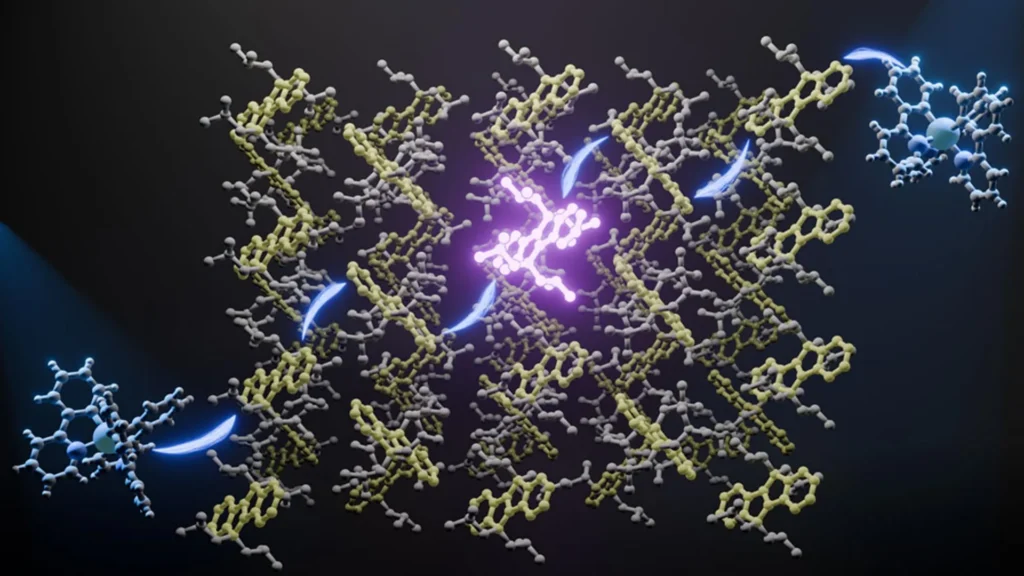
The breakthrough achieved by the Kyushu University team stems from their innovative manipulation of an organic semiconductor known as dihydroindenoindenedene (DHI). This molecule, with its inherent semiconducting properties, served as the foundational scaffold for their upconversion material.
The researchers meticulously engineered the DHI molecule by appending alkyl chains to its sp³ hybridized carbon atoms. These carbon atoms possess four bonds that are directed in fixed three-dimensional orientations, allowing for precise control over molecular architecture. This strategic modification created a carefully orchestrated spacing between adjacent DHI molecules within the solid-state material. The result was a molecular arrangement where the molecules were sufficiently close to enable efficient energy transfer between them, yet sufficiently separated to prevent the detrimental strong electronic interactions that typically hinder performance in other solid-state systems.
This precisely engineered molecular architecture endowed the resulting material with exceptional properties, including strong luminescence, remarkably long-lived excited states, and highly effective energy transfer kinetics. Crucially, the material exhibited a solid-state fluorescence quantum yield exceeding 60%, a testament to its internal efficiency.
When this engineered DHI material was integrated with a suitable donor molecule, the entire system achieved an impressive upconversion efficiency of 1.9%. Sasaki further clarified the practical implications of this figure: "This means roughly two UV photons are produced for every hundred visible-light photons absorbed. It may sound low, but it runs on natural sunlight alone. Most solid-state materials cannot realize this even at much higher light intensity." This statement underscores the remarkable achievement of operating effectively under natural sunlight, a condition under which many prior solid-state upconversion materials faltered.
Promising Avenues for Solar-Powered UV Applications
The potential applications for this novel solar-powered UV light source are vast and transformative. The research team has already taken steps to protect their intellectual property by filing a patent application for the material. Beyond its impressive performance metrics, the material offers significant practical advantages that pave the way for its widespread adoption. It can be synthesized through relatively straightforward procedures and is constructed from cost-effective starting materials, making it an economically viable solution for various industries.
The researchers envision a future where this material could be integral to a range of sustainable technologies. These include advanced solar-powered photocatalysis, a process that uses light to drive chemical reactions, offering greener alternatives for industrial synthesis and environmental remediation. It could also revolutionize indoor air purification systems, providing a more energy-efficient and sustainable method for maintaining healthy indoor environments. Furthermore, its applicability extends to low-intensity 3D printing technologies, potentially enabling more accessible and eco-friendly additive manufacturing.
A Fourteen-Year Scientific Odyssey Culminating in Discovery
This significant scientific achievement is not an overnight success but rather the culmination of a dedicated, fourteen-year research endeavor. The journey began in 2012 when Nobuo Kimizuka, now Professor Emeritus at Kyushu University’s Research Center for Negative Emissions Technologies, embarked on an ambitious exploration of photon upconversion through triplet energy migration within self-assembled molecular systems. His overarching vision was to establish a new paradigm in molecular systems chemistry, where the intrinsic ability of molecules to self-assemble could be harnessed to perform valuable functions.
Over the subsequent years, Kimizuka’s research group made consistent and incremental progress, initially focusing on solution-based and gel-based systems. However, the elusive goal of achieving efficient upconversion in a solid-state format remained a formidable challenge.
The pivotal breakthrough finally materialized in May 2024, a significant moment occurring less than a year before Professor Kimizuka’s planned retirement. The months that followed were characterized by an intense and focused effort to bring this long-standing project to fruition. A dedicated team, comprising graduate students Naoyuki Harada, Hayato Shoyama, and Nutnicha Boonmong, collaborated closely with Associate Professor Sasaki and then-Assistant Professor Kiichi Mizukami of Kyushu University’s Faculty of Engineering. Together, they meticulously synthesized years of research findings into a coherent and impactful final publication.
Sasaki shared a poignant anecdote about the completion of the research: "We handed the draft to Professor Kimizuka just 11 days before he left the lab, which for us felt like a heartfelt retirement gift." This gesture underscores the deep personal investment and collaborative spirit that fueled the research.
Reflecting on the profound significance of their work, Professor Kimizuka stated, "This discovery is the culmination of over 14 years of our research and marks a major milestone in photon-upconversion and molecular self-assembly research." His words encapsulate the enduring dedication and the transformative impact of this scientific journey.
Broader Implications and Future Outlook
The implications of Kyushu University’s breakthrough in solid-state photon upconversion extend far beyond the laboratory. The ability to efficiently convert visible sunlight into UV light in a stable, solid-state material opens up exciting new avenues for sustainable energy utilization and advanced material development. This research addresses a critical need for more efficient light-harvesting and energy-conversion technologies in an era increasingly focused on environmental sustainability and resource conservation.
The development could potentially lead to the creation of self-powered UV sterilization units for water purification in remote or off-grid locations, significantly improving public health. In agriculture, it might enable targeted UV treatments for crops, enhancing growth or combating specific pests and diseases without the need for energy-intensive artificial lighting. The integration of this technology into building materials could lead to structures that passively generate UV light for various applications, reducing reliance on grid electricity.
Furthermore, the fundamental understanding gained from this research into molecular design and solid-state energy transfer mechanisms could inspire further innovations in fields such as organic electronics, photonics, and advanced materials science. The successful navigation of the complex challenges associated with molecular spacing and electronic interactions in solid-state systems provides a valuable blueprint for future material design.
As the world continues to seek cleaner, more efficient energy solutions, the work of the Kyushu University researchers stands as a beacon of innovation. Their dedication to solving complex scientific puzzles and their ability to translate fundamental quantum principles into practical, real-world applications offer a compelling glimpse into a future powered by smarter, more sustainable light technologies. The successful patenting of their material suggests a clear path towards commercialization, hinting at a future where the energy of everyday sunlight can be harnessed in novel and impactful ways, all thanks to the remarkable properties of molecules working in harmony.