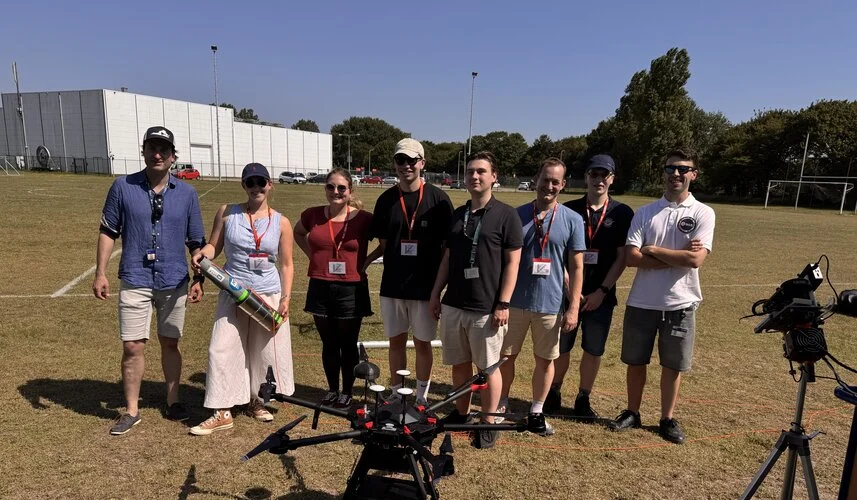
A groundbreaking test flight, marking a significant step in the development of advanced radar detection technology, recently took place at the European Space Agency’s (ESA) technical centre, ESTEC, in the Netherlands. A drone, equipped with an innovative student-designed radar retroreflector, ascended into the skies above the facility, demonstrating the technology’s potential for enhanced tracking of small airborne objects. This pivotal test, conducted on July 30, 2026, follows a successful competition organized by the Institute of Electrical and Electronics Engineers (IEEE) and paves the way for future launches and broader applications in aerospace and beyond.
The unusual payload, a 50 cm long plastic tube housing the retroreflector, was suspended by a five-meter rope beneath a powerful drone. On a notably warm day, the test team, including ESA engineers and the student developers from Ruhr University Bochum, Germany, meticulously managed the equipment to mitigate the effects of the heat. The drone, expertly piloted by ESA engineer Giovanni Serafini, executed a series of precise maneuvers, lifting the payload to an altitude of 120 meters before descending to a mere three meters above ESTEC’s football field. These carefully choreographed movements were designed to simulate various flight profiles and evaluate the retroreflector’s performance under different conditions and angles.

The Genesis of Innovation: A Student Competition’s Success
The retroreflector technology is the brainchild of a dedicated student team from Ruhr University Bochum, who developed it for a competition organized by the Institute of Electrical and Electronics Engineers (IEEE). Daria Tsukanova, a member of the student team, explained the fundamental principle behind their invention. "A retroreflector is a passive structure, in this case a 28 cm long metal tube covered with cavities, designed to reflect signals back towards their source," she stated. "This makes an object easier to detect and track without requiring active electronics or transmitters onboard." This passive nature is a key advantage, minimizing power consumption and complexity.
The primary application envisioned for this technology is to significantly improve the radar visibility of small, often elusive airborne vehicles such as drones and sounding rockets. These rockets, designed to carry experiments to the fringes of space before returning to Earth, are typically made of metal and are thus inherently reflective. However, even these metallic structures can become undetectable to radar at certain viewing angles. The student team’s retroreflector aims to extend these detection limits, ensuring continuous radar tracking of these vehicles and other similarly sized objects for extended periods. The plastic tube used in the test served as a surrogate for a sounding rocket, allowing for realistic flight simulations.
Cost-Effectiveness and Accessibility: Key Design Principles
A significant aspect of the student-developed retroreflector is its remarkable cost-effectiveness and accessibility. Stephan Hauptmeier, another member of the Ruhr University Bochum team, highlighted this crucial feature. "What’s unique about this technology is that it’s very cheap," he explained. "The reflector itself is passive, made by 3D printing and laser cutting." This manufacturing approach not only reduces production costs but also allows for rapid prototyping and customization.

Furthermore, the technology leverages existing, well-established radar systems. "Another advantage is that to detect it, we can use a radar technology well-established in the automotive industry – the same one that is part of driver assistance systems and will, for example, cause a car to break automatically if an obstacle is detected," Hauptmeier added. "This means no special ‘space-grade’ radar is needed." This reliance on automotive-grade radar technology dramatically lowers the barrier to entry for its implementation, making advanced tracking capabilities accessible to a wider range of users and applications.
Václav Valenta, an ESA microwave engineer, emphasized the synergy between ESA’s existing technological advancements and the student project. "This has been a unique opportunity to leverage hardware previously developed within ESA’s Technology Development Element programme for planetary and in-orbit missions, based on automotive radar technology," he noted. "By making one of these prototypes available to students, we enable them to gain practical experience with real radar technology and explore how such systems can be configured and optimised for specific applications." This collaboration exemplifies ESA’s commitment to fostering innovation and providing students with invaluable real-world experience.
A Phased Approach: From Drone Tests to Rocket Launch
The drone test campaign at ESTEC represented a crucial validation phase for the retroreflector. In a single afternoon, the team successfully confirmed the functionality of their invention. This successful test serves as a vital precursor to the next, more ambitious stage: a launch aboard a sounding rocket. This upcoming launch is scheduled to take place later in the summer, reaching an altitude of up to one kilometer above a field in Brno, Czech Republic.

Karol Masztalerz, an ESA Graduate Trainee, underscored the significance of this project’s evolution. "This project is a great example of how student initiatives can evolve beyond the competition environment," he commented. The initiative has transformed from a university-led challenge into a substantial international collaboration. This expanded partnership now includes ESA, two prominent European universities – Ruhr University Bochum in Germany and Imperial College London in the UK – several industry partners, and the Czech Rocket Society. The Czech Rocket Society is notably providing their new Sherpa rocket for the upcoming flight, a testament to the growing support and belief in the technology.
A Collaborative Endeavor: Bridging Academia, Industry, and Space Exploration
The successful drone testing at ESTEC is the culmination of a multi-faceted collaborative effort. The project was initially recognized as the winner of an International Microwave Symposium (IMS) competition, organized by the IEEE. The management of this initiative has been a joint effort between Václav Valenta from ESA and Markus Gardill from the Brandenburg University of Technology Cottbus-Senftenberg. Gardill, who served as co-chair and chair of the IEEE’s Microwave Theory and Techniques Society’s technical committee for Microwave Aerospace Systems (TC-29), played a key role in organizing the competition.
A critical component of the project involved the adaptation of radar hardware. The radar unit utilized for the testing was initially sent to Imperial College London. There, engineer Václav Pavlíček undertook the important task of modifying both the system configuration and operating parameters. These adjustments were necessary to ensure the radar’s suitability for the new terrestrial use cases being explored by the student team, demonstrating a flexible and adaptable approach to technological application.

Broader Implications: Enhancing Space Situational Awareness and Beyond
The successful demonstration of this student-developed radar retroreflector technology holds significant implications for various fields. In space exploration, it offers a cost-effective method for improving the tracking of small satellites, debris, and sounding rockets, contributing to enhanced space situational awareness. The ability to detect and track smaller objects more reliably is crucial for collision avoidance and for managing the increasingly crowded orbital environment.
Beyond space applications, the technology’s reliance on automotive radar systems suggests potential for terrestrial uses. Improved tracking of drones used for delivery, surveillance, or agricultural purposes could enhance safety and efficiency. Furthermore, the principles behind the retroreflector could be adapted for applications requiring enhanced detection of various objects in challenging environments, such as search and rescue operations or industrial monitoring. The low cost and passive nature of the device make it an attractive solution for applications where active power sources or complex electronics are impractical or undesirable.
The project’s progression from a university competition to a collaborative effort involving major space agencies and academic institutions highlights the power of interdisciplinary innovation. It serves as a compelling example of how fundamental research, coupled with practical engineering and strategic partnerships, can lead to tangible advancements with far-reaching potential. The upcoming sounding rocket launch will undoubtedly provide further data and insights, solidifying the role of this student-led initiative in shaping the future of radar detection technology.