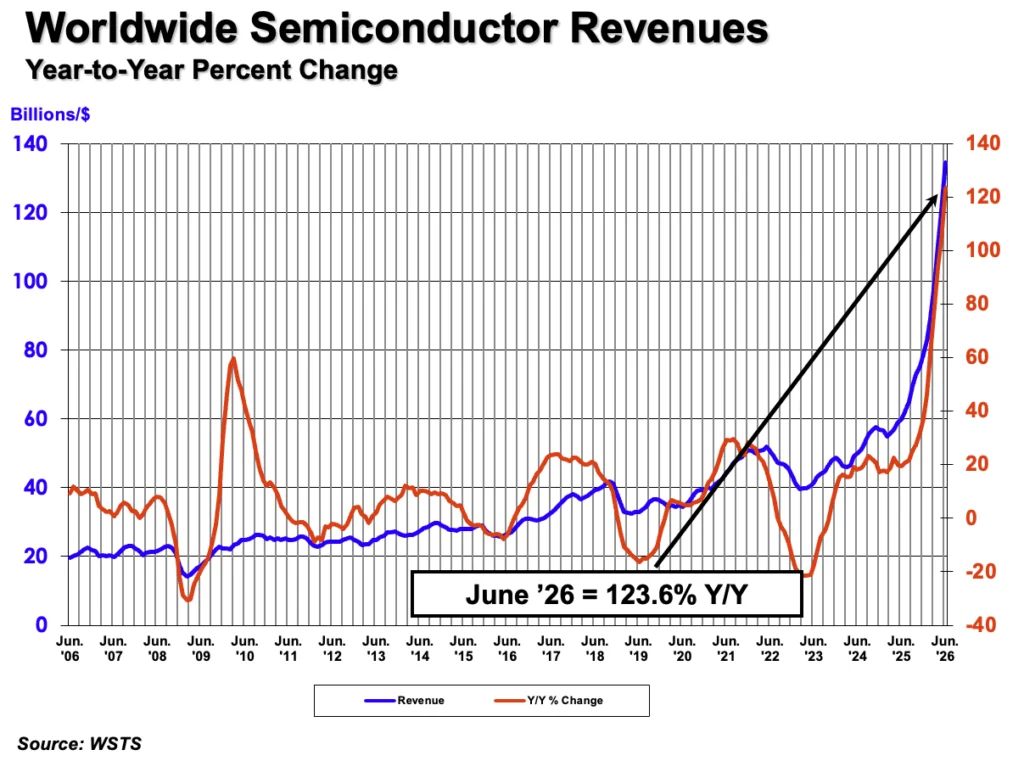
Global semiconductor sales soared to an impressive $403.3 billion during the second quarter of 2026, marking a robust 35.1% increase compared with the first quarter of the year. These significant figures, released by the Semiconductor Industry Association (SIA), underscore a period of dynamic expansion within the critical global chip market. The comprehensive data further reveals a remarkable year-on-year growth trajectory, with worldwide chip sales reaching $134.5 billion in June 2026 alone. This monthly total represents an extraordinary 123.6% surge over sales recorded in June 2025 and a substantial 9.7% increase from the previous month, May 2026. These statistics, compiled by the World Semiconductor Trade Statistics (WSTS) organization and presented as a three-month moving average, paint a vivid picture of an industry not only in recovery but actively charting a course for unprecedented heights.
Contextualizing the Semiconductor Market’s Resurgence
The semiconductor industry, often considered the backbone of the modern digital economy, powers everything from consumer electronics and automotive systems to advanced industrial machinery and critical data infrastructure. Its performance is a bellwether for global technological innovation and economic health. The robust growth observed in Q2 2026 follows a period of significant market recalibration. After the intense demand and supply chain disruptions witnessed during the 2020-2022 period, which led to widespread chip shortages, the industry experienced a corrective phase in 2023, characterized by inventory adjustments and a temporary slowdown in certain segments. However, the current data for 2026 signals a powerful rebound, driven by renewed technological imperatives and expanding applications.
This resurgence is not merely a return to pre-correction levels but an acceleration fueled by several transformative technologies. Artificial intelligence (AI) continues to be a monumental driver, with demand for high-performance computing (HPC) chips, specialized AI accelerators, and memory solutions surging across data centers, cloud services, and edge devices. The ongoing global rollout of 5G infrastructure, coupled with the proliferation of Internet of Things (IoT) devices in smart cities, industrial automation, and connected homes, further amplifies the need for diverse semiconductor components. Additionally, the automotive sector’s rapid transition towards electric vehicles (EVs) and autonomous driving systems—both highly chip-intensive—contributes significantly to the sustained market expansion. Geopolitical considerations and strategic investments in domestic manufacturing capabilities across various nations also play an increasingly critical role in shaping market dynamics and supply chain resilience, influencing where and how these vital components are produced and distributed.
A Chronology of Sustained Growth: Q1 to Q2 2026 and Beyond
The journey to Q2 2026’s impressive performance can be traced through a clear chronology of escalating demand and market confidence. The first quarter of 2026, while demonstrating positive momentum, laid the groundwork for the explosive growth seen in the second quarter. The 35.1% quarter-on-quarter increase from Q1 to Q2 highlights a rapid acceleration in market activity, suggesting that initial cautious optimism has solidified into tangible order volumes and robust sales.
Monthly figures provide an even finer-grained view of this upward trend. Following a strong start to the year, May 2026 sales set a high benchmark, only to be surpassed in June 2026. The 9.7% month-on-month increase from May to June signifies consistent, compounding growth within the quarter. More strikingly, the comparison to the previous year, June 2025, reveals a monumental 123.6% jump. This year-on-year metric is particularly telling, indicating that the industry has not only recovered from any prior downturns but has significantly expanded its overall market size and operational capacity within a relatively short span. This consistent upward trajectory, from the initial recovery signals of late 2025 through the first half of 2026, suggests a deeply entrenched demand pattern rather than a transient market fluctuation.
Industry Projections and Executive Confidence
The strong performance in the second quarter has significantly bolstered industry confidence, leading to revised and ambitious forecasts for the remainder of the year. The SIA now anticipates global semiconductor sales to comfortably exceed $1.5 trillion during the entirety of 2026. This projection, if realized, would represent an unprecedented milestone for the industry, far surpassing previous annual revenue records.
John Neuffer, president and CEO of the SIA, articulated this optimistic outlook, stating, “Global chip sales are expected to exceed $1.5 trillion in 2026, with Q2 sales substantially outpacing sales in Q1 2026.” Neuffer’s remarks underscore the transformative nature of the current market cycle. He further emphasized the broad-based nature of this growth, highlighting “strong sales across the Americas, Asia Pacific and China as major contributors to market growth.” This geographical diversity in demand indicates a synchronized global appetite for semiconductor technologies, rather than localized spikes. Neuffer also pointed to the foundational drivers: “semiconductor demand continuing to be supported by the development and deployment of new technologies.” This statement reinforces the notion that innovation, rather than mere market recovery, is the primary engine of the current expansion.
Regional Performance: A Global Symphony of Growth
The latest data confirms that the surge in semiconductor demand is a truly global phenomenon, with every major regional market recording significant year-on-year sales growth during June 2026. This widespread expansion reflects the interconnectedness of the global economy and the pervasive integration of semiconductor technology across diverse industries worldwide.

The Americas region emerged as the frontrunner, registering an astounding 160.9% increase in sales compared with June 2025. This exceptional growth in North and South America can be attributed to robust investments in data centers, advanced manufacturing initiatives, a thriving tech startup ecosystem, and substantial government incentives aimed at bolstering domestic chip production and R&D. Following closely, Asia Pacific and other markets experienced a substantial 124.4% rise in sales, reflecting the region’s continued dominance in manufacturing, consumer electronics production, and the rapid adoption of new digital technologies across its vast populations.
China, a perennial powerhouse in semiconductor consumption and increasingly in design and manufacturing, saw sales increase by 112.8% year-on-year. This growth signals a strong internal market and ongoing efforts to develop its indigenous semiconductor capabilities amidst geopolitical complexities. Europe also demonstrated solid performance, with sales climbing by 75.2%. This growth is likely propelled by the region’s advancements in industrial automation, automotive technology, and strategic digital transformation initiatives. Japan, a historical leader in semiconductor innovation, recorded a respectable 39% increase, indicative of its specialized contributions to high-end materials, equipment, and niche chip markets.
Month-on-month growth figures for June 2026 further underscore the sustained momentum across all regions. China led this sequential growth with a 10.4% increase, followed closely by Asia Pacific and other markets at 9.8%, and the Americas at 9.6%. Japan recorded an 8.6% rise, while Europe saw a 7.7% increase. These consistent monthly gains across all major geographies highlight the broad and sustained nature of the current market expansion.
Broader Implications and Future Outlook
The current trajectory of the semiconductor industry carries profound implications for the global economy, technological innovation, and geopolitical landscapes. The anticipated $1.5 trillion market size for 2026 signifies an unprecedented level of investment and economic activity, contributing significantly to global GDP growth and job creation across the entire technology value chain, from raw material suppliers to end-product manufacturers.
Economic Impact: The boom fuels massive capital expenditure in new fabrication plants (fabs), R&D, and talent acquisition. This trickles down to related sectors, including equipment manufacturers, software developers, and logistics providers. Strong chip sales often correlate with robust consumer spending on electronics and enterprise investment in IT infrastructure, signaling broader economic health.
Technological Acceleration: Abundant and increasingly powerful semiconductors are the bedrock for next-generation technologies. The sustained growth ensures continued funding for research into novel materials, advanced packaging techniques, quantum computing components, and neuromorphic chips. This fosters an environment ripe for breakthroughs that will shape the coming decades, from truly intelligent AI systems to hyper-efficient sustainable computing solutions.
Supply Chain Resilience and Geopolitical Considerations: The lessons learned from the 2020-2022 chip shortages have profoundly impacted industry strategy. The current growth phase is accompanied by concerted efforts to diversify supply chains, regionalize manufacturing capabilities, and reduce reliance on single points of failure. Governments worldwide are investing heavily in domestic chip production (e.g., through acts like the CHIPS and Science Act in the US and the European Chips Act), driven by national security concerns and economic competitiveness. This trend, while ensuring future supply, also introduces complexities related to trade policies, intellectual property, and international collaboration. The "chip wars" and technological rivalry between major global powers are likely to intensify, making the semiconductor industry a critical arena for geopolitical influence.
Sustainability and Environmental Responsibility: As production scales, the industry faces increasing scrutiny regarding its environmental footprint, particularly energy consumption and water usage in manufacturing. Future growth will necessitate greater emphasis on sustainable practices, green manufacturing processes, and the development of energy-efficient chip architectures to mitigate these impacts.
Looking beyond 2026, industry analysts project that the demand for semiconductors will remain robust, driven by the relentless march of digitalization and innovation. While market cycles are an inherent characteristic of the semiconductor industry, the fundamental drivers—AI, IoT, 5G, automotive, and cloud computing—are long-term structural shifts rather than transient trends. The challenge for the industry will be to maintain this delicate balance of innovation, production scalability, and supply chain resilience amidst an ever-evolving technological and geopolitical landscape. The current performance in the first half of 2026 sets a formidable precedent, positioning the global semiconductor industry for a period of sustained expansion and transformative impact.