In the spring of 2024, Manu Srivastava, a doctoral candidate at the Massachusetts Institute of Technology (MIT) specializing in quantum gravity, received an unsolicited email from a group of high school students in India. While Srivastava, a member of the MIT Center for Theoretical Physics—a Leinweber Institute—regularly receives requests for mentorship, this particular message stood out for its sincerity and academic ambition. The students were seeking guidance to enter the 13th annual Beamline for Schools (BL4S) competition, a prestigious international initiative organized by CERN, the European Organization for Nuclear Research. This initial correspondence sparked a months-long collaboration that eventually led the students to the world’s leading particle physics laboratory in Geneva, Switzerland, where they conducted original research with implications for global neutrino experiments.
The Global Search for Scientific Excellence
The Beamline for Schools competition represents one of the most rigorous scientific challenges available to secondary students worldwide. In its 13th edition, the program saw a record-breaking 712 teams from 89 countries apply, involving more than 4,500 students. Of these thousands of applicants, only five teams were selected to perform their experiments at CERN and DESY (Deutsches Elektronen-Synchrotron). Team attoPION, the group mentored by Srivastava, emerged as one of the elite few.
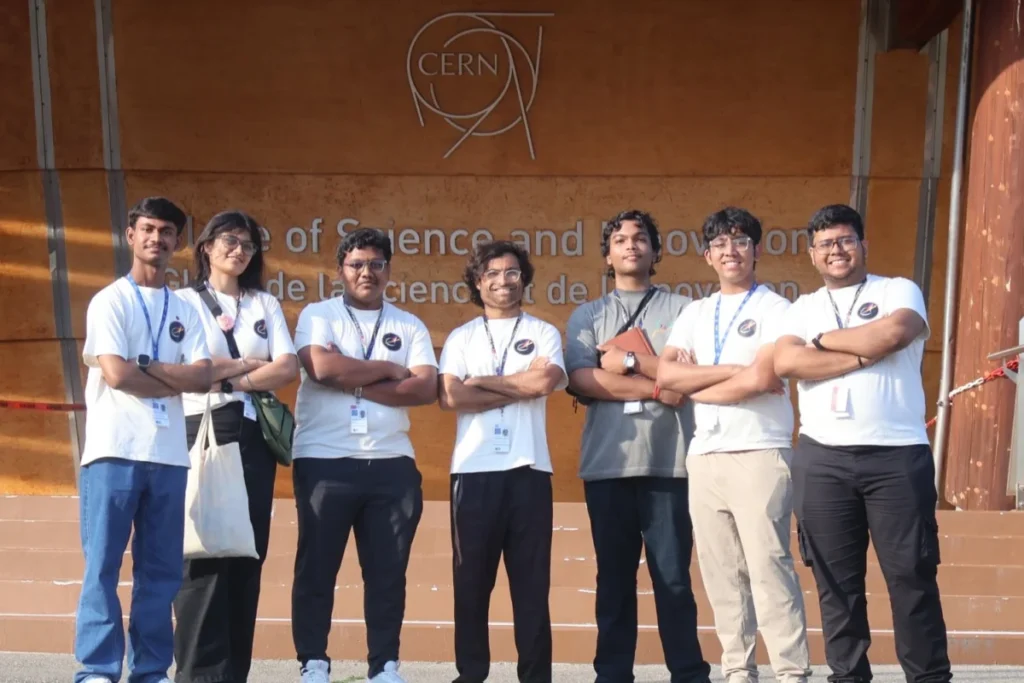
The team was comprised of six students from four different cities across India, who had connected through various science fairs and mutual academic interests. Their goal was not merely to replicate a textbook experiment but to contribute to the current understanding of particle interactions. Srivastava, who works under the supervision of Professor Hong Liu at MIT, noted that while he usually declines mentorship requests—often brokered by commercial firms—the direct and genuine nature of the students’ outreach resonated with his own early career experiences. Having grown up in India himself, Srivastava recognized the potential in the group and the rarity of such an opportunity.
Defining the Scientific Objective: Pion Charge Exchange
The collaborative process began with narrowing down the students’ multiple experimental ideas into a singular, feasible, and scientifically valuable proposal. Under Srivastava’s guidance, the team focused on the phenomenon of pion charge exchange. Pions are subatomic particles categorized as mesons, consisting of a quark and an antiquark. They play a critical role in the strong nuclear force that binds protons and neutrons together within an atom’s nucleus. Pions can exist in three states: positively charged, negatively charged, or neutral.
The experiment proposed by Team attoPION involves a positively charged pion interacting with a neutron within a target material. This interaction results in the production of a neutral pion and a positively charged proton. The core objective of the team’s research was to characterize the cross-section—essentially the probability or frequency—of this specific reaction. While the concept may seem academic, the data produced by such an experiment has significant real-world applications in the field of high-energy physics.
Synergy with the Deep Underground Neutrino Experiment (DUNE)
One of the most critical aspects of Team attoPION’s proposal was its relevance to the Deep Underground Neutrino Experiment (DUNE). DUNE is a flagship international science project hosted by the U.S. Department of Energy’s Fermilab, involving over 1,000 scientists from 30-plus countries. The experiment aims to study neutrinos—nearly massless, "ghost-like" particles—to understand the origin of matter and the nature of the universe.
According to Dave Newbold, a co-spokesperson for DUNE and a prominent figure in the particle physics community, the work being done by these high school students is far from a mere educational exercise. Newbold highlighted that understanding pion interactions with matter is vital for quantifying uncertainties in DUNE’s measurements. When neutrinos interact with the detectors in DUNE, they often produce pions. If researchers cannot accurately predict how these pions will behave or transform (such as through charge exchange), it becomes difficult to estimate the original neutrino’s "flavor" and energy.
Accurate energy reconstruction is the cornerstone of DUNE’s mission to observe CP violation, which could explain why the universe is dominated by matter rather than antimatter. Newbold remarked that the proposal submitted by Team attoPION was at a level of sophistication rarely seen in secondary education, noting that it mirrored the "test beam" experiments used by professional physicists to calibrate large-scale detectors like ProtoDUNE at CERN.
The Journey to Geneva: From Simulation to Execution
Once selected as winners, the transition from theoretical planning to physical experimentation required an intense period of preparation. The students worked closely with Srivastava and Berare Göktürk, a support scientist for the Beamline for Schools program. This phase involved rigorous simulations and the development of a data-acquisition strategy.
A significant challenge identified during the preparation was the rarity of the charge-exchange process. In the high-velocity environment of a particle accelerator beamline, detecting a specific, infrequent interaction requires highly sensitive equipment and precise timing. The students had to design a detector array capable of filtering out "background noise"—other more common particle interactions—to isolate the neutral pions produced in the charge exchange.
The team spent two weeks at CERN, where they were granted access to a secondary beamline of the Proton Synchrotron. This environment provided them with hands-on experience using state-of-the-art detectors, including scintillators and calorimeters. Under the supervision of CERN staff and Srivastava, the students operated the hardware, monitored real-time data streams, and began the complex task of data analysis.
Navigating the Realities of Experimental Physics
Berare Göktürk emphasized that the primary goal of the BL4S program is to immerse students in the "journey of a scientist." This journey is often defined by technical hurdles and the management of uncertainty. With only 12 days of dedicated beam time, the students faced immense pressure to ensure their equipment functioned correctly and their data was reliable.
Göktürk noted that while the team aimed for a publishable result that could benefit the DUNE collaboration, the educational value lay in the process itself. The students were required to troubleshoot electronics, adjust for beam fluctuations, and collaborate across different time zones and backgrounds. This exposure to the "messiness" of real-world physics is a departure from the controlled environment of a high school laboratory, where experiments are designed to yield predictable outcomes.
For Srivastava, the mentorship role required him to step outside his comfort zone as a theoretical physicist. His research at MIT usually involves the abstract mathematics of quantum gravity and string theory, far removed from the hardware-intensive world of beamline detectors. However, he credited the interdisciplinary culture of the MIT Center for Theoretical Physics for giving him the breadth of knowledge necessary to guide the students through an experimental project.
Broader Implications for STEM Education and Research
The success of Team attoPION serves as a case study in the power of democratized access to scientific mentorship. In an era where high-level academic guidance is often gated behind expensive programs or private consulting firms, the "cold email" that led to this collaboration highlights the importance of institutional outreach. Srivastava’s decision to mentor the team voluntarily underscores a commitment to fostering scientific talent regardless of geographic or financial barriers.
Furthermore, the project demonstrates the increasing role of "citizen science" and student-led research in contributing to major scientific endeavors. If the data collected by Team attoPION is validated, it could provide a small but meaningful piece of the puzzle for the DUNE experiment, proving that even those at the beginning of their scientific careers can contribute to the frontiers of knowledge.
The impact on the students themselves is likely to be long-lasting. By navigating the bureaucratic and technical halls of CERN, they have moved beyond the role of students to become junior researchers. Srivastava observed that the students’ proficiency and dedication were the primary drivers of the project’s success, stating that they "deserve all the credit" for their achievement.
A Timeline of the AttoPION Project
The trajectory of the project illustrates the timeline required for international scientific collaboration at this level:
- Early Spring 2024: Team attoPION sends a cold email to Manu Srivastava at MIT.
- Spring 2024: Mentorship begins; the team evaluates several experimental directions before settling on pion charge exchange.
- April 2024: Submission of the formal proposal to the CERN Beamline for Schools competition.
- Summer 2024: CERN announces Team attoPION as one of the five winning teams from a pool of 712.
- Late Summer/Early Autumn 2024: Intensive simulation and preparation sessions with CERN support scientists.
- Autumn 2024: The team travels to Geneva for two weeks of hands-on experimentation at the CERN beamline.
- Post-Autumn 2024: Data analysis continues, with the goal of producing a result relevant to the DUNE collaboration.
Conclusion: The Future of Particle Physics
As the global physics community looks toward the next generation of experiments, including the completion of DUNE and potential upgrades to the Large Hadron Collider, the involvement of young researchers remains vital. The story of Team attoPION and Manu Srivastava is a testament to the fact that the next breakthrough in our understanding of the universe might start with a simple email and a shared curiosity about the smallest building blocks of reality.
The work conducted at CERN by these six Indian students not only advances the specific study of pion charge exchange but also reinforces the collaborative, international spirit that has defined particle physics for decades. As they return to their respective schools in India, they carry with them data that may one day influence how we perceive the very fabric of the cosmos. For the scientific community, it is a reminder that talent is global, and the bridge between a high school classroom and the world’s most advanced particle accelerator is shorter than it might appear.